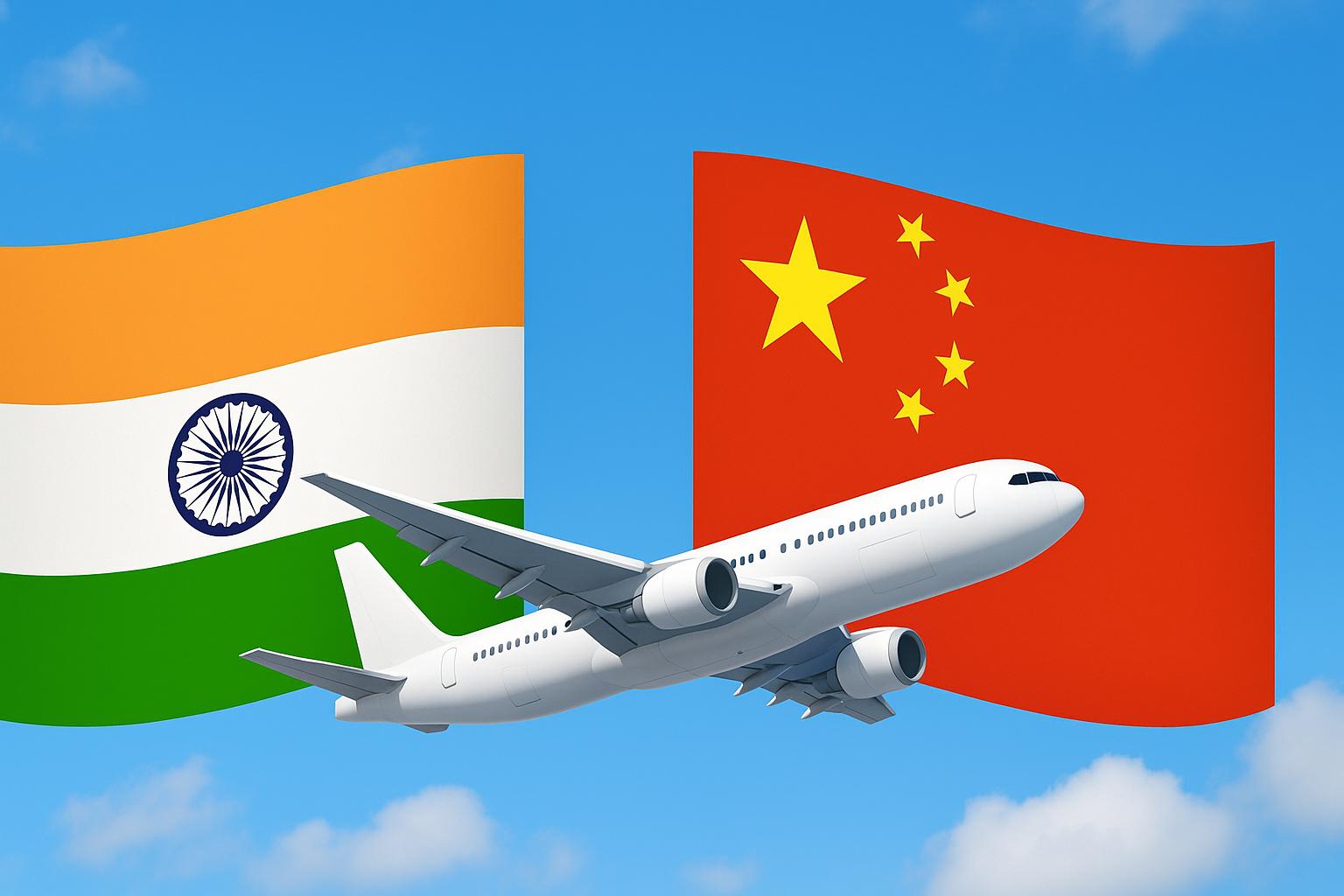
After a gap of more than five years, direct flights between India and mainland China are set to resume by the end of October 2025, marking a significant milestone in the gradual thawing of relations between the two Asian giants. The Ministry of External Affairs confirmed on October 2 that both countries had agreed to restart air services between designated points, beginning with the winter season schedule on October 26. The resumption will depend on the decisions of airlines and the completion of operational requirements, but the announcement has already triggered immediate action from carriers on both sides.
India’s largest airline IndiGo became the first carrier to declare its plans, announcing that it will begin daily flights between Kolkata and Guangzhou from October 26. The airline also revealed that it intends to add direct services between Delhi and Guangzhou in the coming months, with further expansions under consideration. Tata-owned Air India is also preparing to launch flights between Delhi and Shanghai by the end of the year, while several Chinese carriers are expected to reintroduce services on routes they previously dominated. Prior to the pandemic, Chinese airlines held the largest share of direct traffic between the two countries.
The absence of direct flights since 2020, compounded by strict visa restrictions, had resulted in high airfares and inconvenient connections for passengers. Currently, travelers between India and China rely on hub airports in Southeast Asia such as Singapore, Hong Kong, Bangkok, Kuala Lumpur, and Ho Chi Minh City. This has not only increased travel times but also allowed foreign airlines to capture much of the market that once belonged to Indian and Chinese carriers. Industry experts say that the demand for travel remains strong, particularly for business and trade, and the resumption of direct services is expected to immediately boost competition, lower fares, and increase convenience for passengers.
The disruption of air connectivity between India and China was initially triggered by the Covid-19 pandemic, which caused global international flight operations to collapse. Even after many countries restored pre-pandemic levels of flights, direct India-China services did not resume because of strained bilateral relations following the 2020 Line of Actual Control standoff. China consistently pushed for flights to restart, but India held back, citing tense relations. In recent months, however, diplomatic engagement has smoothed the path for closer connectivity.
The breakthrough came after a series of meetings and discussions between senior officials from both sides. During Indian Foreign Secretary Vikram Misri’s visit to Beijing in January, the two countries agreed in principle to resume flights. Chinese Foreign Minister Wang Yi’s visit to New Delhi in August reinforced this agreement, with both governments declaring that flights would restart “at the earliest.” These talks were supported by ongoing meetings between civil aviation officials, including a high-level exchange between India’s Civil Aviation Minister and the Administrator of the Civil Aviation Administration of China in September 2024.
The broader context of improved relations was also critical. Agreements on border patrolling and bilateral meetings between Prime Minister Narendra Modi and Chinese President Xi Jinping during multilateral summits reflected a gradual easing of tensions. This positive momentum paved the way for addressing longstanding demands on both sides for easier visa processes and resumption of passenger flights.
The revival of direct connectivity is expected to benefit airlines from both countries. In 2019, before the pandemic, direct flight passengers accounted for more than 45 percent of total passenger flows between India and China. At the time, Chinese carriers dominated, operating nearly 70 percent of all direct services. According to data from December 2019, there were 539 scheduled direct flights monthly between the two countries, with a cumulative seat capacity of over 125,000. Of these, IndiGo and Air India together accounted for just under one-third, while Chinese airlines such as Air China, China Eastern, China Southern, and Shandong Airlines accounted for the majority.
However, industry analysts note that the situation in 2025 is different. Indian carriers are much stronger today. Air India, now privatized and with significant new investments, has ambitious plans for international expansion. IndiGo, already the market leader in India’s domestic sector, has shifted its focus towards building a larger international network. Both airlines are expected to challenge the dominance of Chinese carriers once flights resume, ensuring that the competitive landscape looks markedly different from 2019.
Passengers, meanwhile, stand to gain the most. With airlines from India, China, and Southeast Asia competing for traffic, fares are expected to drop, schedules to improve, and travel times to shorten. This development will also help businesses and trade, as direct connectivity reduces friction in cross-border exchanges. While Chinese carriers may believe they will reclaim their former share, the growth of Indian aviation makes it far from certain that history will repeat itself.
The resumption of direct flights marks not just a logistical convenience but a symbolic step in India-China ties. It reflects a cautious but important step towards normalization, even as broader geopolitical challenges remain. For now, passengers, airlines, and trade stakeholders are preparing to benefit from the return of a vital air bridge that had been severed for far too long.