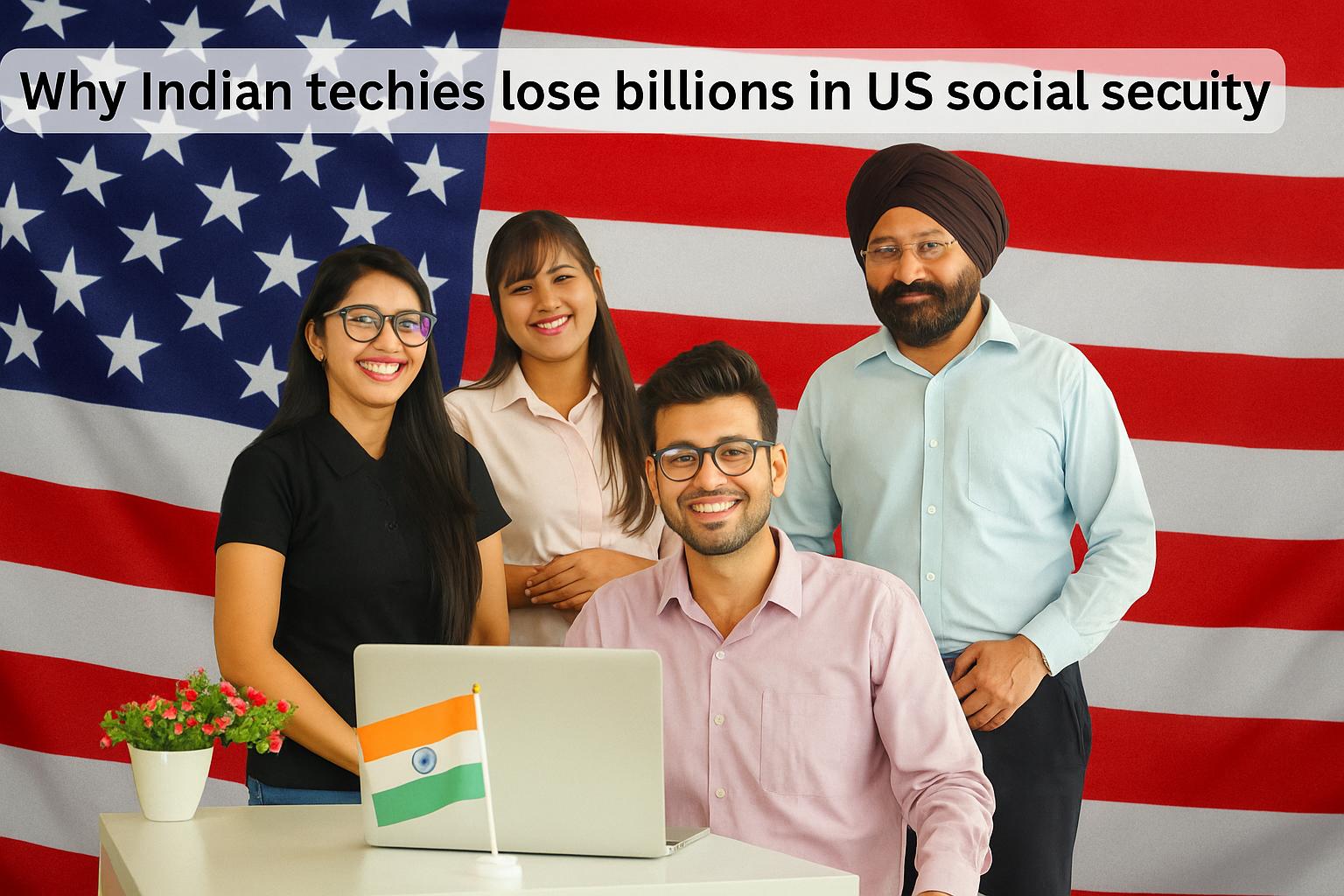
Every year, thousands of highly skilled Indian professionals move to the United States on temporary work visas such as the H1B and L1. Their contributions to the American technology sector and wider economy are undeniable, powering billion-dollar businesses and playing a crucial role in innovation and growth. Yet while these professionals help build wealth abroad, billions of their own hard-earned dollars vanish into the US system without ever returning to them. The absence of a totalisation agreement between India and the US has left Indian workers particularly vulnerable, forcing them into a system where they pay but rarely benefit.
A totalisation agreement is essentially a bilateral pact signed between two countries to align their social security systems. It helps prevent workers from paying into two different retirement schemes simultaneously and ensures that work credits earned in one country can be combined with those earned in another to meet eligibility requirements for retirement or disability benefits. More than 30 countries, including Canada, the United Kingdom, Germany, South Korea, and Japan, have signed such agreements with the US. India, despite being the single largest source of H1B visa holders, still has no such arrangement.
The absence of this agreement has a direct financial impact. Under US law, temporary workers must contribute 7.65 percent of their wages to payroll taxes under the Federal Insurance Contributions Act, with 6.2 percent going toward Social Security and 1.45 percent toward Medicare. These payments are deducted automatically by employers. However, to claim US social security benefits, a worker must contribute for at least 40 quarters, which equals 10 years of work. Most Indian professionals return to India within six years due to visa limits, well before they qualify for any benefits. The result is that their contributions are forfeited.
Research has shown the sheer scale of these losses. Indian professionals on H1B and L1 visas contribute an estimated $3 billion annually to US social security. Over the decades, the cumulative total easily exceeds tens of billions of dollars. Between 2002 and 2012 alone, Indians paid over $27 billion into the system. Once collected, these funds do not remain linked to the individual worker but are absorbed into the US Social Security Trust Funds. Operated on a pay-as-you-go model, the system uses current contributions to fund current retirees, meaning Indian workers subsidize benefits for others while receiving nothing themselves.
Countries with totalisation agreements enjoy very different outcomes. Workers from Germany, for example, can combine years worked in the US and Germany to meet eligibility requirements in either country. Canadians can avoid paying into the US system if they are already contributing to the Canadian plan. Even Brazil, which only signed its agreement in 2015, has started implementation. The failure of India and the US to reach such an arrangement, despite decades of negotiations, places Indian workers at a severe disadvantage.
The US position has remained cautious, citing differences in the structure of India’s Employee Provident Fund Organisation and the US system. Washington has been reluctant to equate India’s social security model with its own, arguing that the EPFO does not provide the same kinds of guarantees and entitlements. This has stalled progress and left Indian professionals shouldering a burden with no reciprocal benefit.
The lack of a totalisation agreement has implications far beyond individual financial losses. The billions effectively forfeited by Indian workers contribute to America’s efforts to support its aging population. In practical terms, Indian professionals have become involuntary donors to the US retirement safety net. For India, a country still developing its own social security framework and grappling with challenges of reintegrating returning professionals, the absence of such a pact represents a significant policy gap.
The bottom line is simple: Indian workers abroad are losing billions, and India’s bargaining power remains underutilized. A totalisation pact between India and the US would prevent double taxation, allow contribution credits to be totalised, and provide a mechanism for payouts or refunds for Indian citizens who return home. Until such an agreement is reached, the billions of dollars paid by Indian professionals will continue to flow into the US social security system, providing no return to those who contributed the most.