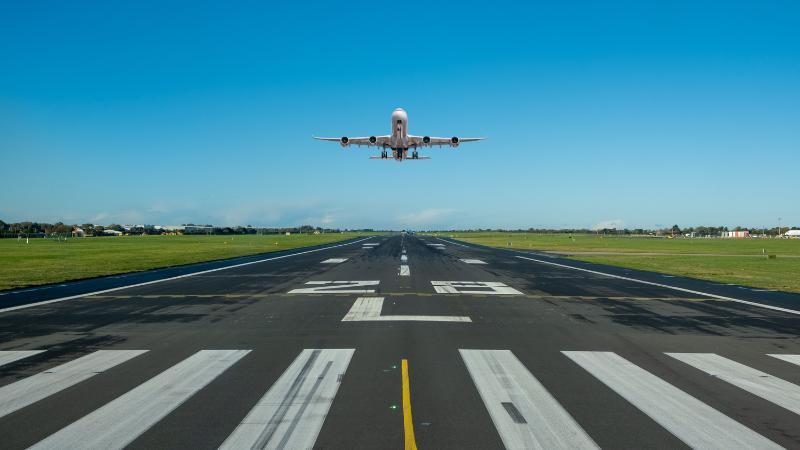
A flight from Dulles International Airport to Roanoke, Virginia, experienced a runway overrun during landing on Wednesday evening around 10 p.m. The incident involved United Express Flight 4339, operated by CommuteAir, which was carrying 50 passengers and three crew members.
The aircraft was unable to stop on the runway after touchdown but was safely halted by the Engineered Materials Arresting System, commonly known as EMAS. This system, installed at the end of the runway, consists of lightweight crushable concrete blocks that collapse under the weight of the aircraft’s tires, bringing it to a controlled stop. Officials confirmed that the technology functioned as designed and prevented the event from escalating into a serious accident.
All passengers and crew were safely evacuated and transported to the terminal by shuttle buses. Authorities confirmed that there were no injuries, and the aircraft remained secure after the stop. Emergency protocols were immediately enacted, and airport operations resumed shortly afterward with minimal disruption.
Runway overruns are rare but represent one of the most concerning risks in aviation. Systems like EMAS have been developed to mitigate such dangers, particularly at airports with limited runway space or surrounding obstacles. Nationwide, there are 122 EMAS beds installed at 70 airports, each serving as a safeguard against the unexpected. The Roanoke incident highlights how vital these installations have become for passenger safety.
The Federal Aviation Administration has launched an investigation into the cause of the overrun. Factors that will be examined include aircraft performance, weather conditions, runway conditions, and pilot decision-making during the approach and landing. Investigations typically involve retrieving flight data recorders, reviewing communications between pilots and controllers, and conducting mechanical inspections to identify any irregularities.
Passengers described the moment as tense but were relieved by the outcome. Many credited the swift actions of the crew and the effectiveness of the EMAS system with ensuring their safety. Aviation experts frequently cite EMAS as one of the most effective advancements in runway safety over the past two decades, particularly for preventing catastrophic outcomes when an aircraft overshoots a runway.
The successful stop of Flight 4339 is likely to reinforce calls for expanding EMAS technology to additional airports that currently lack the system. While cost and space constraints have limited its installation in some locations, safety advocates argue that events like this prove the importance of prioritizing such infrastructure. As air travel continues to increase, the need for robust safeguards is expected to grow.
The FAA has not released a timeline for the completion of its investigation, but officials assured that findings will be made public once available. Meanwhile, airport safety teams continue to monitor the runway and assess any damage caused during the stop. No long-term impact on operations is anticipated, and flights at Roanoke have continued as scheduled.
This incident underscores the multiple layers of safety designed into the aviation system. From crew training to engineering solutions like EMAS, these measures transform potential disasters into manageable situations. For passengers of Flight 4339, the outcome was a safe arrival despite the frightening circumstances, serving as a reminder of how preparation and technology combine to protect lives in modern air travel.
The aircraft was unable to stop on the runway after touchdown but was safely halted by the Engineered Materials Arresting System, commonly known as EMAS. This system, installed at the end of the runway, consists of lightweight crushable concrete blocks that collapse under the weight of the aircraft’s tires, bringing it to a controlled stop. Officials confirmed that the technology functioned as designed and prevented the event from escalating into a serious accident.
All passengers and crew were safely evacuated and transported to the terminal by shuttle buses. Authorities confirmed that there were no injuries, and the aircraft remained secure after the stop. Emergency protocols were immediately enacted, and airport operations resumed shortly afterward with minimal disruption.
Runway overruns are rare but represent one of the most concerning risks in aviation. Systems like EMAS have been developed to mitigate such dangers, particularly at airports with limited runway space or surrounding obstacles. Nationwide, there are 122 EMAS beds installed at 70 airports, each serving as a safeguard against the unexpected. The Roanoke incident highlights how vital these installations have become for passenger safety.
The Federal Aviation Administration has launched an investigation into the cause of the overrun. Factors that will be examined include aircraft performance, weather conditions, runway conditions, and pilot decision-making during the approach and landing. Investigations typically involve retrieving flight data recorders, reviewing communications between pilots and controllers, and conducting mechanical inspections to identify any irregularities.
Passengers described the moment as tense but were relieved by the outcome. Many credited the swift actions of the crew and the effectiveness of the EMAS system with ensuring their safety. Aviation experts frequently cite EMAS as one of the most effective advancements in runway safety over the past two decades, particularly for preventing catastrophic outcomes when an aircraft overshoots a runway.
The successful stop of Flight 4339 is likely to reinforce calls for expanding EMAS technology to additional airports that currently lack the system. While cost and space constraints have limited its installation in some locations, safety advocates argue that events like this prove the importance of prioritizing such infrastructure. As air travel continues to increase, the need for robust safeguards is expected to grow.
The FAA has not released a timeline for the completion of its investigation, but officials assured that findings will be made public once available. Meanwhile, airport safety teams continue to monitor the runway and assess any damage caused during the stop. No long-term impact on operations is anticipated, and flights at Roanoke have continued as scheduled.
This incident underscores the multiple layers of safety designed into the aviation system. From crew training to engineering solutions like EMAS, these measures transform potential disasters into manageable situations. For passengers of Flight 4339, the outcome was a safe arrival despite the frightening circumstances, serving as a reminder of how preparation and technology combine to protect lives in modern air travel.