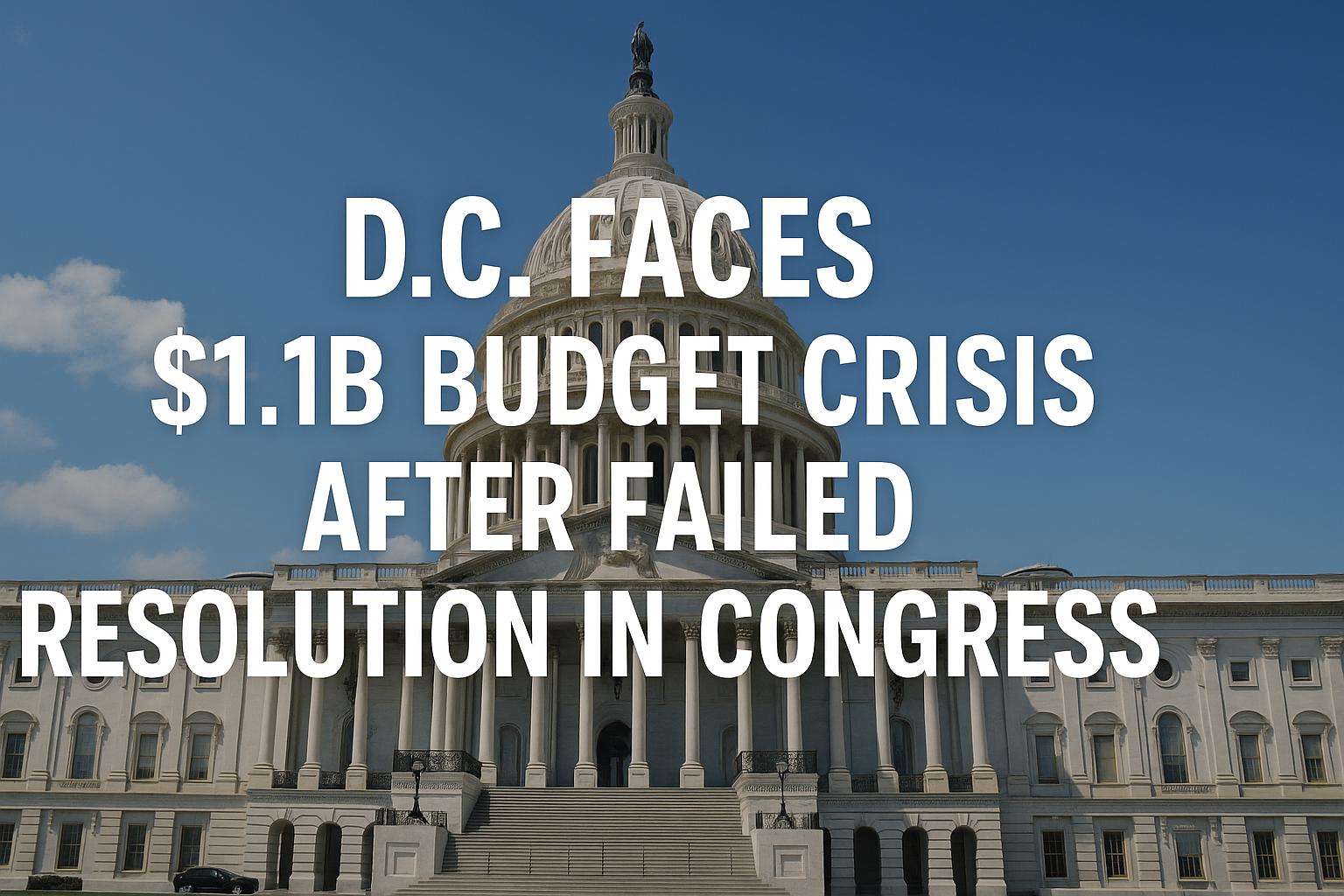
The District of Columbia is facing a budget crisis after the collapse of a continuing resolution in Congress, which many hoped would restore $1.1 billion in local tax revenue. With the fiscal year deadline approaching, city leaders are working under mounting pressure to close funding gaps and prepare for the possibility that the blocked money may never be released.
The issue began in March when Congress approved a resolution to keep the federal government funded. Buried in the measure was a provision that stripped the District of its authority to spend at already-approved 2025 budget levels. Instead, the city was forced back to the prior year’s spending plan, effectively creating a $1.1 billion shortfall. Local officials clarified that the problem is not a lack of revenue — the money has been collected through taxes — but rather a cap on spending imposed from Capitol Hill.
To soften the blow, District leaders turned to emergency financial maneuvers. About $550 million was made available through special legislation, while another $450 million was managed by delaying payments and reallocating funds between accounts. These steps reduced the shortfall but left an estimated $100 million unresolved. The adjustments also forced spending freezes and reshuffling of priorities, leaving several programs with uncertain funding.
The dispute has divided lawmakers. Some have argued that the District should have immediate access to its own tax dollars, while others insist that the restrictions are necessary for accountability. This divide has made it difficult to resolve the issue, even as the city approaches a fiscal cliff.
The latest continuing resolution, which failed to pass, contained a provision that would have released the $1.1 billion back to the city. With that measure off the table and the fiscal year ending on September 30, the District now faces the possibility of permanently losing access to its local funds for the year. Leaders warn that this could set a dangerous precedent, opening the door for future congressional interventions in the city’s budget process.
The broader issue highlights the longstanding tension between the District’s elected leadership and congressional authority. While D.C. manages its own local budget, Congress maintains the power to block or amend it at will. This structure has led to repeated clashes over spending decisions, and the current standoff underscores the vulnerability of the city’s autonomy.
For residents, the concern goes beyond the numbers. The restricted funds represent tax dollars collected locally but frozen by an external decision. Without action from Congress, the city will be forced to operate with reduced flexibility and fewer resources, despite having the revenue in hand.
The clock is ticking, and unless lawmakers reach an agreement that includes the D.C. fix, the $1.1 billion will remain out of reach. The outcome of this dispute will shape not only the city’s immediate fiscal health but also the future relationship between the District and the federal government.
The issue began in March when Congress approved a resolution to keep the federal government funded. Buried in the measure was a provision that stripped the District of its authority to spend at already-approved 2025 budget levels. Instead, the city was forced back to the prior year’s spending plan, effectively creating a $1.1 billion shortfall. Local officials clarified that the problem is not a lack of revenue — the money has been collected through taxes — but rather a cap on spending imposed from Capitol Hill.
To soften the blow, District leaders turned to emergency financial maneuvers. About $550 million was made available through special legislation, while another $450 million was managed by delaying payments and reallocating funds between accounts. These steps reduced the shortfall but left an estimated $100 million unresolved. The adjustments also forced spending freezes and reshuffling of priorities, leaving several programs with uncertain funding.
The dispute has divided lawmakers. Some have argued that the District should have immediate access to its own tax dollars, while others insist that the restrictions are necessary for accountability. This divide has made it difficult to resolve the issue, even as the city approaches a fiscal cliff.
The latest continuing resolution, which failed to pass, contained a provision that would have released the $1.1 billion back to the city. With that measure off the table and the fiscal year ending on September 30, the District now faces the possibility of permanently losing access to its local funds for the year. Leaders warn that this could set a dangerous precedent, opening the door for future congressional interventions in the city’s budget process.
The broader issue highlights the longstanding tension between the District’s elected leadership and congressional authority. While D.C. manages its own local budget, Congress maintains the power to block or amend it at will. This structure has led to repeated clashes over spending decisions, and the current standoff underscores the vulnerability of the city’s autonomy.
For residents, the concern goes beyond the numbers. The restricted funds represent tax dollars collected locally but frozen by an external decision. Without action from Congress, the city will be forced to operate with reduced flexibility and fewer resources, despite having the revenue in hand.
The clock is ticking, and unless lawmakers reach an agreement that includes the D.C. fix, the $1.1 billion will remain out of reach. The outcome of this dispute will shape not only the city’s immediate fiscal health but also the future relationship between the District and the federal government.