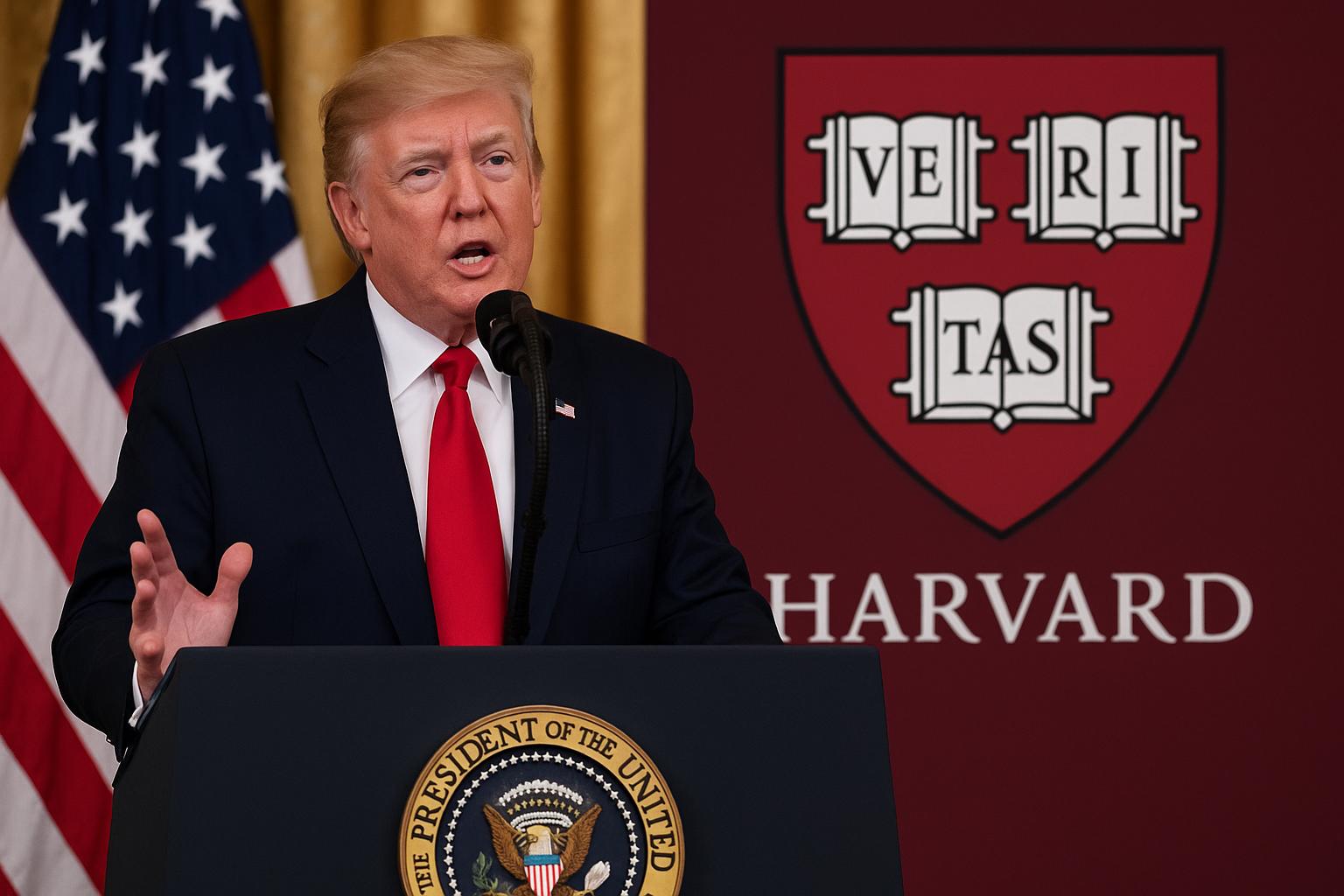
US President Donald Trump announced on Tuesday that his administration had reached a settlement with Harvard University under which the institution would pay $500 million to resolve a dispute that has lasted for months. Speaking at the White House, Trump told reporters that the agreement was nearly finalized, adding that Education Secretary Linda McMahon was handling the last details. According to him, the settlement includes Harvard agreeing to operate new trade schools that would train students in artificial intelligence, engineering, and other technical fields. While Trump made the announcement with confidence, Harvard has not confirmed the deal, and it remains uncertain if the university has accepted the terms as stated by the president.
The clash between the administration and Harvard traces back to Trump’s repeated accusations that the university tolerated antisemitic incidents involving Jewish and Israeli students. Harvard has consistently denied those claims, but the president made the issue central to his demand for accountability. Earlier this year, Trump ordered cuts to Harvard’s federal funding and attempted to block the institution from enrolling international students. He insisted that no research funding or grants would be restored unless Harvard agreed to pay at least $500 million to the government. The demand triggered a deep legal battle that escalated in federal courts.
The dispute intensified when a federal judge in Boston ruled that the administration had acted unlawfully by terminating more than $2 billion in research grants previously awarded to Harvard. The ruling, delivered by District Judge Allison Burroughs, was a significant win for Harvard, which had chosen to challenge the administration instead of quietly reaching a compromise. The decision barred the government from immediately halting further research funding, but Trump continued to push for a financial penalty, saying Harvard should not escape consequences for what he described as years of mismanagement and a permissive stance toward campus antisemitism.
Harvard leaders warned that the administration’s actions could result in severe financial strain, with interim President Alan Garber stating that the institution stood to lose nearly $1 billion annually if funding cuts persisted. He emphasized that such a loss would lead to staff layoffs, hiring freezes, and reduced capacity to carry out major research projects. Despite those warnings, Trump persisted with his strategy of using funding as leverage, framing the dispute as part of a broader effort to hold elite universities accountable. According to him, Harvard’s penalty was justified given what he described as the seriousness of the alleged violations.
This confrontation was not isolated to Harvard alone. Trump’s administration had also increased pressure on other universities across the United States, targeting institutions over a range of issues such as pro-Palestinian protests, climate change policies, diversity and inclusion programs, and policies on transgender rights. Several universities entered settlements to restore lost funding. Columbia University agreed to a $200 million settlement in July, and Brown University resolved its dispute with a $50 million deal. Trump emphasized that Harvard’s settlement would be much larger to reflect the scale of the alleged problems.
The situation reflects a broader political battle over higher education, where federal funding and cultural disputes have increasingly intersected. For Trump, the Harvard case has become a symbol of his administration’s willingness to confront what he describes as biased and unaccountable institutions. The focus on trade schools and training programs tied to the settlement also aligns with his push to expand vocational and technical education as alternatives to traditional university pathways. However, with Harvard yet to publicly acknowledge the settlement, uncertainty continues over whether the details outlined by the president will materialize as official policy. Until then, the announcement stands as both a political statement and a potential turning point in the relationship between the government and one of America’s most prestigious universities.