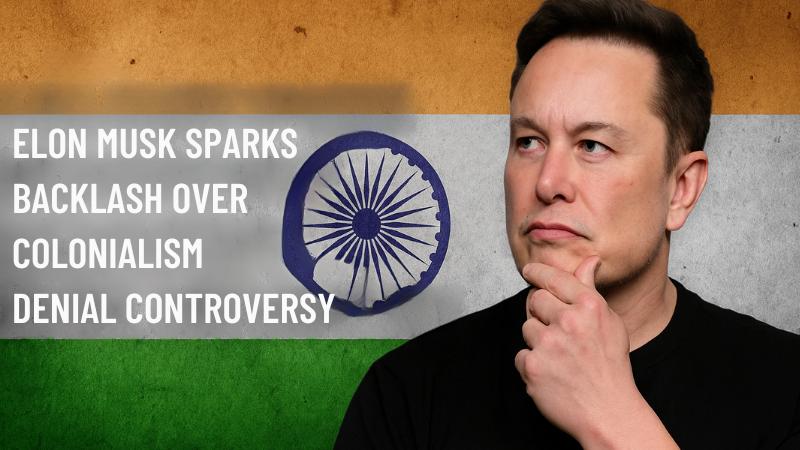
Elon Musk has come under criticism after sharing a post that denied British colonization of India. The post, written by Canadian commentator Stefan Molyneux, claimed that there was “no such thing as colonization.” Many critics immediately denounced the statement as an attempt to whitewash history and erase the lasting impact of centuries of exploitation. Musk’s decision to share the post, accompanied by a thinking emoji, was viewed by many as lending visibility to a deeply problematic and revisionist narrative.
The backlash has been strong, with Indians, historians, and commentators stressing that colonial denial is not just inaccurate but harmful. The period of foreign rule over India was marked by widespread exploitation, economic extraction, suppression of local industries, and repeated famines that caused immense suffering. Critics pointed out that dismissing colonization disregards the lived experiences of millions of people and trivializes the historical record. For many, this type of denial is seen as dangerous, on par with other forms of historical revisionism that seek to erase atrocities.
Scholars emphasize that colonial rule reshaped India in ways that continue to have long-term consequences. Economic policies drained resources from the subcontinent and redirected them abroad, leaving deep scars on local economies. Traditional industries were dismantled, and wealth was systematically extracted for the benefit of the empire. The toll of repeated famines, exacerbated by exploitative governance, cost millions of lives. Denying these realities not only disrespects history but also undermines ongoing conversations about global inequality that are rooted in the colonial legacy.
Many observers criticized Musk for amplifying the post, pointing out that figures of his influence bear responsibility when engaging with controversial material. Even a seemingly casual reaction from someone with global visibility can amplify fringe narratives and provide legitimacy to dangerous ideas. Critics argue that Musk’s actions, intentional or not, risk giving oxygen to voices that seek to erase or distort history for ideological purposes.
The uproar also raises larger questions about the role of social media in spreading historical misinformation. Online platforms allow revisionist narratives to circulate widely and quickly, and when prominent individuals engage with them, the impact is magnified exponentially. Analysts warn that unchecked denial of historical atrocities can desensitize audiences, distort public understanding, and embolden extremist ideologies. This dynamic makes it more important than ever for influential figures to exercise caution in what they share and endorse.
In India, the controversy struck a particularly deep chord. The memory of colonial rule remains central to the nation’s identity and history. Generations continue to reflect on the ways foreign dominance stripped resources, suppressed cultural development, and exploited human lives. For many Indians, Musk’s interaction with the denialist post was seen as a dismissal of their nation’s painful past. Outrage across social platforms highlighted the sensitivity surrounding colonial history and the rejection of any attempt to minimize its devastating effects.
The criticism directed at both Molyneux and Musk underscores the importance of preserving historical truth. Denying colonization not only dishonors the memory of those who lived under oppressive rule but also risks distorting the understanding of how global power dynamics evolved. Historians stress that collective memory must be safeguarded to ensure accountability and to prevent the repetition of past injustices. The episode has reignited broader debates about truth, misinformation, and responsibility in the digital age.
As the controversy continues, the incident serves as a reminder of how easily revisionist ideas can gain traction when amplified by influential voices. It also highlights the ongoing struggle to preserve accurate historical narratives against attempts to minimize or erase them. Whether intentional or not, Musk’s engagement with the post has sparked a necessary conversation about responsibility, history, and the dangers of whitewashing the past.
The backlash has been strong, with Indians, historians, and commentators stressing that colonial denial is not just inaccurate but harmful. The period of foreign rule over India was marked by widespread exploitation, economic extraction, suppression of local industries, and repeated famines that caused immense suffering. Critics pointed out that dismissing colonization disregards the lived experiences of millions of people and trivializes the historical record. For many, this type of denial is seen as dangerous, on par with other forms of historical revisionism that seek to erase atrocities.
Scholars emphasize that colonial rule reshaped India in ways that continue to have long-term consequences. Economic policies drained resources from the subcontinent and redirected them abroad, leaving deep scars on local economies. Traditional industries were dismantled, and wealth was systematically extracted for the benefit of the empire. The toll of repeated famines, exacerbated by exploitative governance, cost millions of lives. Denying these realities not only disrespects history but also undermines ongoing conversations about global inequality that are rooted in the colonial legacy.
Many observers criticized Musk for amplifying the post, pointing out that figures of his influence bear responsibility when engaging with controversial material. Even a seemingly casual reaction from someone with global visibility can amplify fringe narratives and provide legitimacy to dangerous ideas. Critics argue that Musk’s actions, intentional or not, risk giving oxygen to voices that seek to erase or distort history for ideological purposes.
The uproar also raises larger questions about the role of social media in spreading historical misinformation. Online platforms allow revisionist narratives to circulate widely and quickly, and when prominent individuals engage with them, the impact is magnified exponentially. Analysts warn that unchecked denial of historical atrocities can desensitize audiences, distort public understanding, and embolden extremist ideologies. This dynamic makes it more important than ever for influential figures to exercise caution in what they share and endorse.
In India, the controversy struck a particularly deep chord. The memory of colonial rule remains central to the nation’s identity and history. Generations continue to reflect on the ways foreign dominance stripped resources, suppressed cultural development, and exploited human lives. For many Indians, Musk’s interaction with the denialist post was seen as a dismissal of their nation’s painful past. Outrage across social platforms highlighted the sensitivity surrounding colonial history and the rejection of any attempt to minimize its devastating effects.
The criticism directed at both Molyneux and Musk underscores the importance of preserving historical truth. Denying colonization not only dishonors the memory of those who lived under oppressive rule but also risks distorting the understanding of how global power dynamics evolved. Historians stress that collective memory must be safeguarded to ensure accountability and to prevent the repetition of past injustices. The episode has reignited broader debates about truth, misinformation, and responsibility in the digital age.
As the controversy continues, the incident serves as a reminder of how easily revisionist ideas can gain traction when amplified by influential voices. It also highlights the ongoing struggle to preserve accurate historical narratives against attempts to minimize or erase them. Whether intentional or not, Musk’s engagement with the post has sparked a necessary conversation about responsibility, history, and the dangers of whitewashing the past.