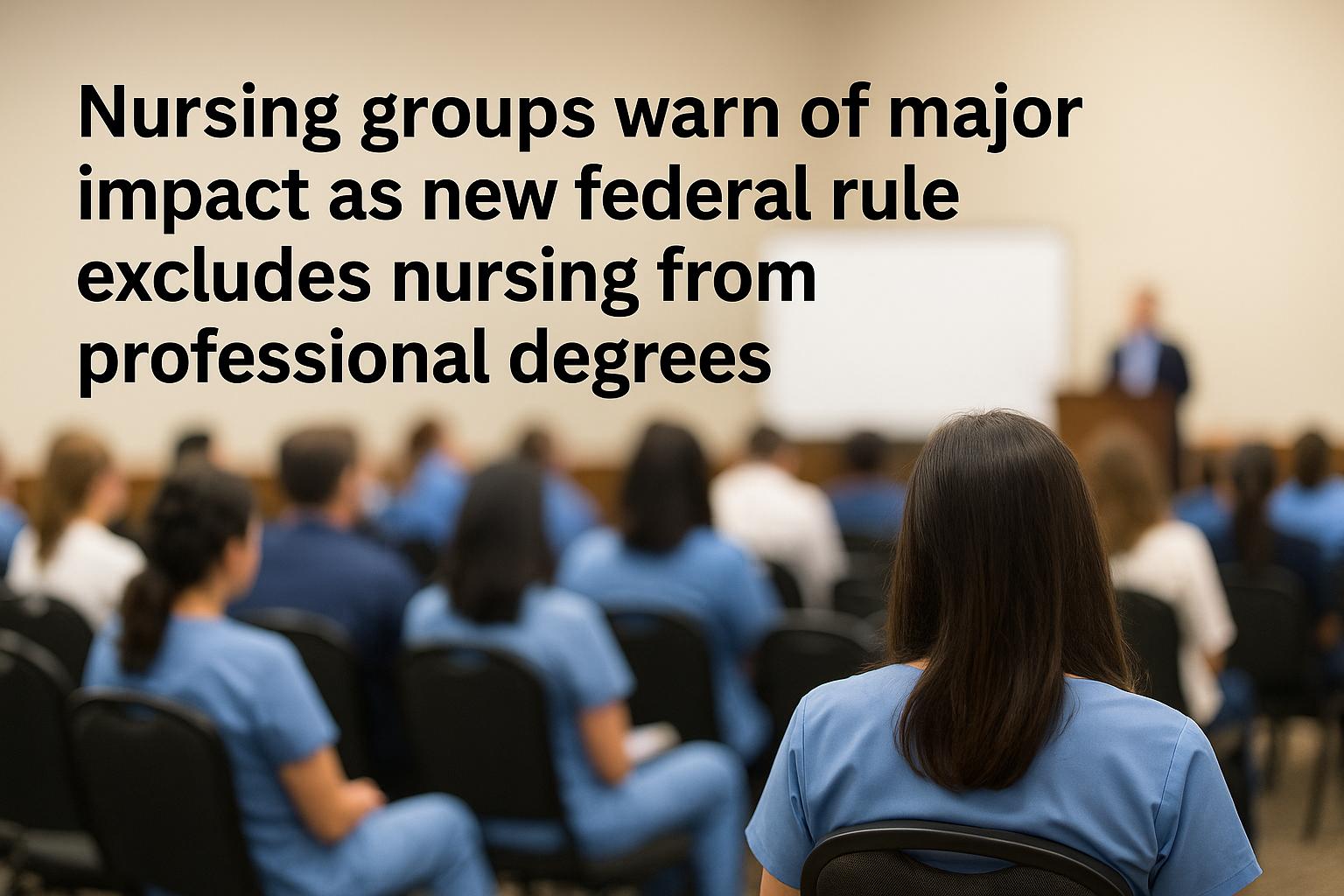
The Department of Education’s decision to exclude nursing from its updated definition of a “professional degree” has set off widespread concern among national nursing organizations, which argue the change could significantly restrict access to advanced nursing education and deepen the country’s ongoing workforce shortage. The redefinition comes as part of the federal government’s implementation of President Donald Trump’s “One Big Beautiful Bill Act,” a sweeping measure that restructures student loan programs and places new caps on borrowing.
Under the law, students pursuing designated professional degrees may borrow up to $200,000 in federal loans, while all other graduate students are limited to $100,000. By removing nursing from the list of professional degree programs, the Education Department is effectively denying aspiring nurses the higher borrowing limit historically used by many to complete their graduate studies. Nursing groups note that a graduate-level education is increasingly essential for roles such as nurse practitioners, clinical specialists, nurse educators, and advanced practice nurses, all of which require extensive training and licensure.
Dr. Jennifer Mensik Kennedy, president of the American Nursing Association, warned that the policy will discourage students from entering a field already facing severe shortages. She said that the United States is short tens of thousands of nurses and advanced practice providers, and restricting access to funding could further erode the pipeline needed to support clinical care and nursing education. According to her, limiting loan availability will also hinder the development of new nursing faculty, a crucial factor at a time when nursing schools face capacity constraints due to a lack of qualified instructors.
The American Association of Colleges of Nursing echoed the concerns and urged the Department of Education to reconsider the classification. The organization stated that excluding nursing contradicts longstanding recognition that professional degrees include programs leading to licensure and direct patient care. It warned that adopting the change could have “devastating” consequences for the stability of the national nursing workforce, which has struggled with burnout, aging demographics, and pandemic-related strain.
Several labor and professional groups argue that the administration’s priorities appear misaligned with the needs of healthcare workers. Mary Turner, a registered nurse and president of National Nurses United, said the policy will make advanced nursing education less attainable and ultimately impact patient access to care. She criticized the administration for simultaneously limiting education options, weakening workplace protections, and reducing access to healthcare services.
Federal officials have dismissed the concerns, stating that the definition of a professional degree remains consistent with historical precedents. A spokesperson for higher education policy argued that institutions have benefitted from federal loan programs for too long without adequate oversight and that the clarified definition reflects input from committee members, including higher education representatives. The spokesperson said institutions challenging the measure are resisting long-overdue reforms aimed at curbing excessive tuition.
The financial burden of nursing programs highlights the significance of the loan dispute. A four-year bachelor of science in nursing can cost between $89,560 and $211,390 when including tuition, housing, and fees, according to industry data. Advanced nursing programs can cost substantially more. Without access to higher loan limits, many students may find the costs out of reach.
Nursing is not the only field affected by the new classification. Degree programs for physician assistants, physical therapists, educators, social workers, audiologists, architects, and accountants were also excluded from the professional degree list. Fields recognized as professional degrees include medicine, law, dentistry, pharmacy, veterinary medicine, clinical psychology, and several others.
Critics have also raised concerns about gender disparities, noting that many excluded fields—including nursing, counseling, and social work—are dominated by women. Political figures have questioned why theology qualifies as a professional degree while advanced nursing does not, suggesting the policy may have broader social implications.
The revised loan structure and degree classifications are scheduled to take effect on July 1, 2026, giving institutions and prospective students limited time to adjust. Nursing organizations maintain that unless the policy is amended, it will exacerbate existing workforce shortages and undermine efforts to strengthen patient care across the United States.