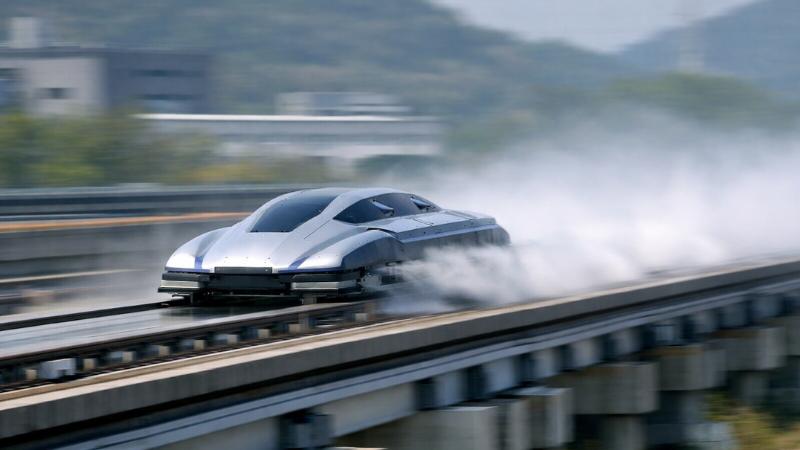
China has set a new global benchmark in rail transportation technology after successfully accelerating a superconducting magnetic levitation train to a speed of 700 kilometres per hour in just two seconds. The achievement marks the fastest acceleration ever recorded for a maglev system and positions China as the first country to demonstrate this capability using superconducting electric maglev technology.
The experiment was conducted by researchers at the National University of Defence Technology, who tested a magnetic levitation vehicle weighing approximately 1,000 kilograms. The test took place on a specially designed 400-metre track and demonstrated not only the rapid acceleration but also controlled deceleration at extremely high speeds. Scientists involved in the project confirmed that the system operated safely and stably throughout the trial, reinforcing confidence in the practical potential of the technology.
Footage from the test quickly circulated online, drawing widespread attention. The video shows a chassis-like vehicle streaking across the short test track in a matter of seconds, leaving behind a visible misty trail caused by air displacement. The dramatic visuals highlighted the power and precision of the superconducting maglev system and underscored the scale of the technological breakthrough.
Maglev trains operate on principles fundamentally different from conventional rail systems. Instead of running on steel wheels and rails, maglev vehicles float above a guideway using powerful magnetic forces. This levitation removes almost all physical friction between the train and the track, allowing for significantly higher speeds while reducing noise, vibration, and mechanical wear. The absence of direct contact also lowers long-term maintenance demands compared to traditional rail infrastructure.
In a superconducting maglev system, electromagnets installed on both the train and the guideway work together to lift the vehicle a few centimetres above the surface. Additional magnetic controls ensure stability by keeping the train centred and preventing lateral movement, even during rapid acceleration. Forward motion is generated through a linear motor system, in which electric currents are sequentially activated along the guideway to create a travelling magnetic field that pulls the train forward while pushing it from behind.
Researchers say the successful test also offers a glimpse into the future of ultra-high-speed travel, including potential applications in hyperloop-style transport systems. In such concepts, maglev trains would operate inside low-pressure or vacuum-sealed tubes, further reducing air resistance and enabling sustained speeds far beyond current high-speed rail limits.
China already operates one of the world’s fastest commercial maglev services in Shanghai, where trains connect the city centre to Pudong International Airport at speeds of up to 430 kilometres per hour. Beyond existing operations, the country has been developing next-generation maglev prototypes designed to reach speeds of 600 kilometres per hour or more. The latest superconducting test suggests that even higher performance thresholds may be achievable in the future.
Officials and engineers involved in the project describe the milestone as a significant step toward redefining long-distance and urban transportation. While further testing and engineering work will be required before the technology can be deployed at scale, the record-setting run highlights China’s growing role in advancing high-speed rail innovation and shaping the next era of global transport systems.