A growing body of scientific evidence is prompting doctors and public health experts to rethink how diabetes is diagnosed in India. A major new review published in The Lancet Regional Health has raised serious concerns about the accuracy of glycated haemoglobin, or HbA1c, the test most commonly used worldwide to diagnose and monitor diabetes. According to the authors, relying solely on HbA1c may significantly misrepresent India’s true diabetes burden and delay diagnosis for millions of people.
The review highlights that conditions widespread in India, including iron deficiency anaemia, inherited haemoglobin disorders known as haemoglobinopathies, and glucose-6-phosphate dehydrogenase deficiency, can distort HbA1c readings. G6PD deficiency, a genetic condition that increases vulnerability to anaemia, is particularly prevalent across several Indian regions. These biological factors can cause HbA1c to underestimate or overestimate average blood glucose levels, potentially masking early diabetes in some individuals while exaggerating severity in others.
Researchers warn that exclusive reliance on HbA1c could delay diabetes diagnosis by several years in certain patients, increasing the risk of complications. Variations in laboratory quality control, especially in low-resource settings, further compound the problem. Large public health surveys that depend only on HbA1c may therefore undercount or misclassify diabetes cases, leading to flawed policy planning and resource allocation.
The warning comes amid India’s escalating diabetes crisis. An Indian Council of Medical Research–led survey published in 2023 estimated that over 10.1 crore Indians are living with diabetes, while another 13.6 crore have prediabetes. Experts believe these figures may still be an underestimation if diagnostic tools are not appropriately tailored to Indian populations.
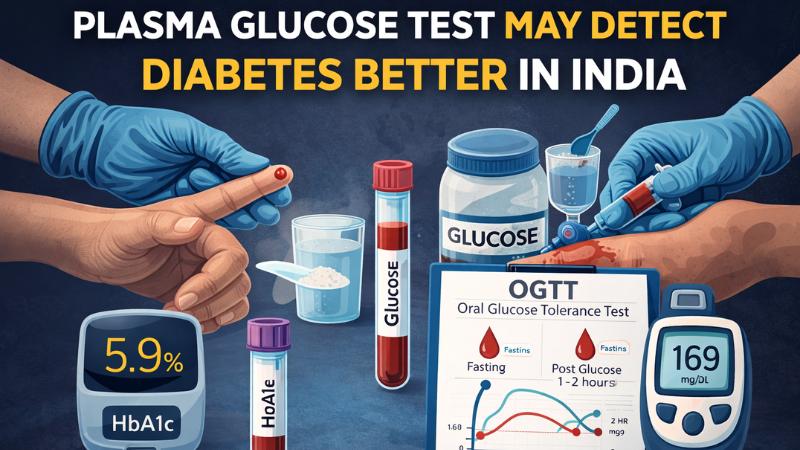
The review strongly supports greater use of glucose-based tests, particularly the oral glucose tolerance test, or OGTT, which directly measures the body’s response to a glucose load. Unlike HbA1c, which estimates long-term sugar exposure indirectly, OGTT captures real-time glucose metabolism, reducing the risk of false-negative results. In India, OGTT is typically performed using fasting and two-hour post-glucose measurements after consuming 75 grams of glucose.
Two years ago, the International Diabetes Federation recommended an updated approach, advising high-risk individuals to undergo a one-hour OGTT using the same glucose load. Experts note that the one-hour glucose value is a strong predictor of progression to type 2 diabetes, cardiovascular complications, obstructive sleep apnoea, and metabolic dysfunction–associated fatty liver disease, a condition increasingly common in India.
The review explains why HbA1c often fails in the Indian context. High rates of nutritional compromise and iron deficiency anaemia, reported in some regions to affect more than half the population, can significantly skew HbA1c values. In men with undiagnosed G6PD deficiency, exclusive reliance on HbA1c could delay diagnosis by up to four years, increasing long-term health risks.
The authors propose a resource-based diagnostic framework adapted to India’s healthcare realities. In low-resource settings, they recommend OGTT for diagnosis, combined with regular self-monitoring of blood glucose and basic blood investigations. In tertiary care centres, a combined strategy is advised, using standardized HbA1c alongside OGTT and advanced tools such as continuous glucose monitoring and alternative markers like fructosamine. The review calls for a shift away from a one-size-fits-all approach to diabetes diagnosis. Experts argue that combining HbA1c with plasma glucose–based tests will lead to earlier detection, more accurate classification, and better long-term outcomes, particularly in populations where anaemia and genetic blood disorders are common.