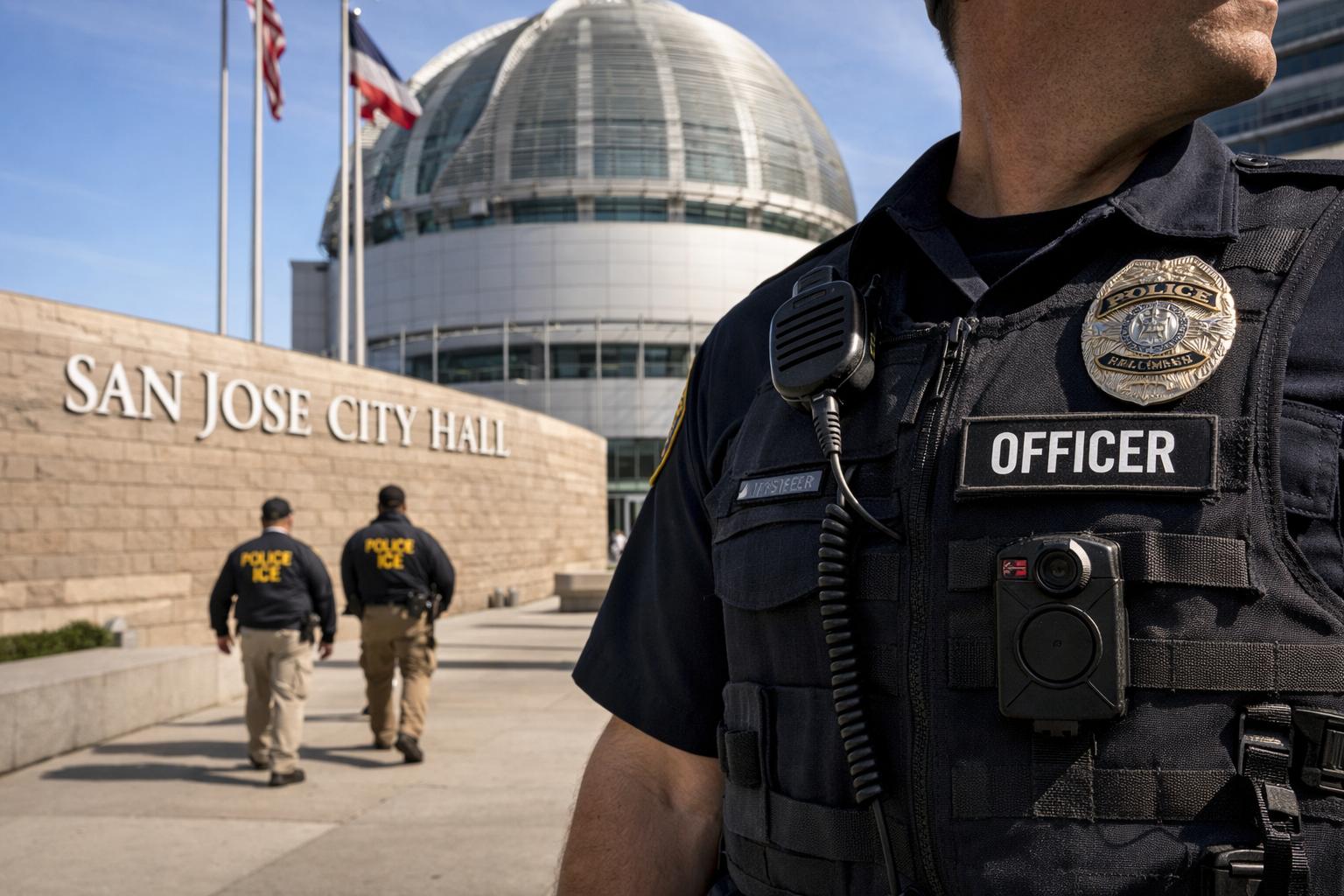
San Jose officials say the city’s efforts to regulate immigration enforcement activities remain firmly in place, even as a recent federal court decision temporarily paused a related California law. Local leaders emphasized that the ruling does not weaken San Jose’s existing requirements for law enforcement officers to clearly identify themselves while on duty.
The Ninth Circuit Court of Appeals issued a decision Thursday that put California’s No Vigilantes Act on hold pending further review, with judges scheduled to revisit the matter on March 3. The state law requires law enforcement officers to display visible identification during operations. However, San Jose leaders maintain that the city’s own policy continues to apply because it covers all law enforcement personnel rather than targeting federal agents specifically.
District 5 Councilmember Peter Ortiz said the city attorney’s office has confirmed that the federal ruling does not affect San Jose’s local ordinance. According to Ortiz, the city’s policy was deliberately structured to withstand legal challenges and to ensure transparency in policing practices. He noted that visible identification remains a key measure to protect community safety and maintain public trust.
The No Vigilantes Act was part of a broader package of immigration-related legislation signed by Governor Gavin Newsom in September, aimed at increasing oversight of U.S. Immigration and Customs Enforcement operations. A separate measure, known as the No Secret Police Act, which sought to restrict federal agents from wearing masks, was also recently paused because it applied only to federal authorities. State lawmakers are now considering amendments to broaden that law’s scope.
Advocacy groups representing immigrant communities expressed concern about the recent federal decisions. Mariam Arif, a spokesperson for the Services, Immigrant Rights, and Education Network (SIREN), said clear identification requirements are an important safeguard against impersonation and help protect due process. She added that legal uncertainty can heighten fear among immigrant families already navigating a complex enforcement environment.
San Jose adopted its own identification and anti-masking policies last fall, alongside additional restrictions on immigration enforcement activities within city limits. The City Council also prohibited ICE from using municipal property for enforcement operations. Under current rules, the San Jose Police Department must notify the city manager when officers respond to incidents involving ICE agents, and federal authorities are expected to inform local police before conducting operations.
Ortiz said these measures reflect the city’s broader commitment to accountability and transparency. He argued that local safeguards are intended to ensure residents understand who is conducting enforcement actions in their neighborhoods and to prevent confusion during high-stress encounters.
Some advocates remain skeptical about the practical impact of identification and masking rules on federal immigration operations. Liz Gonzalez, an organizer with Silicon Valley De-Bug, said the recent court rulings could reinforce ICE’s authority despite local resistance efforts. She questioned whether policy changes alone will significantly alter enforcement practices on the ground.
For now, city officials maintain that San Jose’s policies remain fully enforceable and continue to serve as a layer of protection for immigrant communities while the federal legal process unfolds.