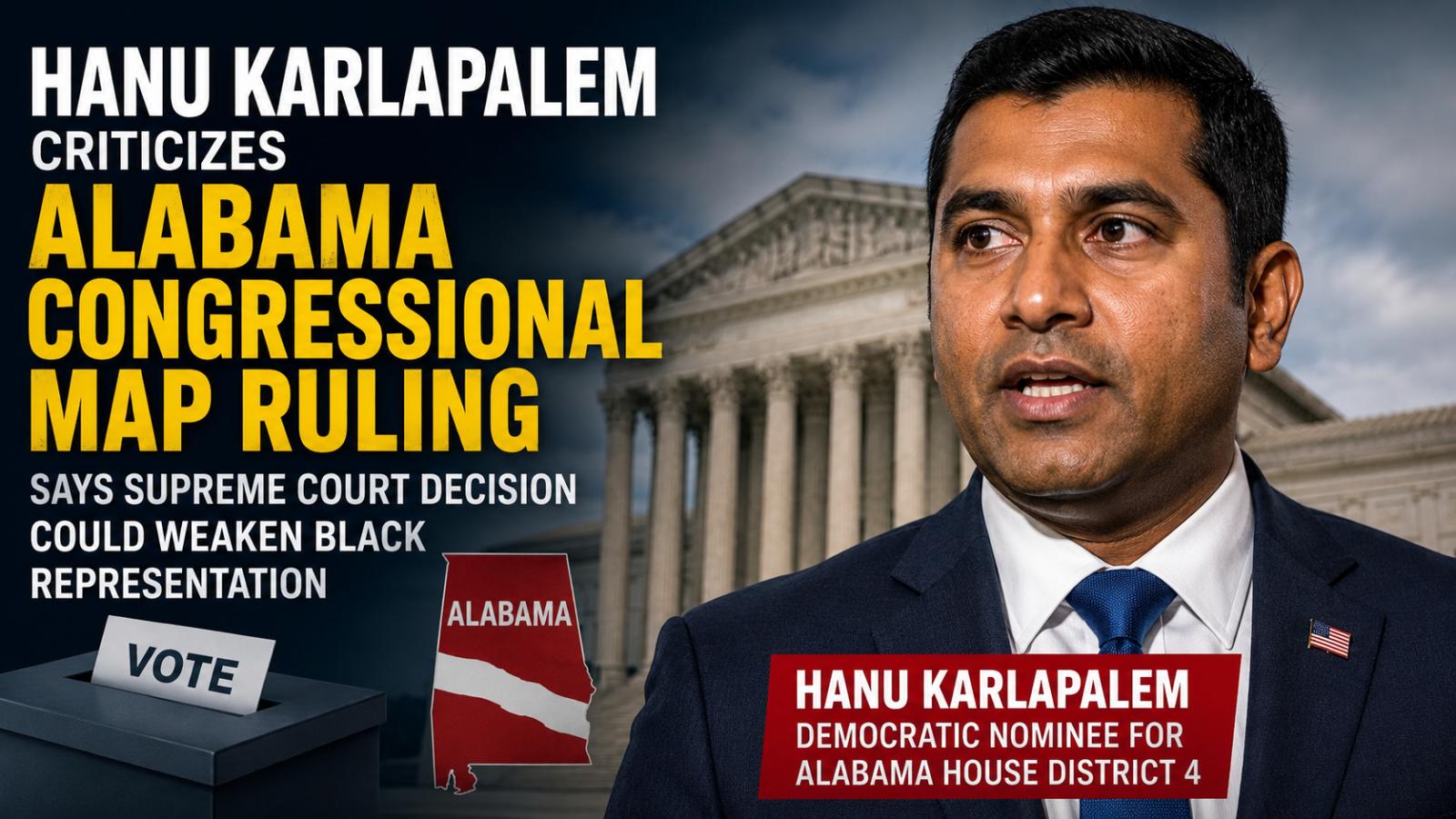
Hanu Karlapalem Alabama District 4 campaign officials are criticizing the U.S. Supreme Court’s Alabama congressional map ruling, saying it could weaken Black political representation before the 2026 elections.
Karlapalem, the Democratic nominee for Alabama House District 4, released a statement on Wednesday, June 3, 2026, after the court’s 6-3 decision allowed Alabama to use a disputed congressional map in the 2026 election cycle.
Hanu Karlapalem Alabama District 4 campaign criticizes ruling
Karlapalem said the ruling places Alabama’s second majority-Black congressional district at risk after years of litigation under the Voting Rights Act. That district helped elect Shomari Figures in 2024, making him Alabama’s second Black member of Congress alongside Terri Sewell.
Karlapalem argued that reducing opportunities for Black voters to elect candidates of their choice would weaken representation in Congress and in Alabama communities.
The Madison-based technology business owner is challenging Republican State Rep. Parker Moore in the Tuesday, November 3, 2026, general election. Karlapalem accused Alabama Republican leaders of supporting policies that restrict voting access and criticized Moore for backing legislation opposed by voting-rights advocates.
Voting rights become part of Alabama House District 4 race
Kenneth Hines, a former chairman of the Limestone County Democratic Party, said minority representation remains important in Alabama politics. Retired Air Force Lt. Col. Benard Simelton, former president of the NAACP Alabama State Conference and chairman of Karlapalem’s campaign, also criticized the ruling and urged voter participation.
Karlapalem’s campaign said he has lived in Madison for 26 years, graduated from the University of Alabama in Huntsville, is a life member of the NAACP and previously served as second vice president of the Limestone County NAACP.
The ruling adds voting rights and redistricting to the political debate in Alabama House District 4, where the 2026 race is expected to draw attention from Democrats, Republicans and civil rights advocates focused on Black voter influence in Alabama.