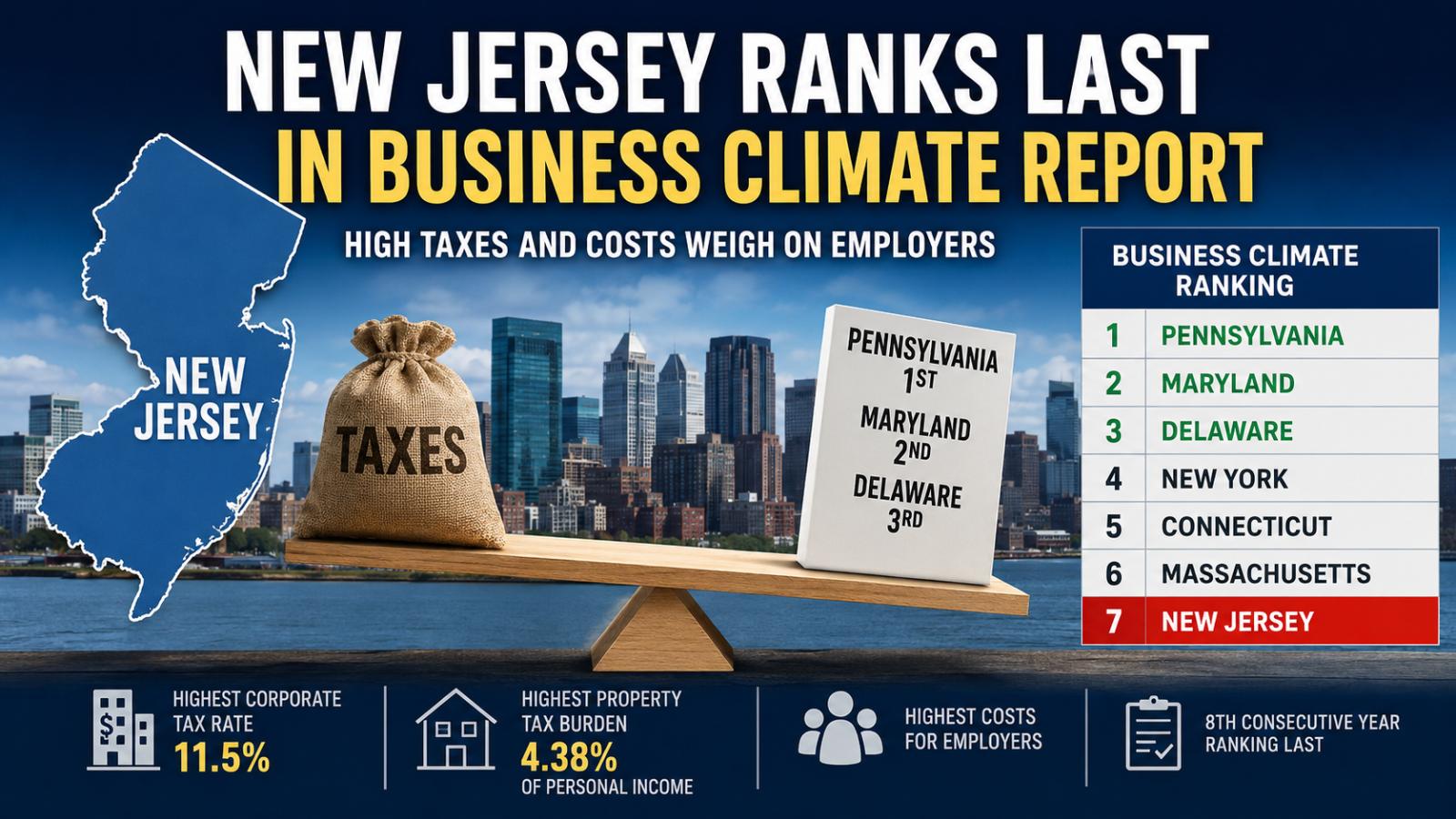
New Jersey ranked last in a regional business climate report from the New Jersey Business and Industry Association, as high taxes and business costs continued to weigh on employers.
The New Jersey business climate report compared seven Northeast and mid-Atlantic states and placed Pennsylvania first, followed by Maryland and Delaware. New Jersey finished at the bottom for the eighth consecutive year.
New Jersey business climate report highlights tax burden
The NJBIA analysis reviewed six cost factors tied to doing business: corporate tax rates, sales taxes, income taxes, property taxes, payroll taxes and the state minimum wage.
Chris Emigholz, NJBIA’s chief government affairs officer, said New Jersey ranked worst for property taxes and corporate taxes. The report listed New Jersey’s top corporate tax rate at 11.5% and its property tax burden at 4.38% of personal income.
New Jersey received an overall business climate score of 12. Pennsylvania scored 34.
Pennsylvania, Delaware and Maryland rank higher
Pennsylvania’s top ranking was helped by the region’s lowest minimum wage and income tax rate, according to the report. Its corporate net income tax rate is 7.49% and is scheduled to fall to 4.99% by 2031.
Michael Busler, a finance professor at Stockton University, said high taxes can affect employers because workers consider after-tax income when evaluating pay. He also said regulation can add costs for businesses seeking to expand.
New Jersey still has major economic strengths
Other experts said New Jersey’s business challenges should be weighed against its advantages. Rutgers University economist James Hughes pointed to the state’s educated workforce, access to New York and Philadelphia, strong K-12 schools and major customer markets as reasons many companies remain in New Jersey.
NJBIA President and CEO Michele Siekerka warned that additional policy burdens could deepen affordability concerns, citing the proposed Climate Superfund Act. Supporters, including environmental, faith, labor and community groups, have called for the bill’s passage, while critics warn it could raise costs.
The report adds to a long-running debate over whether New Jersey’s tax structure and regulatory costs are making the state less competitive with nearby states.