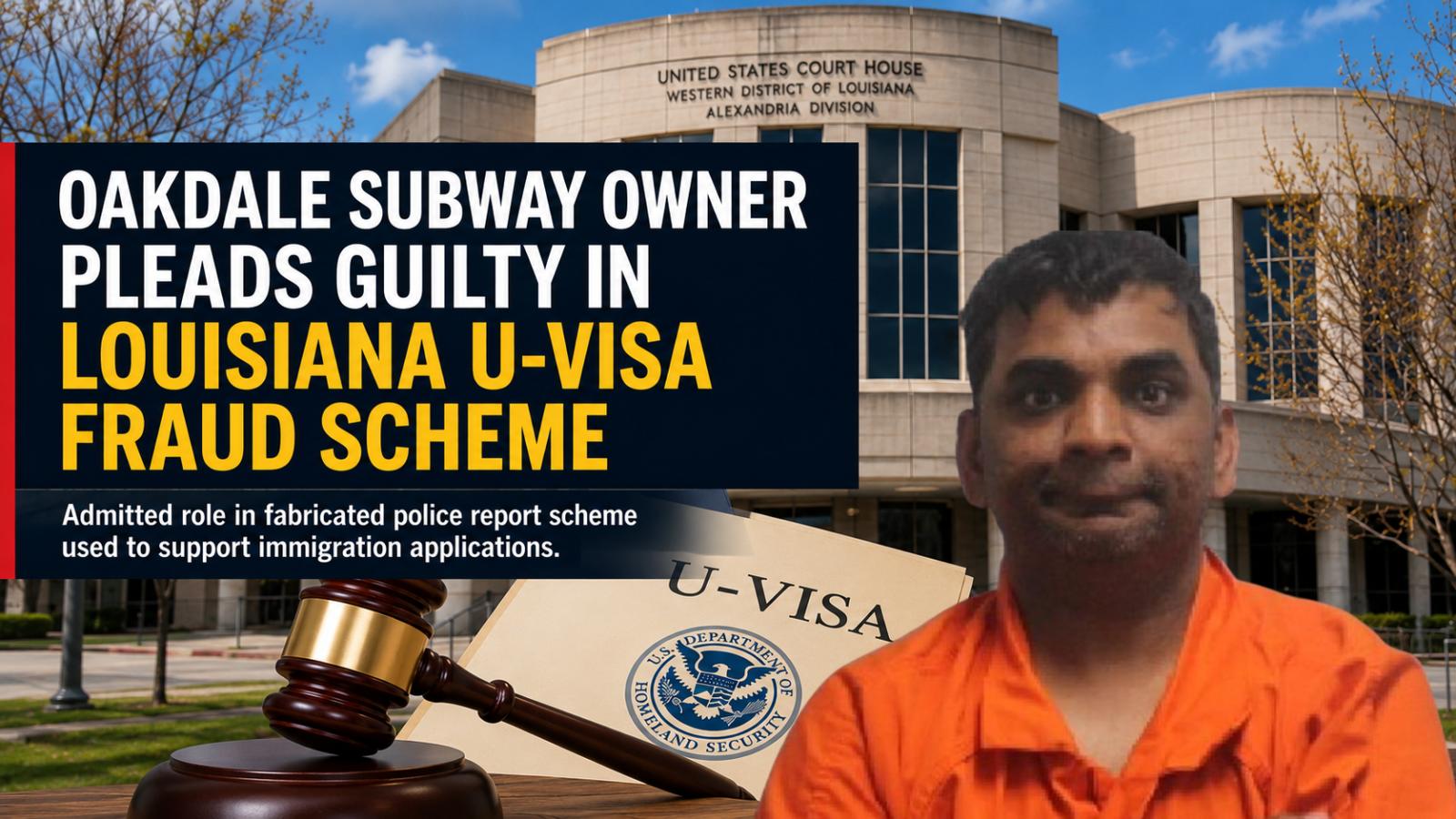
ALEXANDRIA, La. — Tuesday, June 30, 2026 — Oakdale Subway owner Chandrakant Patel pleaded guilty in federal court to conspiracy to commit visa fraud and money laundering in a Louisiana U-Visa fraud scheme involving fabricated police reports, federal prosecutors said.
Patel, 40, entered his plea on Friday, May 29, 2026, in the U.S. District Court for the Western District of Louisiana. Prosecutors said the scheme operated from December 2015 through July 2025.
Louisiana U-Visa Fraud Scheme Used False Police Reports
Authorities said Patel collected thousands of dollars from foreign nationals seeking U-Visas and arranged police reports describing armed robberies that never occurred. He paid officers $5,000 for each report used to support an application, prosecutors said.
According to prosecutors, Patel also attempted to pay a Rapides Parish Sheriff’s Office agent $5,000 in February 2025 for a fraudulent report.
Patel was one of five defendants charged. The others were former Forest Hills Police Chief Glynn Dixon, former Oakdale Police Chief Chad Doyle, former Oakdale Marshal Michael Slaney and former Glenmora Police Chief Tebo Onishea. Prosecutors said the four former officials used their positions to create or approve false reports.
The defendants were indicted on Wednesday, July 2, 2025. Congress created the U-Visa program in 2000 for certain victims of serious crimes who suffered substantial abuse and cooperated with law enforcement.
U.S. Attorney Zachary A. Keller said the conduct endangered the community, undermined trust in the immigration system and was carried out for financial gain.
Patel faces a maximum of 15 years in federal prison: five years on the conspiracy count and 10 years on the money laundering count. He also agreed to forfeit properties, bank accounts, gold bars, jewelry and other assets tied to the scheme.
Dixon pleaded guilty on Thursday, June 4, 2026. Doyle, Slaney and Onishea pleaded guilty in May 2026. Sentencing dates have not been announced.
The case highlights how fabricated law enforcement records can undermine both public trust and the integrity of an immigration program created for victims of serious crimes.