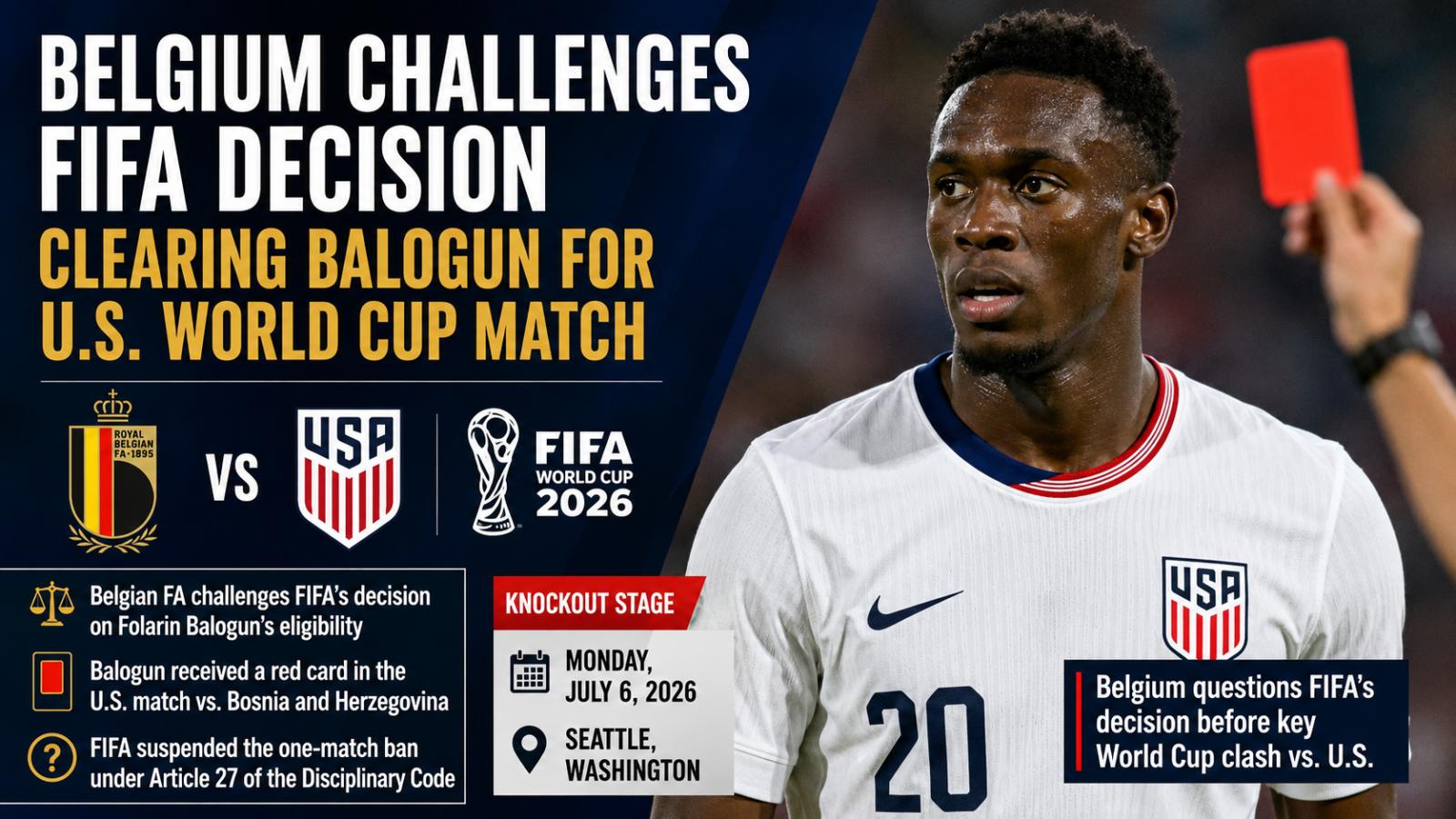
Belgium is challenging FIFA’s decision to clear U.S. forward Folarin Balogun for the United States’ World Cup match against Belgium, escalating a disciplinary dispute before a knockout game with a quarterfinal place at stake.
FIFA suspended Balogun’s one-match ban after he received a red card in the United States’ previous World Cup match against Bosnia and Herzegovina, allowing him to play against Belgium on Monday, July 6, 2026, in Seattle. Reuters reported that FIFA cited Article 27 of its Disciplinary Code, which allows the implementation of a disciplinary sanction to be suspended under certain conditions.
Belgium Questions Balogun Eligibility Before U.S. Match
The Royal Belgian Football Association said it was “astonished” by FIFA’s decision to declare Balogun eligible and said the ruling appeared to conflict with tournament regulations on automatic suspensions after red cards. Belgium said it was reviewing possible options before the match.
The issue has placed FIFA’s disciplinary process under scrutiny because Balogun’s red card was not rescinded. Instead, FIFA suspended the enforcement of the match ban for a one-year probationary period. Under FIFA’s explanation, the suspension could be reactivated if Balogun commits a similar infringement during that period.
Why the FIFA Red-Card Decision Matters
For the U.S. men’s national team, Balogun’s availability is a major boost before a high-pressure World Cup knockout match. For Belgium, the dispute centers on fairness, consistency and transparency in how FIFA applies disciplinary rules during the tournament.
The match carries direct World Cup consequences, with the winner advancing to the quarterfinals. The controversy also extends beyond team selection because it raises questions about how FIFA explains disciplinary decisions that affect knockout-stage games.
FIFA’s ruling keeps Balogun available, but Belgium’s challenge ensures the decision remains one of the biggest talking points before the United States and Belgium meet in Seattle.