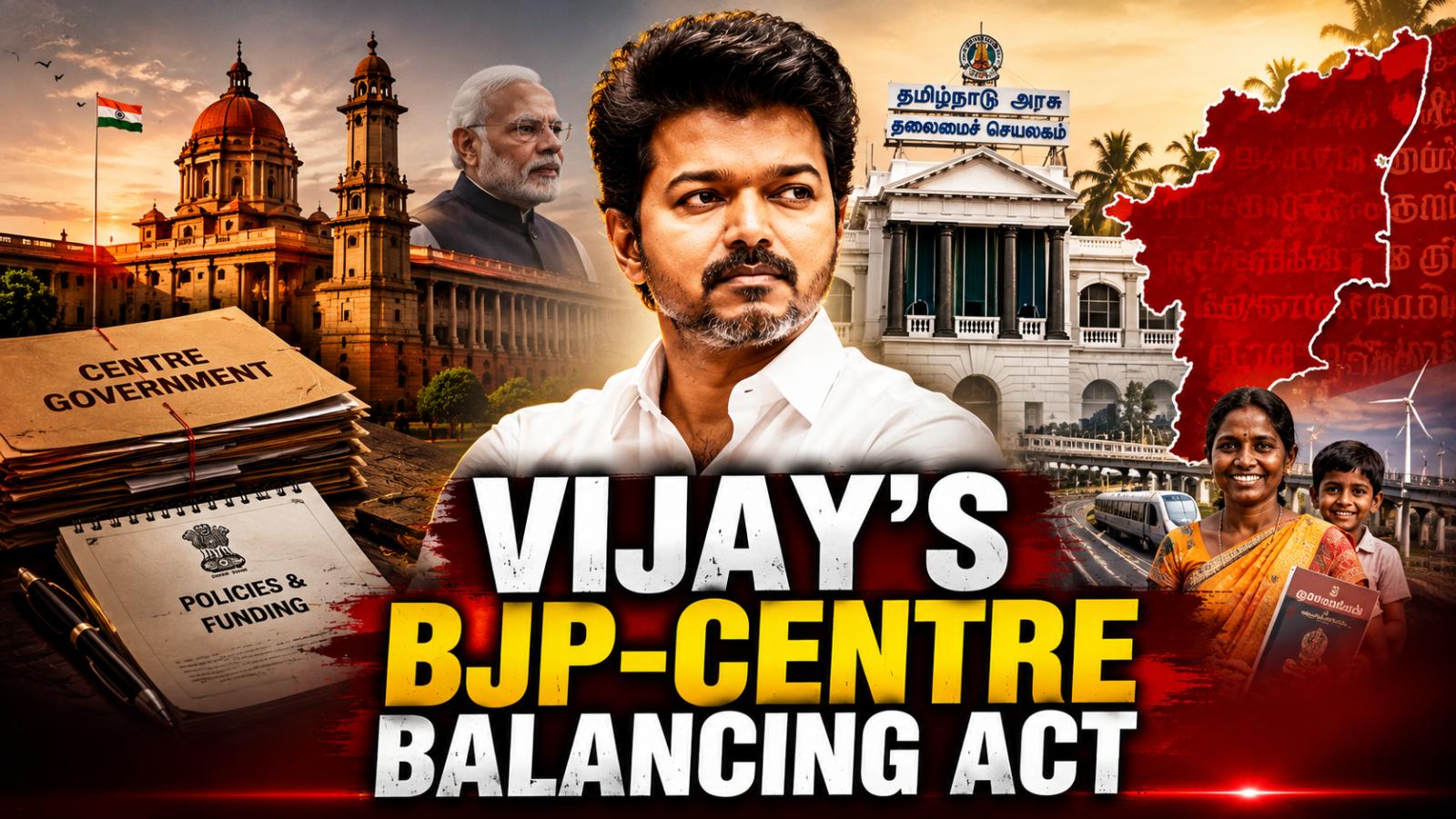
Vijay’s BJP-Centre Balancing Act Reshapes Tamil Nadu Politics
Tamil Nadu Chief Minister C Joseph Vijay is attempting to bring a new style to opposition politics by separating ideological rivalry from administrative responsibility. During the 2026 Assembly election campaign, Vijay and his Tamilaga Vettri Kazhagam placed the BJP at the centre of their political attacks, strongly opposing Hindi imposition, the National Education Policy, centralisation of power and threats to Tamil Nadu’s rights.
But after taking office, Vijay has avoided turning political opposition into administrative deadlock. Instead, he has kept official communication open with Prime Minister Narendra Modi and the Union government. His approach is clear: oppose the BJP on ideology, language and federal rights, but engage with the Centre when Tamil Nadu’s funds, projects and development needs are involved.
This strategy has made Vijay’s early governance model one of the most watched political developments in Tamil Nadu. Unlike the usual pattern of constant Centre-state confrontation, Vijay is trying to use dialogue without giving up his political stand. His government continues to oppose the three-language formula and NEP-linked education funding conditions, but it has also actively sought central support for infrastructure, finance and welfare projects.
Firm Opposition, Practical Governance
Vijay’s first major signal came after his swearing-in on May 10, when he responded positively to Prime Minister Modi’s congratulatory message and expressed hope for cooperation in Tamil Nadu’s development. His May 27 visit to New Delhi strengthened that message. During his meeting with the Prime Minister, Vijay submitted a detailed memorandum covering several important state issues.
The demands included Centre’s intervention in the Mekedatu dam dispute, release of pending education funds, protection for Tamil fishermen arrested by the Sri Lankan Navy, support for defence manufacturing, highways, railways, ports and industrial corridors. He also met Union Finance Minister Nirmala Sitharaman to raise Tamil Nadu’s financial requirements.
At the NITI Aayog Governing Council meeting, Vijay followed the same line. He strongly opposed the Centre’s decision to link Samagra Shiksha funds with NEP implementation and demanded the release of Rs 3,284 crore due to Tamil Nadu. At the same time, he asked for greater central assistance for infrastructure, rural housing and development schemes.
His later letters to the Centre on rural employment funding, cotton import duties, Neyveli Lignite Corporation disinvestment, fishermen safety and Cauvery-related concerns also followed the same pattern: disagreement without disengagement.
For Vijay, this balancing act carries both opportunity and risk. If he secures funds, projects or policy relief for Tamil Nadu, it could strengthen his image as a practical chief minister who can defend state rights while delivering results. But if the Centre does not respond positively, opponents may accuse him of gaining little from engagement.
For now, Vijay’s strategy has given Tamil Nadu politics a fresh talking point. He is not softening his anti-BJP position, but he is refusing to let political rivalry block governance. That makes his model firm in principle, practical in administration and politically significant for the future of opposition politics.