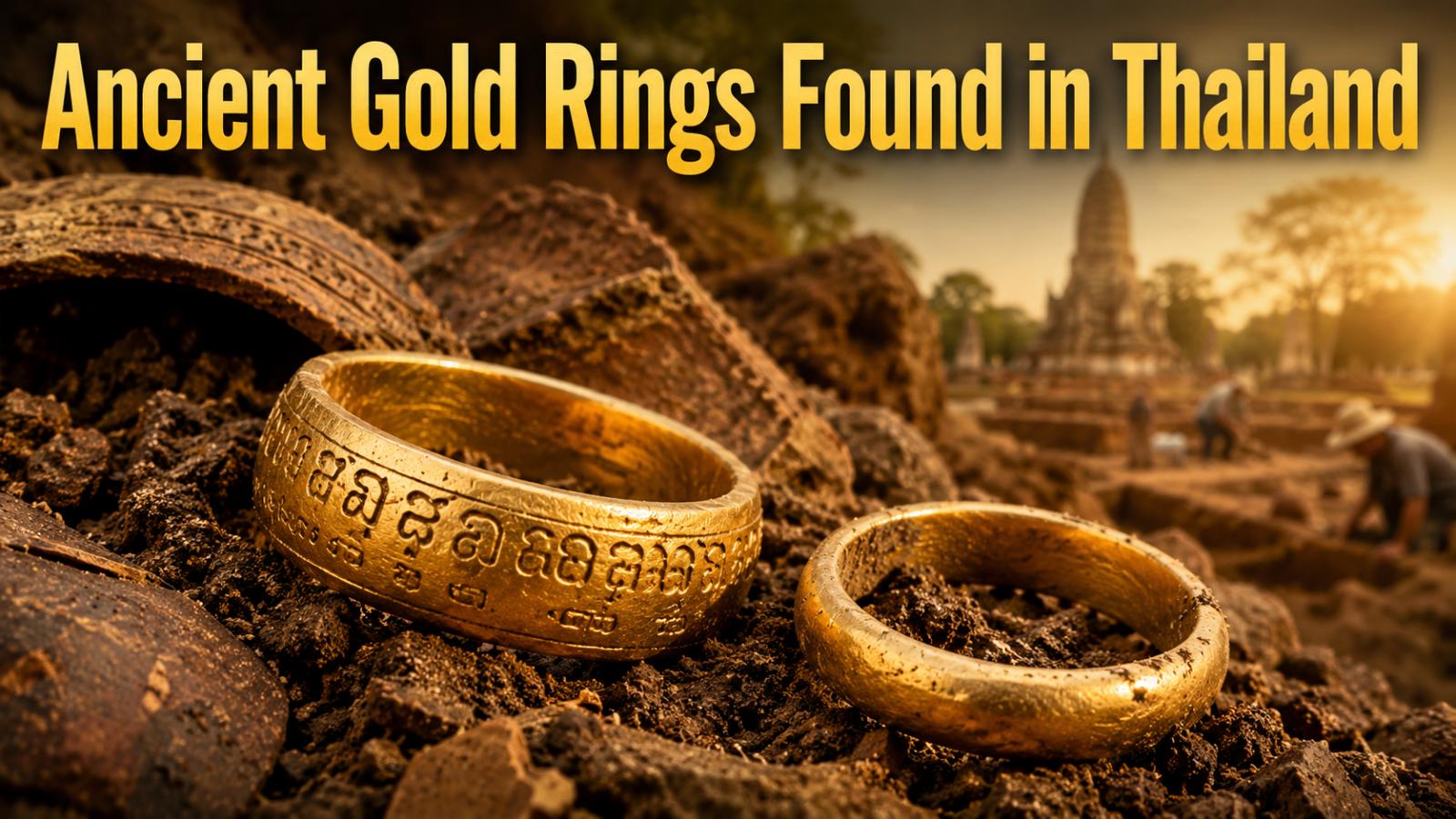
A new archaeological discovery in Thailand has drawn attention to the country’s early links with ancient India. Two gold rings believed to be around 2,000 years old were found at the Don Yai Thong excavation site in Phetchaburi province, along with human skeletal remains and other burial objects. The find is being studied as an important clue to trade, culture and social life during Thailand’s Iron Age.
One of the rings carries an inscription in Brahmi script, an ancient writing system widely associated with early Indian inscriptions. Experts believe the word on the ring may refer to “Pushya,” an auspicious term connected with Indian astronomy and tradition. The second ring is a plain gold band, but its presence beside the same skeleton suggests the person buried there may have held wealth or status.
Why the Brahmi script ring matters
The ring with Brahmi writing is the most significant part of the discovery because it points to possible cultural contact between ancient communities in Thailand and India. Writing, trade goods, religious ideas and social customs often moved through merchant routes, and this ring may be evidence of that wider exchange.
Archaeologists have suggested that the person buried with the rings may have been linked to trade or merchant activity. Some early interpretations connect the inscription and burial style with a Vaishya background, a community traditionally associated with commerce. However, researchers are likely to treat this carefully, as the discovery gives strong clues but not a complete life story of the person buried at the site.
Don Yai Thong site reveals elite burials
The Don Yai Thong site is located around 130 kilometres southwest of Bangkok. Excavation work began after local residents discovered fragments of ancient bronze drums in a rice field. Since then, researchers have uncovered multiple skeletons, pottery, bronze items and gold ornaments.
The presence of gold rings and ceremonial objects suggests that the site may have been used for burials of wealthy or high-ranking individuals. In many ancient societies, valuable objects were placed with the dead as a sign of respect, belief, identity or social position. These findings help archaeologists understand how people lived, traded and expressed status in prehistoric Thailand.
Ancient India link in Southeast Asia
The discovery adds to growing evidence that ancient Southeast Asia was not isolated. Communities across the region were connected through sea routes, trade networks and cultural exchange. The Brahmi script ring is especially valuable because it shows that Indian writing and ideas may have reached Thailand much earlier than many casual readers might expect.
Gold ornaments, bronze drums and burial goods also suggest that the region had active contact with traders and skilled craft communities. The Don Yai Thong excavation may help researchers better understand how Indian influence, local traditions and regional trade came together nearly two millennia ago.
What happens next
Further study is expected to confirm more details about the age of the rings, the identity of the buried person and the wider importance of the site. Once the research is completed, the artefacts are expected to be preserved and possibly displayed for the public.
For now, the gold rings from Phetchaburi stand as a rare and meaningful discovery. They do not just show wealth; they reveal movement, belief and connection across ancient Asia. The Brahmi inscription, in particular, makes the find important for understanding the early cultural bridge between India and Thailand.