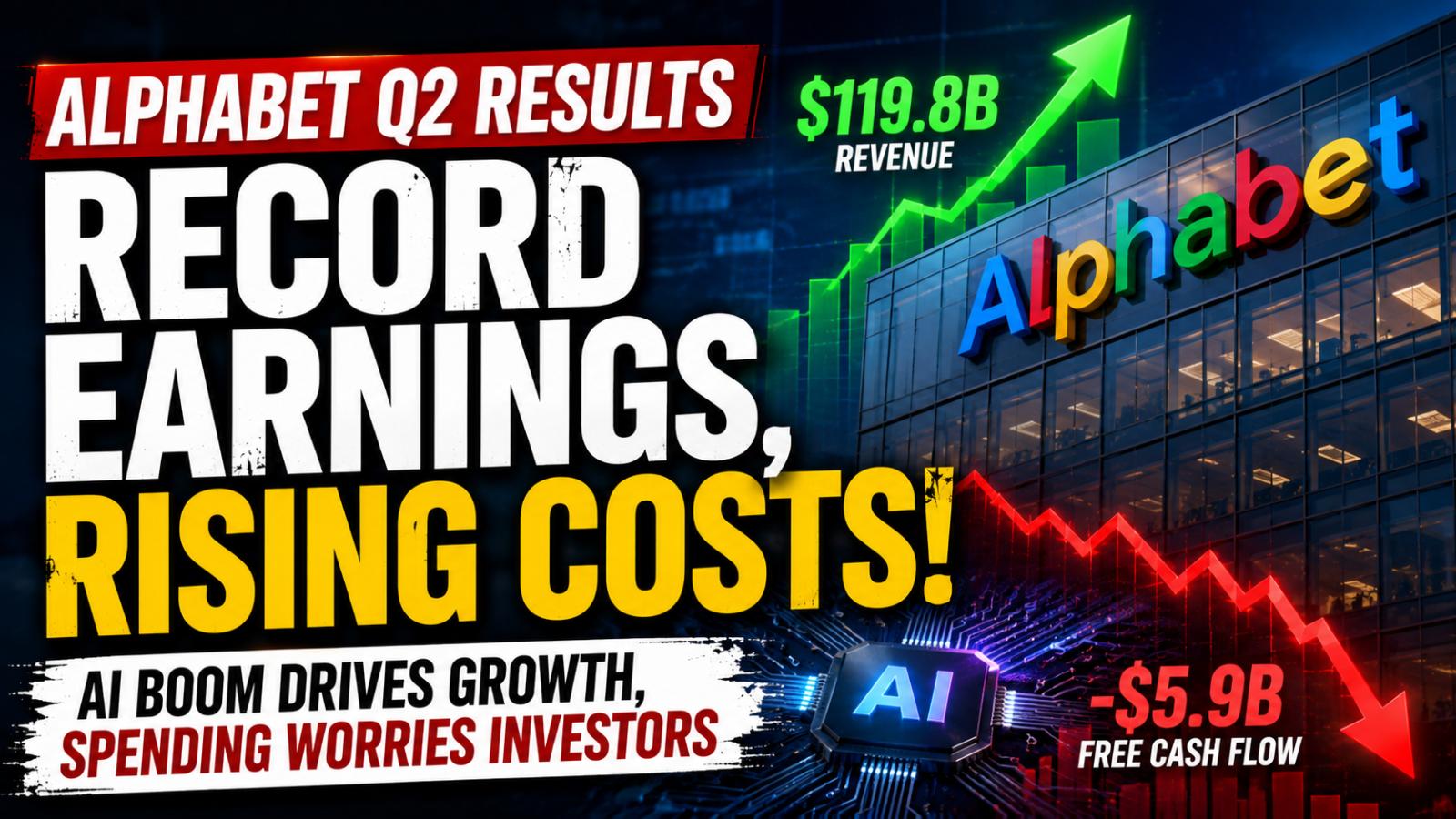
Alphabet Q2 results show AI boom but rising costs as the company posts record revenue, operating profit and Google Cloud growth. Despite the strong financial performance, investors focused on rapidly increasing AI infrastructure spending and negative free cash flow, sending the stock lower after earnings.
Google Cloud revenue growth drives record quarter
Alphabet delivered one of the strongest quarterly performances in its history, reporting second-quarter revenue of $119.8 billion, an increase of 24% from the same period last year. The company exceeded analyst expectations across nearly every major financial metric, reinforcing the strength of its advertising and cloud businesses.
Google Search remained the company's largest revenue engine, generating $63.3 billion during the quarter, while YouTube advertising contributed $11.1 billion. Operating income climbed 30% year over year to reach $40.8 billion, reflecting continued profitability across Alphabet's core businesses.
The standout performer was Google Cloud. Revenue surged to $24.8 billion, representing an 82% increase compared with the same quarter in 2025. The rapid expansion highlights growing enterprise demand for artificial intelligence infrastructure and cloud-based AI services.
The results support Alphabet's view that investments in AI are translating into commercial opportunities rather than remaining limited to research or experimental technologies.
Alphabet AI infrastructure spending raises concerns
Despite the impressive revenue growth, investor attention quickly shifted to the company's spending plans. Alphabet disclosed that it invested $44.9 billion in capital expenditures during the quarter, more than double the $21.7 billion spent in the same period last year.
The company also increased its full-year 2026 capital expenditure guidance to between $195 billion and $205 billion, compared with its previous forecast of $180 billion to $190 billion. Management further indicated that investment levels are expected to increase again during 2027 as demand for AI computing capacity continues to expand.
These investments include new data centres, AI accelerators, networking infrastructure and computing systems needed to support large-scale artificial intelligence models.
While management views these expenditures as necessary to secure long-term leadership in AI, investors questioned whether infrastructure spending is growing faster than the financial returns it currently generates.
Google free cash flow turns negative
The aggressive investment strategy had a noticeable effect on Alphabet's cash generation. Free cash flow fell to negative $5.9 billion during the quarter, compared with positive $10.4 billion one year earlier.
Although the company's operating business remains highly profitable, the scale of capital spending has temporarily outpaced cash generation. That shift became one of the primary reasons Alphabet's shares declined in after-hours trading despite record financial results.
For many investors, the concern is not whether AI can generate revenue. Google's cloud business has already demonstrated strong demand. Instead, the question is how long companies will need to maintain exceptionally high infrastructure investments before those costs begin to moderate.
Sundar Pichai doubles down on AI
Chief Executive Officer Sundar Pichai showed no indication that Alphabet intends to reduce spending. Speaking after the earnings release, he described artificial intelligence as a long-term structural transformation rather than a short-term technology trend.
Pichai said the company remains increasingly optimistic about AI's future and explained that enterprise customers are seeking complete AI systems that combine computing power, secure data processing and advanced machine learning capabilities.
According to the company, continuing to expand computing infrastructure today is essential to meeting future customer demand and maintaining Alphabet's competitive position against other global AI providers.
The AI investment challenge
Alphabet's latest results illustrate one of the defining business questions of the AI era. Companies leading the artificial intelligence race are also investing unprecedented amounts of capital to build the infrastructure required to support future growth.
Google Cloud's 82% revenue growth demonstrates that enterprise adoption of AI continues to accelerate. At the same time, Alphabet's sharply higher capital expenditure and negative free cash flow highlight the financial pressure created by that expansion.
Whether investors ultimately reward this strategy will depend on how quickly AI revenue continues to grow relative to infrastructure costs. If revenue keeps expanding while investment gradually stabilises, Alphabet could strengthen its long-term competitive advantage. Until then, markets are likely to remain focused not only on earnings growth but also on how efficiently those profits are converted into cash.
The financial information in this article is based on Alphabet's official second-quarter 2026 earnings announcement, investor presentation and executive commentary during the company's earnings conference call.