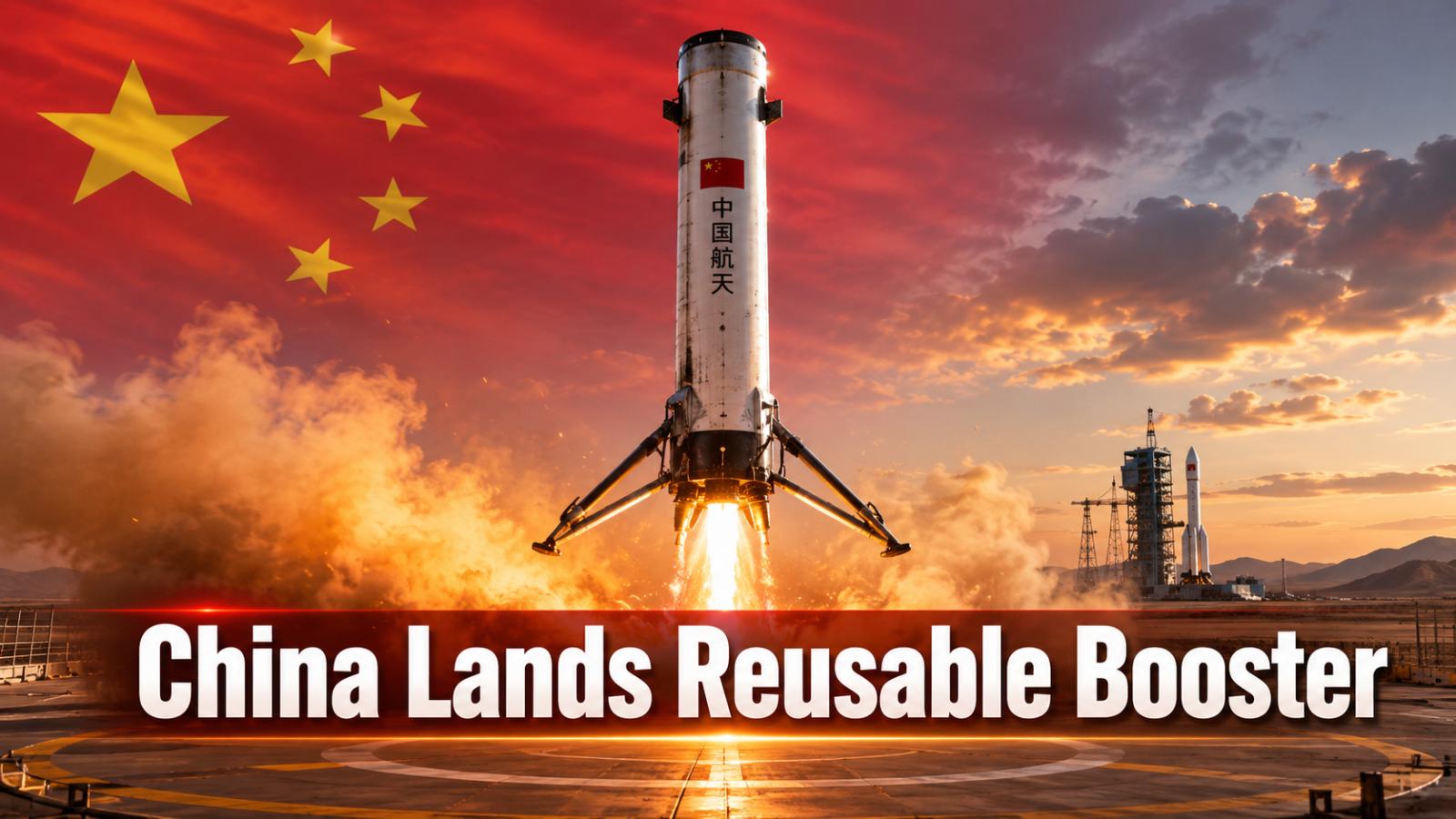
China’s commercial space sector has reached a major milestone with the Zhuque-3 landing. LandSpace successfully recovered the reusable rocket’s first stage, strengthening China’s rocket ambitions and its challenge to SpaceX as booster reuse becomes central to cheaper satellite launches.
Zhuque-3 landing
Chinese startup LandSpace successfully recovered the first stage of its Zhuque-3 rocket on Wednesday, August 19, marking China’s first successful ground-based landing of an orbital-class booster using deployable landing legs. The achievement places LandSpace alongside SpaceX and Blue Origin among private companies that have demonstrated orbital booster landing capability.
The 66.1-metre Zhuque-3 lifted off from the Dongfeng Commercial Space Innovation Pilot Zone in northwestern China. Its nine-engine first stage separated during flight and returned to a landing site in Gansu province, about 390 kilometres southeast of the launch area, according to Chinese state media cited by Reuters.
The landing succeeded on LandSpace’s second recovery attempt. Its first Zhuque-3 mission in December 2025 reached orbit, but the booster failed to complete its controlled landing. Wednesday’s mission also represented China’s fourth attempt to recover an orbital-class booster.
LandSpace reuse
Recovering a booster is only the first step toward building a commercially useful reusable launch system. LandSpace now plans to fly a recovered first stage again within six months, an important test of whether the company can turn a successful demonstration into a repeatable launch operation.
The company eventually wants each Zhuque-3 booster to fly as many as 20 times. Reusing expensive first-stage hardware can reduce launch costs and allow companies to increase launch frequency, particularly as demand rises for large satellite constellations.
Falcon 9 rival
LandSpace has positioned Zhuque-3 as a Chinese answer to SpaceX’s Falcon 9. The rocket uses a stainless-steel structure, which LandSpace says offers better heat resistance and potential manufacturing savings compared with Falcon 9’s aluminium-lithium construction.
Zhuque-3 uses methane and liquid oxygen, while Falcon 9 uses kerosene and liquid oxygen. LandSpace says its fuel combination burns more cleanly, an advantage that could simplify maintenance between flights.
For expendable missions, Zhuque-3 can carry up to 14.2 metric tonnes to low Earth orbit, compared with Falcon 9’s 22.8 tonnes, according to figures cited by LandSpace. SpaceX still holds a major operational advantage, flying Falcon 9 roughly 150 times a year and repeatedly reusing individual boosters.
China rocket recovery race
China has been testing more than one approach to reusable launch technology. In July, the country successfully recovered a Long March 10B first stage at sea using hooks and a net-based system mounted on a floating platform. Zhuque-3 instead returned vertically using landing legs, bringing China closer to the recovery model made routine by SpaceX.
The breakthrough does not mean China has caught SpaceX. The harder challenge is proving rapid refurbishment, repeated reflights and reliable high-frequency launches. Zhuque-3’s next reuse mission will therefore matter more commercially than the landing alone.
STAR Market IPO
The successful recovery also arrives as LandSpace prepares for a potential listing on Shanghai’s STAR Market. The company is seeking to raise about 7.5 billion yuan, roughly $1.11 billion, to support development and expand reusable launch services. Its updated prospectus says it is targeting profitability by 2029.
For China’s commercial space industry, the Zhuque-3 landing is a significant technical breakthrough. The bigger test now is whether LandSpace can turn reusable rocket technology into a dependable, lower-cost launch business capable of competing at global scale.