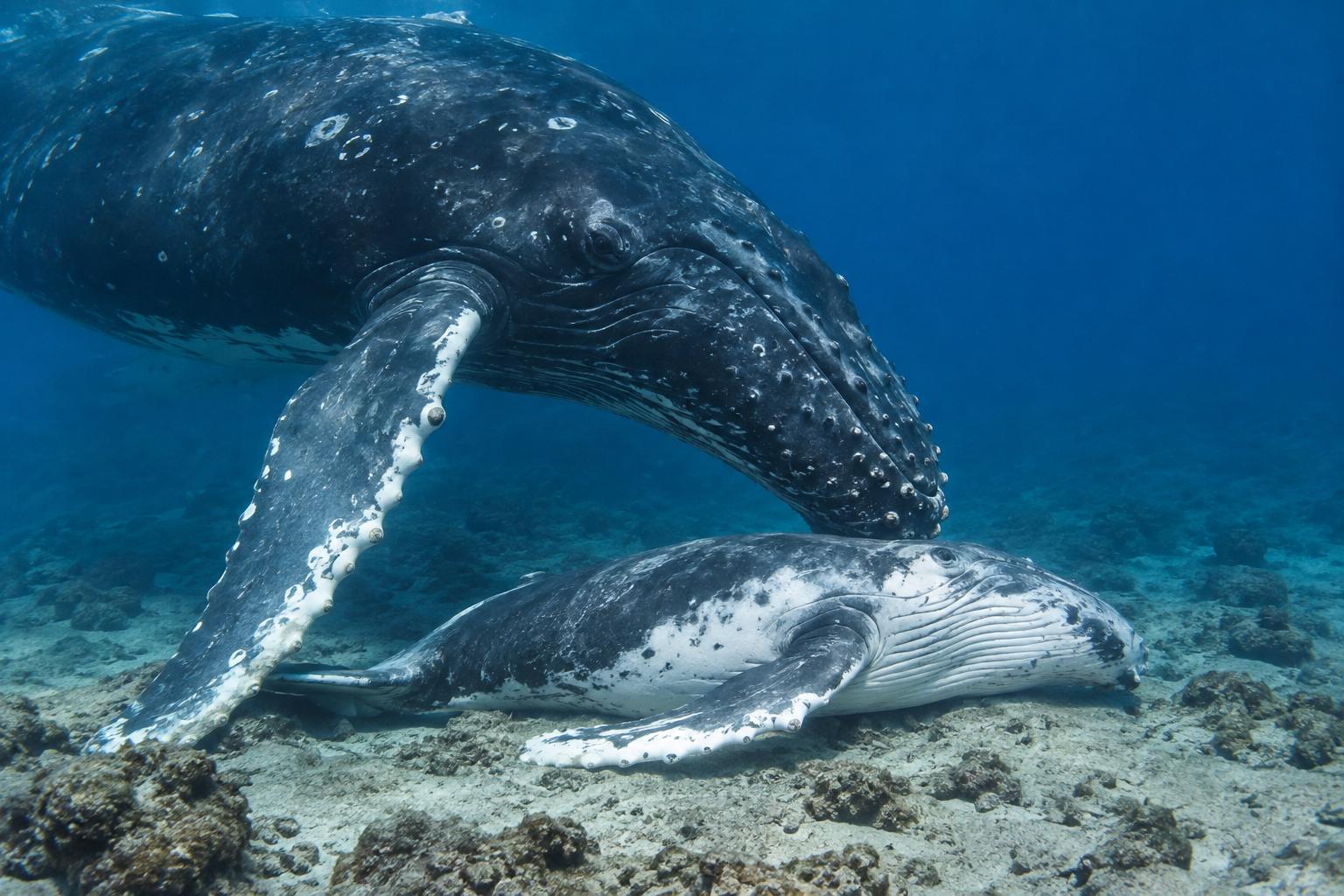
Rare footage of a humpback whale with a stillborn calf off Australia’s Gold Coast documents prolonged maternal contact after the calf’s death. Researchers say the July 17, 2025 encounter may reflect grief-like behavior, while cautioning that the whale’s emotional state cannot be confirmed.
Researchers have documented rare underwater footage of a female humpback whale remaining close to and repeatedly interacting with her stillborn calf off Australia’s Gold Coast, providing an unusual look at how the species may respond to the death of offspring.
The observations were detailed in a study published on September 16, 2026, in Discover Animals by Jan-Olaf Meynecke and Andrew Mulville. The researchers describe the encounter as the first detailed documented case of post-mortem attentive behavior involving a stillborn calf in humpback whales.
Rare encounter at Palm Beach Reef
The encounter occurred on July 17, 2025, at Palm Beach Reef in Queensland, about one kilometer from the Gold Coast shoreline. Researchers observed two adult humpback whales before underwater footage revealed the deceased calf resting on the seafloor.
The presumed mother repeatedly approached the calf, touching it with her head and pectoral fin. She also remained positioned eye-to-eye beside the calf for extended periods. The whales stayed in the area during observations from about 8 a.m. until 10 a.m. local time.
Behavior may indicate maternal attachment
Unlike some documented responses among toothed whales, the humpback did not attempt to lift the calf toward the surface.
Researchers said the behavior was consistent with what scientists call post-mortem attentive behavior, which can include touching, guarding or remaining near a deceased member of the same species.
The observations may represent a grief-like response, but the researchers cautioned that an animal’s emotional state cannot be determined from behavior alone. Other explanations could include maternal attachment, confusion or instinctive caregiving.
Why the footage matters
Post-mortem behavior has been documented more often among dolphins, orcas and other toothed cetaceans, while comparable observations involving baleen whales remain uncommon.
Two adult humpbacks were also reported in the same area on July 18 and July 19, 2025, although researchers could not confirm that they were the same animals seen during the original encounter.
Scientists say systematic documentation of similar neonatal mortality events could help researchers better understand maternal bonds, cognition and responses to death among large whales. The Gold Coast encounter provides a rare documented case, but further observations will be needed before researchers can determine how broadly such behavior occurs across humpback whale populations.