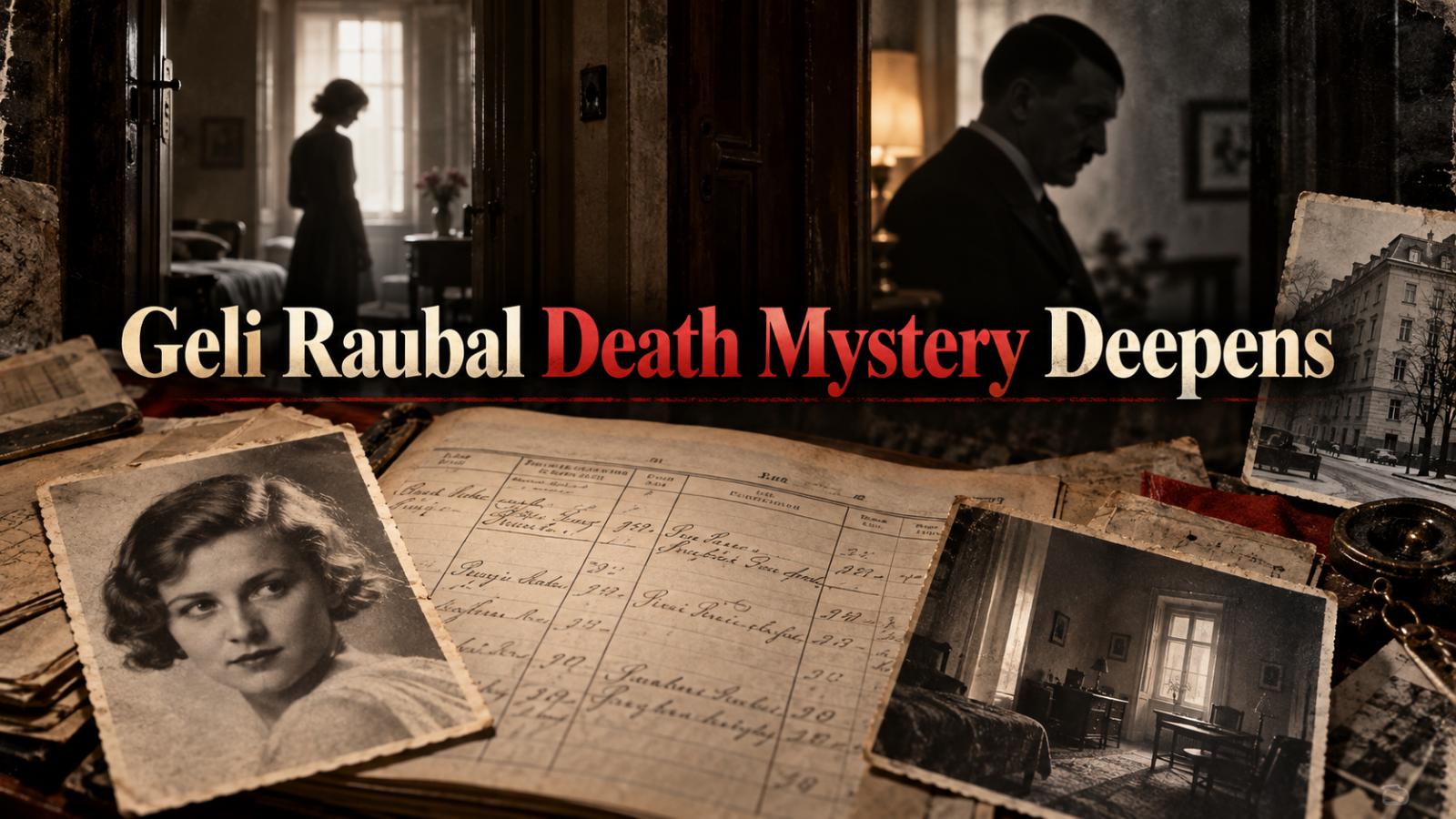
Newly uncovered archival documents have reopened questions surrounding the Geli Raubal death mystery nearly 95 years after Adolf Hitler’s half-niece was found dead in his Munich apartment. The records suggest an earlier death date and challenge a key part of the timeline long associated with the case.
Death date raises new questions
Angela “Geli” Raubal was 23 when she died from a gunshot wound in September 1931. Her death was treated as suicide, and the weapon involved belonged to Hitler. The traditional account held that her body was discovered on September 19, after Hitler had already left Munich for Nuremberg.
Historian Harald Sandner says archival material points to a different chronology. An official Munich death register reportedly records the discovery of Raubal’s body at 10:15 a.m. on September 18. Two historical death notices are also said to give September 18, adding weight to questions about the established date. Contemporary Munich historical records likewise list her death on September 18.
Death log challenges the established account
The one-day difference matters because records indicate Hitler was still in Munich during the morning of September 18 and left for Nuremberg later that day. Under the conventional police timeline, his earlier departure appeared to place him outside Munich before Raubal’s body was discovered.
Three records reportedly pointing to September 18 make the discrepancy harder to dismiss as a single clerical mistake. However, the archival material does not establish exactly when the fatal shooting occurred or explain why the dates differ.
Hitler alibi comes under renewed scrutiny
The revised Hitler timeline has therefore renewed attention on his whereabouts, but it does not establish his involvement in Raubal’s death. Sandner has raised the possibility that officials sympathetic to the Nazi movement may have altered or concealed details of the case, but no surviving evidence currently proves that a cover-up took place.
Records from the period also show that Raubal’s body was released for burial without a full autopsy, a decision that has contributed to continuing uncertainty surrounding the investigation.
Suicide remains the official historical account
Raubal had lived close to Hitler for several years and later stayed in his Munich apartment. Historians have described Hitler as highly controlling of her personal life, while claims of a sexual relationship between the two have circulated for decades without conclusive evidence.
Shortly before her death, the pair reportedly argued over Raubal’s desire to travel to Vienna and continue her musical studies. Such details have fueled numerous theories, but they do not establish whether her death resulted from suicide or another cause.
Sandner findings reshape the timeline
Thomas Weber, a historian of Nazi Germany at the University of Aberdeen, has said the documents presented by Sandner could significantly weaken the chronology historians relied on for decades if the records are authentic. He has also cautioned against treating the changed timeline as evidence that Hitler murdered Raubal.
That distinction is crucial. The new archive records provide potentially important evidence about when Raubal’s body was discovered, not proof of who caused her death. What they do is reopen a historical question once thought largely settled and place Hitler in Munich during a period that the traditional account had effectively excluded him from.
Internal linking opportunities: World History, Germany News, European History, Adolf Hitler history archive and related World War II historical features.