Russia is confronting an unexpected challenge in its human spaceflight program after significant damage was discovered at the country’s primary crewed launch facility in Kazakhstan. The incident occurred moments after the successful liftoff of the Soyuz MS-28 spacecraft, which departed from the Baikonur Cosmodrome on November 27 carrying two Russian cosmonauts and a NASA astronaut to the International Space Station. Although the mission reached orbit without complications, the condition of the launch pad soon became a cause for concern, prompting Russia’s space agency to temporarily suspend future crewed launches.
According to Roscosmos, the Soyuz rocket lifted off from Site 31/6 at approximately 2:30 pm local time, marking another routine departure from the historic site that has supported human missions for more than six decades. On board the spacecraft were Russian cosmonauts Sergey Kud-Sverchkov and Sergei Mikaev, along with NASA astronaut Chris Williams. Their journey to the ISS proceeded nominally, and the spacecraft docked with the station as planned. However, the atmosphere shifted once engineers began examining the launch pad after the rocket’s ascent.
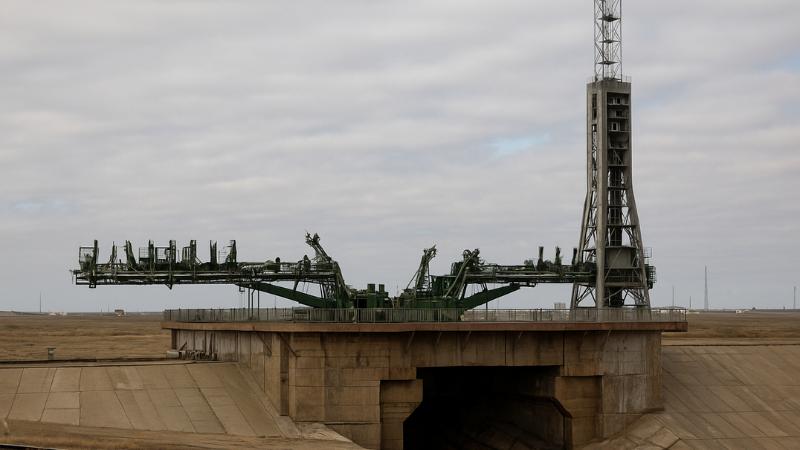
In a statement shared through their official communication channels, Roscosmos reported that the standard post-launch inspection revealed substantial harm to multiple components of the launch infrastructure. The agency did not specify the exact nature or extent of the damage, noting only that it had been identified during routine checks and was now undergoing detailed assessment. Engineers are currently determining the repair timeline, though no estimate has been publicly provided. Roscosmos indicated that the affected components will be restored as soon as possible but refrained from commenting on the duration of the interruption to crewed flight operations.
Independent reports suggested that the failure may have involved a large service platform used to access the rocket’s engines during pre-launch preparations. The structure, weighing roughly 22 tons, is believed to have collapsed into the flame trench beneath the launch mount, the deep channel designed to channel exhaust gases away from the rocket during liftoff. If the structure cannot be repaired quickly, officials may need to replace it entirely, a process that could prolong the halt in human spaceflight activities.
The situation is especially critical because Site 31/6 is currently Russia’s only operational pad for launching cosmonauts. As a result, the discovery of structural failures means the nation lacks an immediate alternative for crewed access to space. This marks the first time since 1961—when the Soviet Union began its pioneering human spaceflight program—that Russia has been unable to send its own personnel into orbit.
Roscosmos has emphasized that repair efforts are underway and that crews are working to restore full launch capability. Until then, the agency faces a rare interruption in a program that has maintained an unbroken presence in human spaceflight for more than six decades. The pause comes at a time when international collaboration aboard the ISS remains active and logistical planning for future missions continues. The coming weeks will determine how quickly Russia can recover from the incident and resume its long-standing role in transporting humans to space.