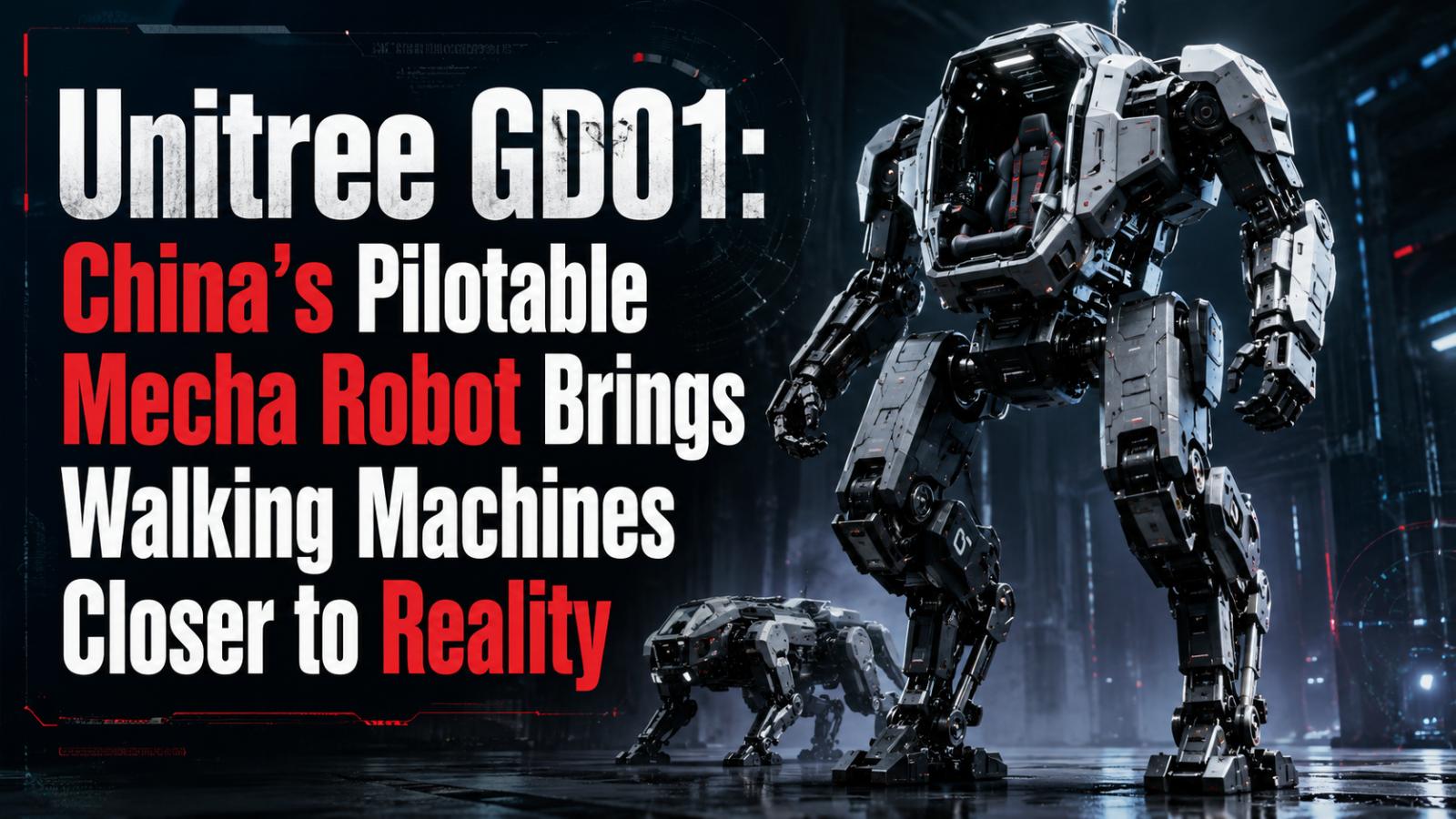
Unitree Robotics has introduced the GD01, a large pilotable robot that is attracting attention because it looks less like a normal machine and more like something from a futuristic movie. The robot is designed to carry a human operator inside an open cockpit and move using robotic legs instead of wheels.
The GD01 is being discussed as one of the latest examples of how fast China’s robotics industry is growing. Unitree, already known for its robot dogs and humanoid machines, is now stepping into a more ambitious category: human-operated walking robots.
The machine is reported to stand nearly 2.8 metres tall and is priced at around 3.9 million yuan, which is roughly in the range of several hundred thousand dollars. That makes it far from a mass-market product, but it clearly shows where advanced robotics may be heading.
What makes the Unitree GD01 robot different?
The most interesting feature of the GD01 is its ability to move in more than one form. It can walk upright on two legs like a humanoid robot, but it can also shift into a four-legged mode for better stability.
This transformable design is important because walking robots face a major challenge: balance. A two-legged robot may look impressive, but it can become unstable on uneven ground. A four-legged stance spreads weight more evenly and can help the machine stay balanced in difficult conditions.
This gives GD01 a more practical edge compared with robots that are limited to only one movement style.
A pilotable robot with an open cockpit
The GD01 is not just a remote-controlled robot. It has been designed with space for a human operator. The cockpit is built into the body of the robot, allowing a person to sit inside and guide the machine.
This is why many people are calling it a manned mecha robot. Unlike regular robots that are controlled from outside, GD01 brings the operator into the machine itself.
The open cockpit design makes it look dramatic and futuristic, but it also raises practical questions. For serious real-world use, safety, protection, control accuracy, and emergency systems will matter a lot. A machine of this size carrying a human cannot depend only on visual appeal.
Two-legged and four-legged movement
In two-legged mode, the GD01 stands upright and moves in a humanoid style. This gives it the appearance of a traditional mecha robot and makes it visually impressive during demonstrations.
In four-legged mode, the machine becomes more stable. This could be useful on rough surfaces, outdoor environments, or places where a tall bipedal robot may struggle to balance.
This dual-mode movement is the main reason GD01 is getting so much attention. It is not simply a giant humanoid robot. It is a walking machine that can change its posture depending on the situation.
Why the GD01 robot matters
The GD01 matters because it shows a shift in robotics. For years, robot dogs and humanoid robots were mostly used for research, inspection, demonstrations, and entertainment. Now companies are trying to build bigger machines that can carry people and perform heavier tasks.
A pilotable walking robot could eventually be useful in areas such as rescue training, industrial testing, theme parks, exhibitions, construction support, and special demonstrations. It may also attract buyers from technology parks, research centres, entertainment companies, and institutions that want futuristic machines for public display.
But the important word here is “eventually.” The GD01 is impressive, but it still needs to prove that it can work outside controlled demonstrations.
The big questions Unitree still needs to answer
The excitement around GD01 is understandable, but several important details are still unclear. Unitree has not fully revealed practical specifications such as battery life, top speed, payload capacity, charging time, operating range, safety systems, and long-term durability.
These details are not minor. They decide whether the GD01 is a useful machine or mainly a high-cost demonstration product.
For example, if the robot can operate only for a short time, its practical use will be limited. If it cannot carry additional tools or equipment, it may not be useful in industrial environments. If its speed is too low, it may work only for controlled shows and exhibitions.
Until these details are clear, GD01 should be seen as a bold robotics showcase rather than a proven replacement for existing industrial machines.
From robot dogs to manned mecha machines
Unitree Robotics became well known for its quadruped robots, commonly called robot dogs. These machines helped the company gain global attention because they were smaller, more affordable than many competitors, and easier to demonstrate in real-world settings.
The company later expanded into humanoid robots, showing that it wanted to compete in more advanced categories. With GD01, Unitree is moving into a new area where robots are not only walking independently but also carrying human operators.
This progression is important. It shows how the robotics industry is moving from small agile robots to larger machines that combine mobility, strength, and human control.
Is the GD01 robot practical or just a showpiece?
Right now, GD01 looks more like a powerful technology statement than a machine ready for everyday use. That does not make it unimportant. Many major technologies begin as expensive demonstrations before becoming useful products.
However, buyers will not spend such a high amount only because the robot looks futuristic. They will want clear answers about reliability, maintenance, safety, operating cost, and use cases.
For entertainment parks, technology exhibitions, robotics research, and promotional events, GD01 could attract serious attention. For construction, disaster response, or industrial work, it still needs stronger proof.
Could pilotable mecha robots become common?
Pilotable mecha robots are still far from becoming common. The technology is expensive, complex, and difficult to maintain. Walking machines also face challenges that wheeled vehicles do not have, including balance, energy usage, terrain handling, and mechanical wear.
Still, GD01 shows that companies are no longer treating manned walking robots only as fantasy concepts. They are building real prototypes and turning them into purchasable machines.
That is what makes GD01 important. It may not become a common vehicle soon, but it pushes the idea of human-operated robots closer to reality.
The Unitree GD01 robot is a bold step in the future of robotics. Its pilotable cockpit, transformable walking design, and ability to move in both two-legged and four-legged modes make it one of the most eye-catching machines in the robotics world.
At the same time, the excitement should be balanced with caution. The robot’s price is high, and several key performance details are still not fully known. Without clear data on battery life, speed, safety, and real-world performance, it is too early to call GD01 a practical breakthrough.
For now, GD01 is best understood as a serious glimpse into the future of manned robotics. It proves that walking mecha-style machines are no longer limited to movies, but their real value will depend on how well they perform beyond the demonstration stage.