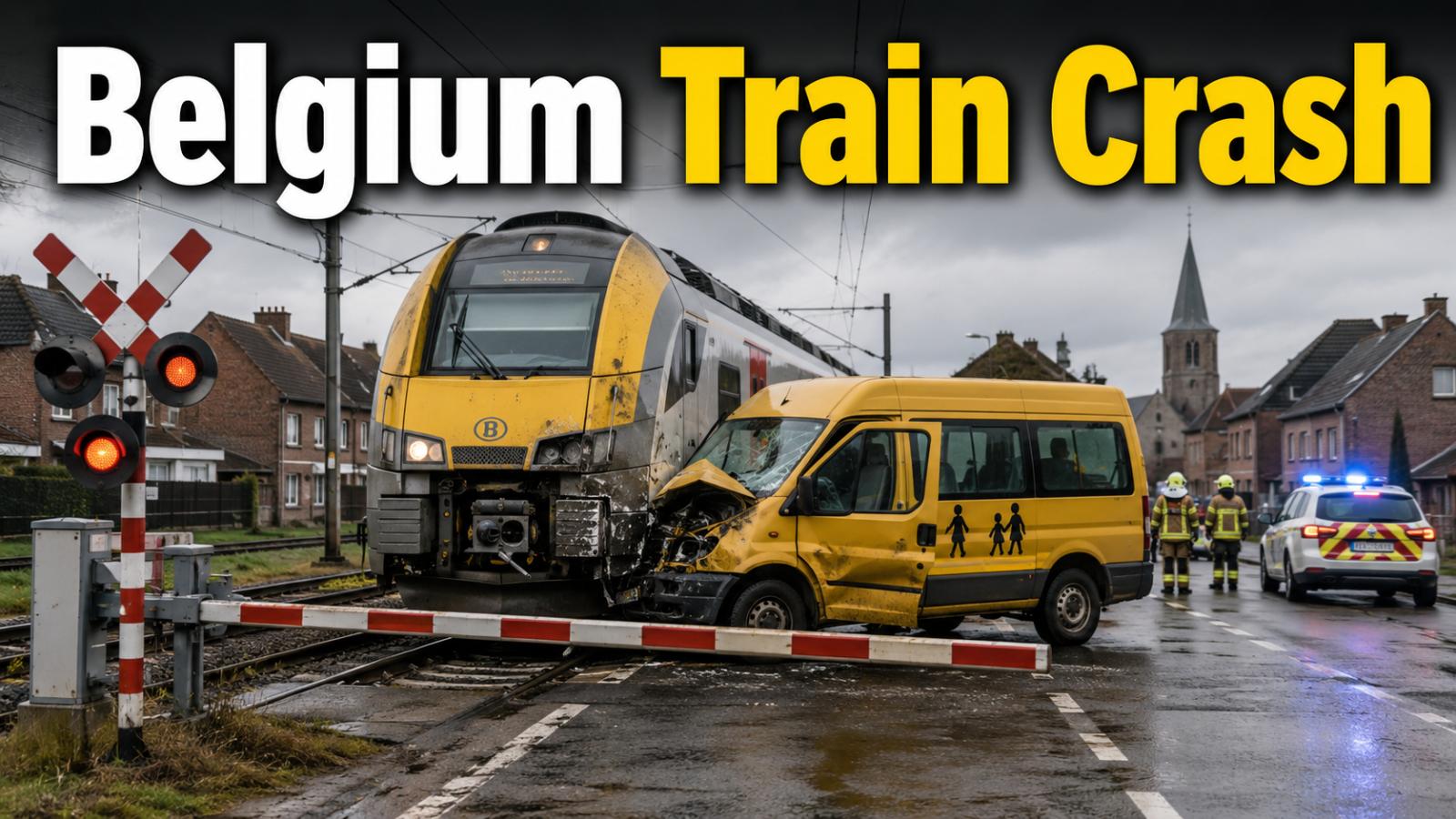
A serious train crash in Buggenhout, Belgium, has left four people dead after a train struck a school minibus at a level crossing on Tuesday morning, May 26, 2026. The accident happened in the town of Buggenhout, located north of Brussels, during the busy morning travel period.
The minibus was carrying schoolchildren along with adults when it reached the railway crossing. Shortly after, the vehicle was hit by an approaching train. Emergency services rushed to the scene, and the area was quickly sealed off as rescue teams, police, and railway officials began their work.
The crash has shaken the local community, especially because children were among those on board the school transport vehicle.
What happened at the level crossing?
Early reports say the school minibus was at a railway level crossing when the train approached. A level crossing is a point where a road and railway track meet at the same height, making safety signals, barriers, and driver attention extremely important.
Officials are looking into whether the crossing barriers and warning lights were active at the time of the accident. Railway authorities are also expected to examine the condition of the crossing system, the movement of the minibus, and the actions taken by the train driver before impact.
According to initial information, the train driver applied emergency braking, but the train could not stop in time. Trains are heavy and need a long distance to come to a complete stop, even when emergency brakes are used.
School minibus was carrying pupils
The vehicle involved in the crash was described as a school minibus. It was reportedly carrying seven children, a driver, and an escort. The exact details of all victims and injured people are being handled carefully by authorities as families are informed.
For parents and schools, this type of accident is especially painful because school transport is expected to be one of the safest parts of a child’s daily routine. The Buggenhout crash has now raised serious questions about road discipline, railway crossing safety, and emergency response systems near school routes.
Investigation begins into the cause
Authorities have started an investigation to understand how the school minibus ended up in the path of the train. Investigators are expected to review witness statements, railway signals, barrier operation, traffic lights, road layout, and any available camera footage.
The probe will also look at whether the crash was caused by human error, a technical fault, confusion at the crossing, or another factor. Until the investigation is complete, officials are unlikely to give a final explanation.
This step is important because the findings may help prevent similar accidents in the future, especially near crossings used by school vehicles.
Rail safety concerns after the crash
The Buggenhout train crash is a harsh reminder of how dangerous level crossings can be when a vehicle enters the track area at the wrong moment. Even a few seconds of delay can become deadly when a train is approaching.
Drivers are always expected to stop when barriers are down, warning lights are flashing, or alarms are active. Vehicles should never attempt to cross until the barriers are fully raised and the warning system has stopped.
For school buses and minibuses, the safety responsibility is even greater. Drivers must make sure there is enough space to fully clear the tracks before entering a crossing.
Community mourns the victims
The deaths have brought grief to families, school staff, and residents in Buggenhout. Emergency workers remained at the site after the collision, while train services in the area were disrupted.
Belgian officials expressed sorrow over the accident and offered condolences to the victims’ families. For the community, the focus now is on supporting those affected and finding clear answers about how the crash happened.
The Buggenhout school bus train accident will likely remain under close investigation in the coming days. The final report may decide whether new safety steps are needed at railway crossings used by school transport vehicles.