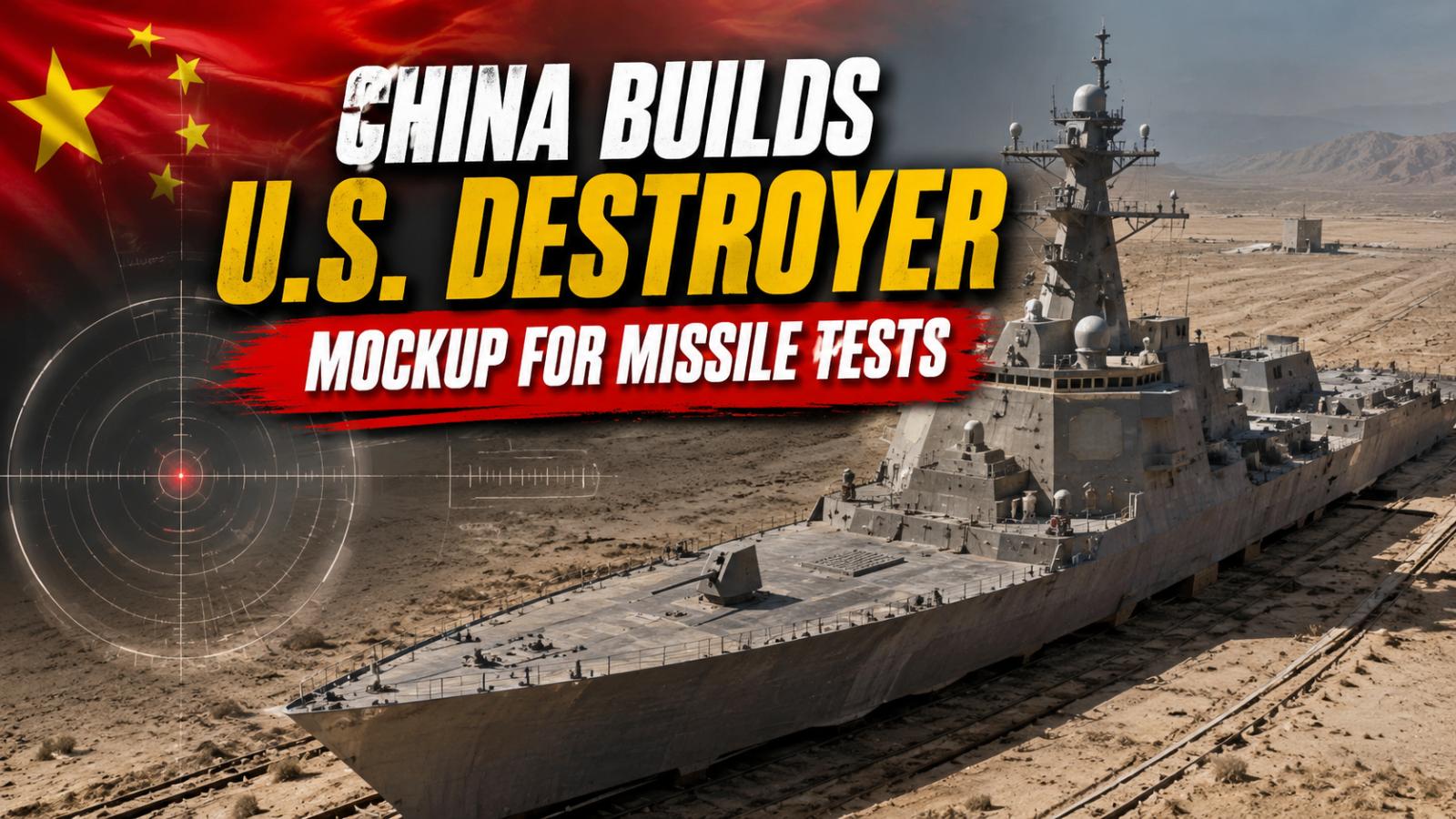
China has constructed a detailed, full-scale target resembling a US Navy Arleigh Burke-class guided-missile destroyer at a remote testing range in Xinjiang. Satellite imagery attributed to US geospatial company Vantor suggests the model could help China study missile targeting, surveillance and strike coordination against a moving naval platform.
Desert Target Shows Greater Structural Detail
The China ship replica stands at a testing location in the Taklamakan Desert, an area previously associated with mock aircraft carriers, destroyers and aircraft targets. Earlier naval models often consisted mainly of flat outlines, rails or simplified deck shapes. The latest structure appears more developed, with a raised superstructure and recognizable deck sections.
Public reporting based on the Vantor satellite images describes the target as resembling an Arleigh Burke-class destroyer. However, Chinese authorities have not publicly confirmed the replica’s purpose, technical configuration or connection to a specific weapons programme. Claims about how closely it reproduces radar or electromagnetic signatures should therefore be treated as analytical assessments rather than established facts.
Burke Mockup Represents a Difficult Naval Target
The choice of an Arleigh Burke mockup is strategically significant because the warship forms a major part of the US Navy’s surface fleet and carrier strike groups. The US Navy says the class uses the Aegis Weapons System, phased-array radar, anti-air and anti-submarine systems, and the Mark 41 Vertical Launching System. These systems allow the destroyer to detect threats and launch different types of defensive or offensive missiles.
An Arleigh Burke-class ship presents a more complex target than a large aircraft carrier. It has a smaller profile, high mobility and layered defensive capabilities designed to detect and intercept approaching threats. A realistic model could help missile developers examine whether sensors and seekers can distinguish important sections of the vessel rather than merely strike its general outline.
Missile Test May Examine the Complete Kill Chain
The desert target may support more than a basic missile test. Analysts believe it could help evaluate a naval kill chain, which involves locating a target, identifying it, maintaining continuous tracking, transmitting coordinates and guiding a weapon toward the selected point.
A rail or track system visible around similar Chinese targets has previously allowed mock ships to move across the range. Movement creates a harder test because surveillance and targeting systems must continually update the target’s location instead of relying on fixed coordinates.
The objective may not always be to simulate sinking a ship. Tests could examine whether a strike can damage critical components such as radar arrays, communication equipment, fire-control systems or vertical launch cells. Disabling those systems could reduce a destroyer’s ability to protect nearby vessels even when the hull remains afloat.
Kill Chain Testing Reflects Wider Naval Planning
China has used desert mockups of US naval and air platforms for several years. Earlier satellite imagery showed carrier-shaped targets and apparent models of American military aircraft, some surrounded by impact marks. These facilities are widely assessed as supporting improvements in target recognition and precision-strike performance.
The latest destroyer-style model does not prove that China can defeat an operating US warship under real combat conditions. A live naval engagement would include electronic warfare, decoys, missile interception, weather, changing formations and support from other ships and aircraft.
Still, the replica indicates sustained interest in testing how surveillance, tracking and missile systems work together against representative US naval targets. Its greater physical detail suggests China may be moving beyond simple accuracy trials toward more demanding exercises involving target identification, movement and attacks on specific ship systems.