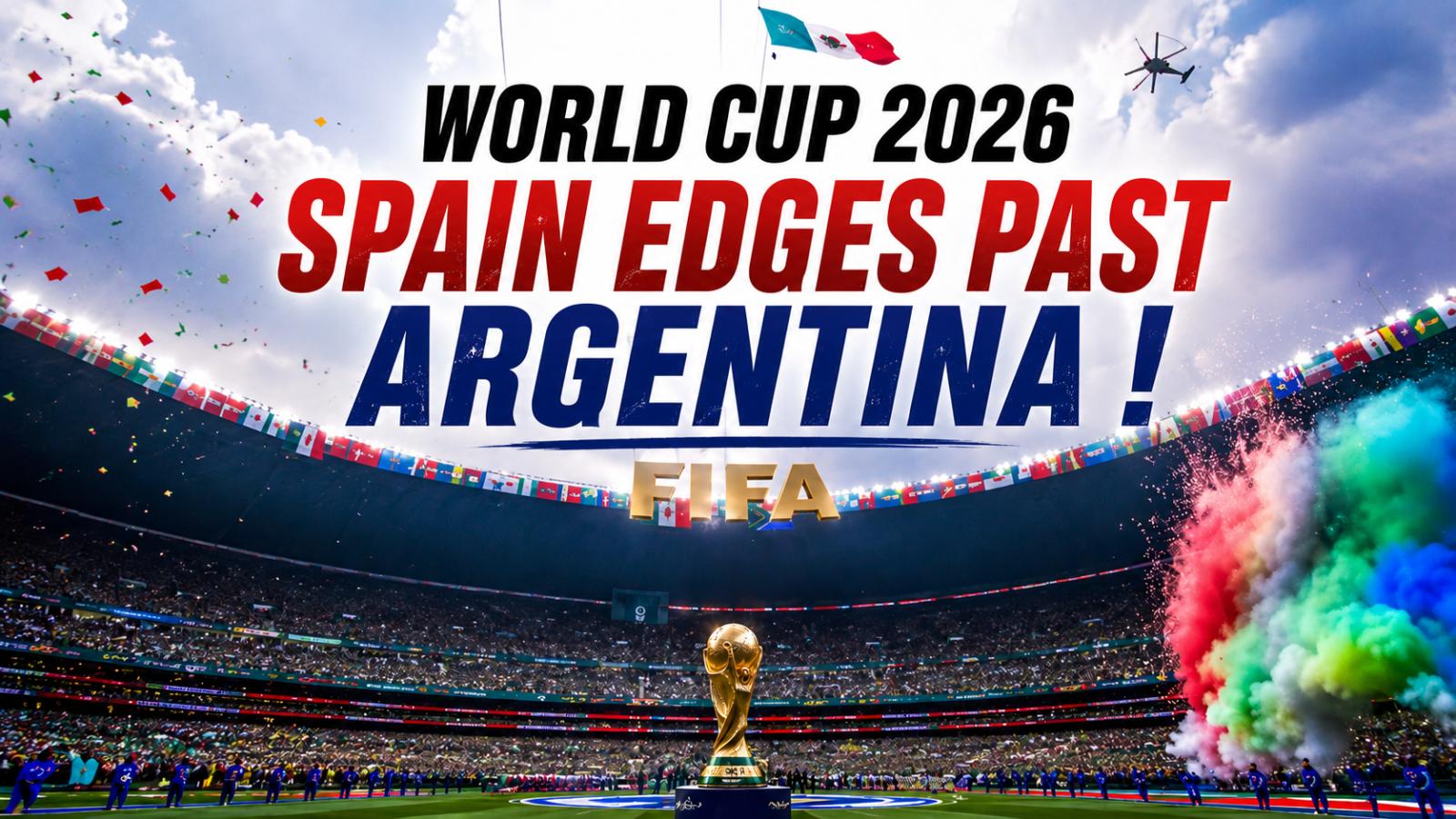
Lionel Messi’s final World Cup appearance ended in heartbreak as Spain defeated Argentina 1-0 after extra time. Ferran Torres scored the winner, but the night belonged equally to Messi’s farewell and the closing of an extraordinary football era.
Lionel Messi final World Cup ends in heartbreak
Football spent almost two decades learning that Lionel Messi could make the impossible appear routine. Defenders vanished behind feints, narrow passing lanes suddenly opened, and matches that appeared lost often became defining chapters in his career.
That history gave Argentina hope when Messi walked onto the field for another FIFA World Cup final. However, Spain delivered a reminder that even the greatest player cannot control every ending.
Spain defeated Argentina 1-0 after extra time at New York New Jersey Stadium, with Ferran Torres scoring the decisive goal in the 106th minute. The victory gave Spain its second men’s World Cup title and ended Argentina’s attempt to defend the trophy won in Qatar.
For Messi, the result likely closed a World Cup journey that began as an 18-year-old in Germany in 2006. At 39, he left the tournament not as a player still searching for validation, but as an icon whose place in football history had already been secured.
Spain beats Argentina through control and patience
Spain did not defeat Messi by chasing him across the field. Luis de la Fuente’s team restricted the spaces he normally uses to influence matches.
Rodri protected the area between midfield and defence, while Spain’s surrounding players quickly closed passing routes toward Julián Álvarez and Argentina’s attacking midfielders. Messi increasingly collected the ball in deeper positions, farther from the areas where he could threaten Spain’s goal.
The approach lacked dramatic tackles or constant physical confrontation. Instead, Spain controlled territory, maintained its structure and forced Argentina to attack through crowded areas.
The final remained goalless after 90 minutes before Torres struck early in the second period of extra time. Argentina pushed for an equaliser, but Spain protected its advantage and completed a tournament in which its organisation proved as important as its technical quality.
Messi 2026 legacy strengthened despite defeat
It would be easy to describe the final as proof that Messi had become too old for the highest level. His performances across the tournament suggest otherwise.
Before the final, Messi had recorded eight goals and four assists, giving him 12 direct goal contributions. FIFA statistics also showed that he entered the match among the tournament leaders for goals, assists, shots and chances created.
What changed against Spain was not simply Messi’s age. He faced an opponent capable of limiting his time, space and passing options for long periods. The ideas remained visible, but Spain prevented him from executing them consistently.
Defeat therefore does not diminish his campaign. Reaching another World Cup final and remaining decisive at 39 strengthened his reputation for longevity and adaptability.
Read more on: BTS FIFA World Cup halftime show
Spain World Cup victory signals a new era
The final also offered an unavoidable image of football’s changing generations. Messi represented the defining player of the previous two decades, while Lamine Yamal and Spain’s younger players represented the sport’s future.
No player directly replaces Messi. However, every generation eventually hands the game to the next. Spain’s victory symbolised that transition without erasing what came before it.
Argentina must now prepare for life without automatically building every tactical decision around its No. 10. Replacing Messi will involve more than finding another scorer or creator. The national team must replace the calm, authority and belief he supplied during difficult moments.
Spain, meanwhile, leaves the tournament with the trophy and several major individual honours. FIFA awarded Rodri the Golden Ball, Unai Simón the Golden Glove and Pau Cubarsí the Young Player Award.
Readers can also explore the complete 2026 FIFA World Cup awards list and previous coverage of the Argentina versus Spain final.
Messi’s World Cup career may have ended without one last celebration. Yet the defeat cannot alter the larger story. He won the trophy in 2022, influenced several generations and returned four years later to make another World Cup revolve around him.
Spain won the final. Time may have closed the chapter. Messi’s legacy remains untouched.