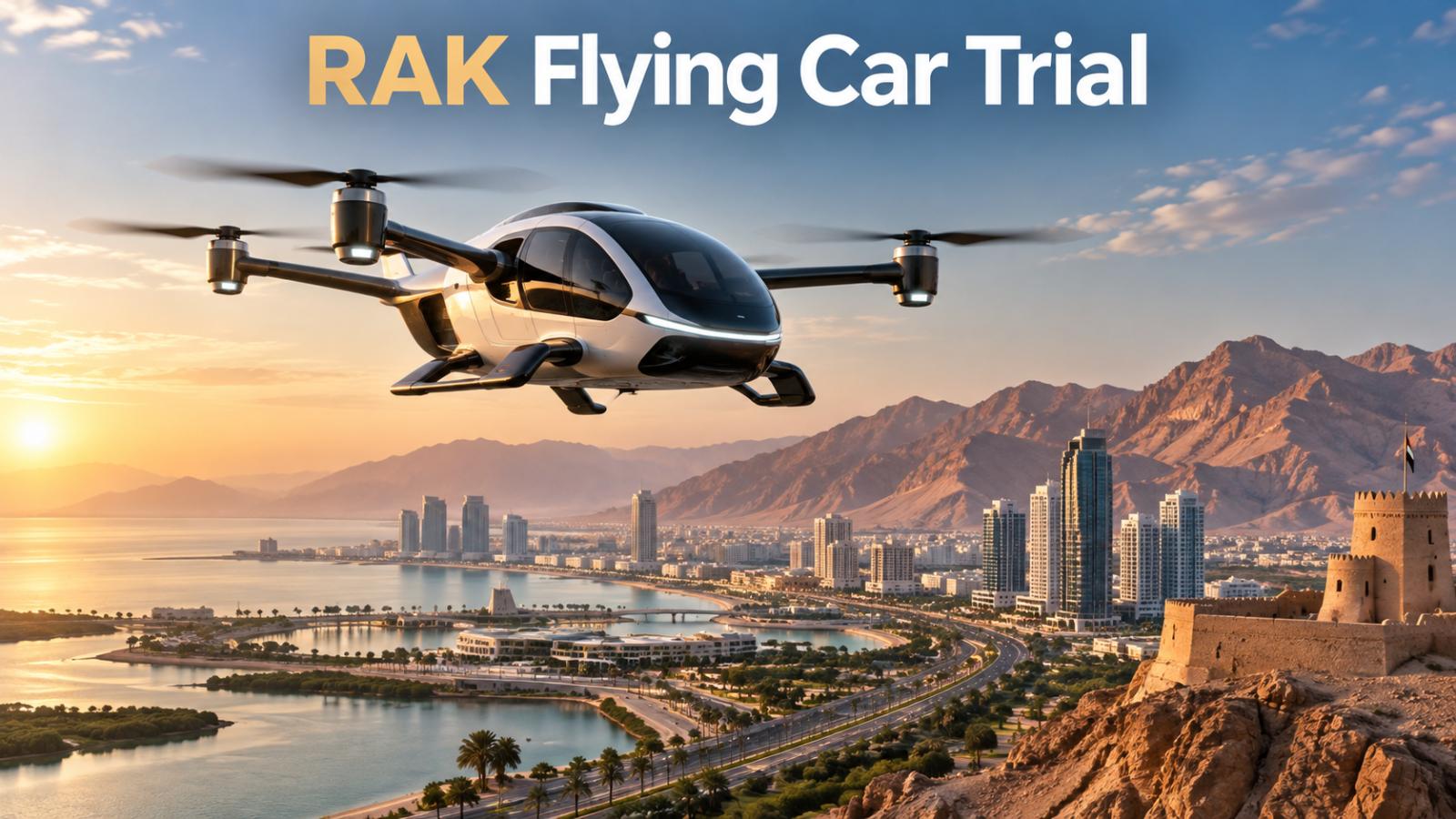
Ras Al Khaimah is accelerating plans for next-generation transport through a RAK flying car test partnership with Chinese advanced air mobility company Aridge. The initiative brings together RAKTA, aviation authorities and emerging eVTOL technology as the emirate explores safer, regulated low-altitude transport.
Aridge test moves flying cars toward operational trials
The Ras Al Khaimah Transport Authority and Ras Al Khaimah Department of Civil Aviation have signed a cooperation agreement with Aridge, an advanced air mobility company affiliated with XPeng, to develop, test and implement new aviation solutions in the emirate.
Sheikh Saud bin Saqr Al Qasimi, UAE Supreme Council Member and Ruler of Ras Al Khaimah, witnessed the agreement. According to the Ras Al Khaimah Government Media Office, Aridge will become the founding partner of the emirate’s advanced air mobility testing hub and establish an operational presence with aircraft and a specialised team.
RAK air testing will focus on safety and operations
The programme is designed to move beyond basic demonstrations toward structured validation and operational trials. Aircraft performance, airspace requirements, flight procedures and safety standards are expected to be tested in phases before any broader commercial deployment is considered.
The UAE General Civil Aviation Authority already identifies advanced air mobility and emerging technologies as an area where operational safety data can help shape future regulations and increasing levels of automation.
The latest agreement also builds on earlier cooperation with XPeng AeroHT. Ras Al Khaimah hosted a flying-vehicle test in 2025, and the new arrangement expands that work into a more permanent testing environment.
UAE sandbox creates controlled testing environment
A regulatory sandbox allows emerging technologies to operate under defined rules and regulatory supervision before permanent regulations are introduced. The UAE government describes such sandboxes as controlled environments where authorities can evaluate innovations, gather evidence and determine whether existing regulations need to change.
For flying vehicles, this approach could help authorities study navigation, airspace coordination, ground handling, emergency procedures and passenger safety without immediately opening the technology to widespread commercial use.
Abu Dhabi route could test inter-emirate travel
Plans associated with the initiative also include a demonstration route between Abu Dhabi and Ras Al Khaimah. The proposed corridor would examine flight planning, airspace coordination, passenger handling and ground support needed for possible future inter-emirate air mobility services.
The demonstration would be a test rather than the launch of a commercial passenger service. Any regular air taxi or flying-car operation would still depend on regulatory approvals, aircraft readiness, infrastructure and proven safety performance.
Mobility project targets wider transport applications
Aridge’s Land Aircraft Carrier combines a ground vehicle with a detachable electric vertical take-off and landing aircraft. The company describes the aircraft as an electric six-rotor vehicle designed as part of a modular flying-car system.
Ras Al Khaimah officials say advanced air mobility could eventually support transport, tourism, logistics and emergency response. The more immediate goal, however, is to establish whether the technology can operate safely and reliably within the UAE’s existing aviation system before moving toward wider deployment.