

















#aircraftcarriers
USS Gerald R. Ford Set to Leave Middle East After Record Deployment
The USS Gerald R. Ford, the US Navy’s newest aircraft carrier, is preparing to leave the Middle East after completing a record 309-day deployment, marking the longest continuous mission for a modern American carrier. The vessel is expected to return to its home port at Naval Station Norfolk, Virginia, around mid-May, concluding an extended operational period that has drawn attention from lawmakers and defense officials. The decision to bring the USS Ford back follows a demanding d
USS Gerald R. Ford Set to Leave Middle East After Record Deployment
The USS Gerald R. Ford, the US Navy’s newest aircraft carrier, is preparing to leave the Middle East after completing a record 309-day deployment, marking the longest continuous mission for a modern American carrier. The vessel is expected to return to its home port at Naval Station Norfolk, Virginia, around mid-May, concluding an extended operational period that has drawn attention from lawmakers and defense officials. The decision to bring the USS Ford back follows a demanding d
US deploys three aircraft carriers to Middle East amid Iran tensions
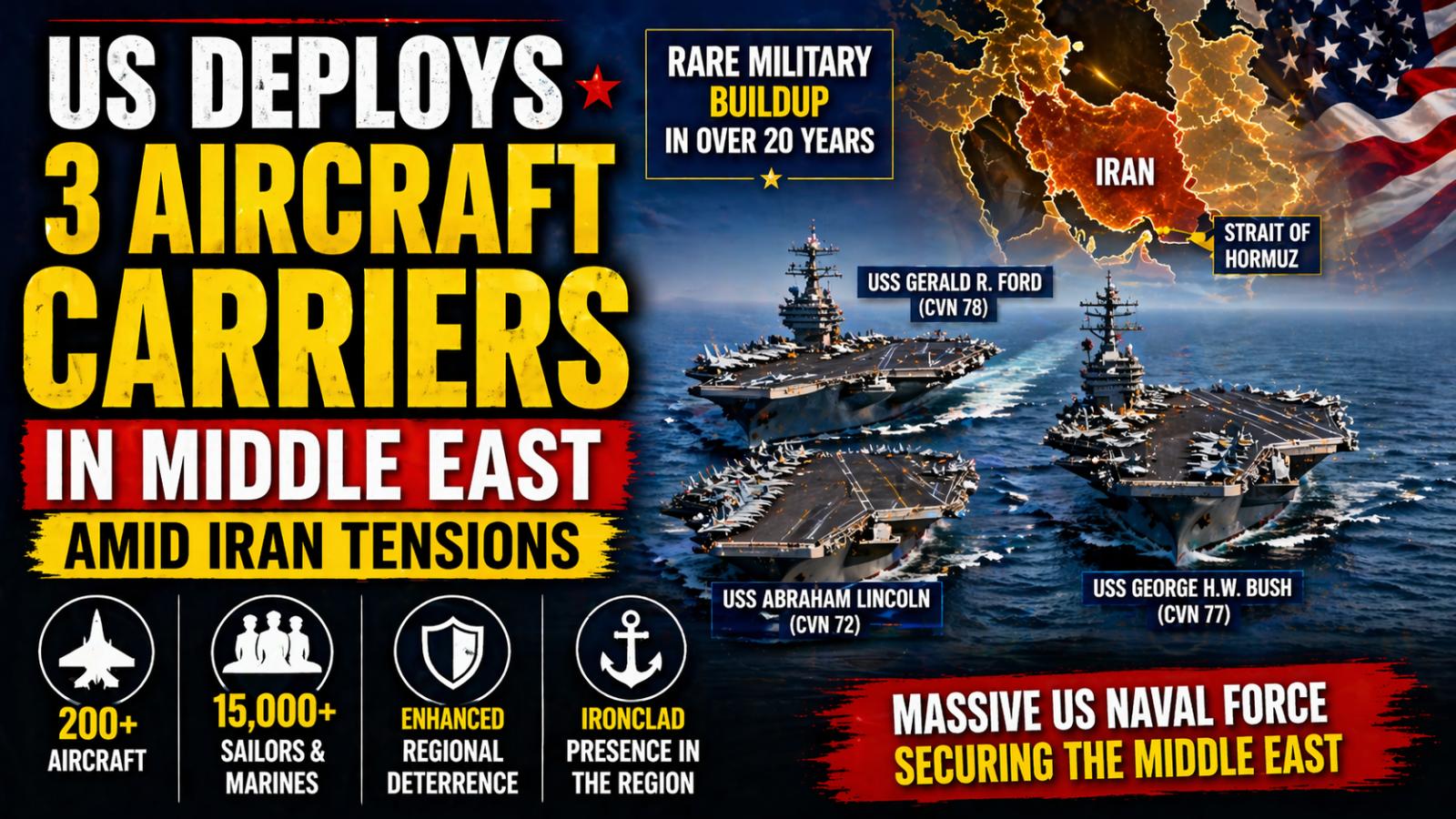
US deploys three aircraft carriers to the Middle East amid Iran tensions, expanding naval operations and reinforcing security in key maritime routes including the Strait of Hormuz. US deploys three aircraft carriers to Middle East amid Iran tensions as Washington significantly expands its military footprint across the region, marking one of the largest naval concentrations in more than two decades. Officials confirmed that three carrier strike groups—the USS Abraham Lincoln, USS Gerald R. Ford, and USS George H.W. Bush—are operating simultaneously, supported by more than 200 aircraft and approximately 15,000 sailors and Marines. A statement from US Central Command on Thursday confirmed the rare deployment, describing it as a significant concentration of naval power aimed at maintaining operational readiness amid rising tensions involving Iran. The carrier groups and their air wings are conducting coordinated missions, underscoring the strategic importance of key maritime routes in the Middle East and reinforcing a broader posture of deterrence. The announcement coincided with remarks from Donald Trump on Thursday, who declined to provide a timeline for a potential resolution to the Iran conflict. He indicated that any agreement would depend on conditions favorable to US interests, highlighting ongoing uncertainty surrounding diplomatic efforts. The absence of a clear timeline has aligned with increased military activity and messaging focused on regional stability. Defense officials stated on Friday that the US blockade of Iranian vessels in the Strait of Hormuz remains “ironclad,” with additional naval assets expected to join the operation in the coming days. The expanding mission signals a broader enforcement effort in one of the world’s most critical shipping corridors. The USS George H.W. Bush, commissioned in 2009, is among the newest Nimitz-class carriers involved, measuring nearly 1,000 feet in length and powered by two nuclear reactors, with the capacity to carry more than 80 aircraft and support a crew exceeding 5,500 personnel.
US deploys three aircraft carriers to Middle East amid Iran tensions
US deploys three aircraft carriers to the Middle East amid Iran tensions, expanding naval operations and reinforcing security in key maritime routes including the Strait of Hormuz. US deploys three aircraft carriers to Middle East amid Iran tensions as Washington significantly expands its military footprint across the region, marking one of the largest naval concentrations in more than two decades. Officials confirmed that three carrier strike groups—the USS Abraham Lincoln, USS Gerald R. Ford, and USS George H.W. Bush—are operating simultaneously, supported by more than 200 aircraft and approximately 15,000 sailors and Marines. A statement from US Central Command on Thursday confirmed the rare deployment, describing it as a significant concentration of naval power aimed at maintaining operational readiness amid rising tensions involving Iran. The carrier groups and their air wings are conducting coordinated missions, underscoring the strategic importance of key maritime routes in the Middle East and reinforcing a broader posture of deterrence. The announcement coincided with remarks from Donald Trump on Thursday, who declined to provide a timeline for a potential resolution to the Iran conflict. He indicated that any agreement would depend on conditions favorable to US interests, highlighting ongoing uncertainty surrounding diplomatic efforts. The absence of a clear timeline has aligned with increased military activity and messaging focused on regional stability. Defense officials stated on Friday that the US blockade of Iranian vessels in the Strait of Hormuz remains “ironclad,” with additional naval assets expected to join the operation in the coming days. The expanding mission signals a broader enforcement effort in one of the world’s most critical shipping corridors. The USS George H.W. Bush, commissioned in 2009, is among the newest Nimitz-class carriers involved, measuring nearly 1,000 feet in length and powered by two nuclear reactors, with the capacity to carry more than 80 aircraft and support a crew exceeding 5,500 personnel.
US Deploys Third Aircraft Carrier as Trump Signals No Urgency for Iran Deal
US President Donald Trump has dismissed speculation that Washington is under pressure to secure a deal with Iran, stating that the United States is in no rush to negotiate amid ongoing tensions. In a recent statement, Trump emphasized that while the US has the flexibility to wait, Iran faces increasing urgency as conditions evolve. He asserted that recent developments have significantly weakened Iran’s military capabilities, pointing to setbacks across its naval and air forces as well as the degradation of its defense systems. Trump also highlighted what he described as a tightening blockade, suggesting that the strategic balance currently favors the United States and its allies. He reiterated that any agreement would only move forward if it aligns with American interests and broader global stability, rejecting claims that his administration is eager to conclude talks quickly. At the same time, the US military has reinforced its presence in the region. United States Central Command confirmed the arrival of a third aircraft carrier, the USS George H.W. Bush, into its operational zone. The carrier is currently positioned in the Indian Ocean, joining the USS Abraham Lincoln in the Arabian Sea and the USS Gerald R. Ford in the Red Sea. The deployment marks a notable expansion of US naval strength in the Middle East during a fragile ceasefire period. The USS George H.W. Bush followed an unusual route, traveling around the Horn of Africa before entering the region, underscoring the strategic importance of its positioning. These developments reflect a continued emphasis on military readiness while diplomatic uncertainty persists, with Washington signaling that timing and terms of any agreement will remain firmly under its control.
US Deploys Third Aircraft Carrier as Trump Signals No Urgency for Iran Deal
US President Donald Trump has dismissed speculation that Washington is under pressure to secure a deal with Iran, stating that the United States is in no rush to negotiate amid ongoing tensions. In a recent statement, Trump emphasized that while the US has the flexibility to wait, Iran faces increasing urgency as conditions evolve. He asserted that recent developments have significantly weakened Iran’s military capabilities, pointing to setbacks across its naval and air forces as well as the degradation of its defense systems. Trump also highlighted what he described as a tightening blockade, suggesting that the strategic balance currently favors the United States and its allies. He reiterated that any agreement would only move forward if it aligns with American interests and broader global stability, rejecting claims that his administration is eager to conclude talks quickly. At the same time, the US military has reinforced its presence in the region. United States Central Command confirmed the arrival of a third aircraft carrier, the USS George H.W. Bush, into its operational zone. The carrier is currently positioned in the Indian Ocean, joining the USS Abraham Lincoln in the Arabian Sea and the USS Gerald R. Ford in the Red Sea. The deployment marks a notable expansion of US naval strength in the Middle East during a fragile ceasefire period. The USS George H.W. Bush followed an unusual route, traveling around the Horn of Africa before entering the region, underscoring the strategic importance of its positioning. These developments reflect a continued emphasis on military readiness while diplomatic uncertainty persists, with Washington signaling that timing and terms of any agreement will remain firmly under its control.
US fighter jet downs Iranian drone near aircraft carrier in Arabian Sea
A United States Navy fighter jet shot down an Iranian drone after it approached an American aircraft carrier operating in the Arabian Sea, according to US Central Command, marking the latest escalation in a period of heightened military tensions across the Middle East. The incident occurred as the unmanned aircraft moved toward the USS Abraham Lincoln with what officials described as unclear intent, despite attempts by US forces to deter it. Military authorities said the drone “ag
US fighter jet downs Iranian drone near aircraft carrier in Arabian Sea
A United States Navy fighter jet shot down an Iranian drone after it approached an American aircraft carrier operating in the Arabian Sea, according to US Central Command, marking the latest escalation in a period of heightened military tensions across the Middle East. The incident occurred as the unmanned aircraft moved toward the USS Abraham Lincoln with what officials described as unclear intent, despite attempts by US forces to deter it. Military authorities said the drone “ag
USS Abraham Lincoln arrives in Middle East as US boosts military posture near Iran
The United States has deployed the aircraft carrier USS Abraham Lincoln and its accompanying warships to the Middle East, a move aimed at reinforcing American military capabilities in a region marked by escalating political and security tensions. The announcement was made on Monday, January 26, by US Central Command, which said the carrier strike group’s presence is intended to support regional security and stability while enhancing both offensive and defensive readiness. Accordin
USS Abraham Lincoln arrives in Middle East as US boosts military posture near Iran
The United States has deployed the aircraft carrier USS Abraham Lincoln and its accompanying warships to the Middle East, a move aimed at reinforcing American military capabilities in a region marked by escalating political and security tensions. The announcement was made on Monday, January 26, by US Central Command, which said the carrier strike group’s presence is intended to support regional security and stability while enhancing both offensive and defensive readiness. Accordin


