#digitaltrade
US-India Trade Talks Advance as Greer Highlights AI Cooperation
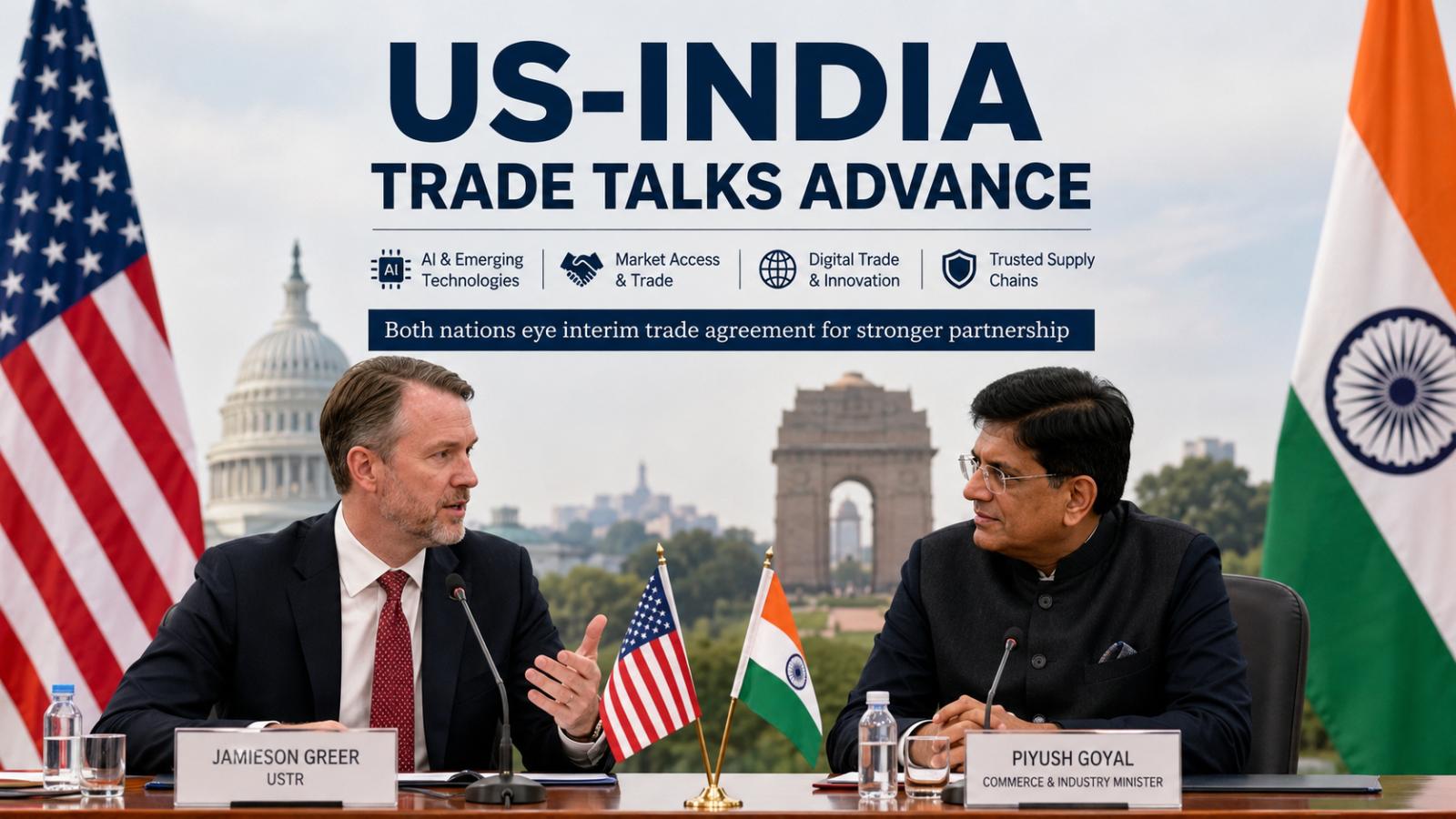
The United States and India reported substantial progress on Wednesday, June 24, 2026, toward an interim bilateral trade agreement, as U.S. Trade Representative Jamieson Greer highlighted artificial intelligence and emerging technologies as growing areas of cooperation. Greer visited New Delhi from Monday, June 22, through Wednesday, June 24, 2026, and held multiple rounds of talks with Indian Commerce and Industry Minister Piyush Goyal. US-India Trade Talks Focus
US-India Trade Talks Advance as Greer Highlights AI Cooperation
The United States and India reported substantial progress on Wednesday, June 24, 2026, toward an interim bilateral trade agreement, as U.S. Trade Representative Jamieson Greer highlighted artificial intelligence and emerging technologies as growing areas of cooperation. Greer visited New Delhi from Monday, June 22, through Wednesday, June 24, 2026, and held multiple rounds of talks with Indian Commerce and Industry Minister Piyush Goyal. US-India Trade Talks Focus
US signals India trade agreement close after key talks
India and the United States are edging closer to a structured trade agreement after fresh negotiations indicated reduced gaps on several contentious issues. US officials described the discussions as the most constructive phase so far, suggesting that a framework deal is now within reach, even though final clearance is still pending. The talks are part of a broader effort to establish a long-term Bilateral Trade Agreement aimed at improving market access, easing tariff friction, and stabilizing supply chain cooperation between the two economies. Tariff reduction and market access remain central issues At the core of the negotiations are tariff structures and access to each other’s markets. The United States is pushing for wider entry for industrial and agricultural goods, while India is focused on protecting sensitive domestic sectors while expanding export opportunities in technology, textiles, and pharmaceuticals. Both sides are trying to balance domestic political pressures with the need to expand bilateral trade volumes, which currently remain below their long-term potential despite strong economic ties. Digital trade and pharmaceutical rules under review A significant portion of the discussion is now centered on digital trade regulations and pharmaceutical standards. The US is seeking clearer digital data flow rules and stronger intellectual property protections, while India is prioritizing flexibility for its growing digital economy and affordable healthcare exports. Pharmaceutical trade remains a key pillar, with India seeking smoother regulatory pathways for generic drug exports, while the US is focusing on compliance and quality standard alignment. Strategic economic alignment driving urgency The urgency behind the negotiations is being shaped by global supply chain realignment and geopolitical competition. Both countries are increasingly aligning their trade policies within the Indo-Pacific framework, with an emphasis on reducing dependency on concentrated manufacturing hubs. India is positioning itself as an alternative global manufacturing base, while the US is looking to diversify sourcing and strengthen resilient supply networks. Next phase depends on unresolved policy gaps Despite visible progress, the agreement is not finalized. Several policy differences still need resolution, particularly around tariff ceilings, digital governance, and sector-specific protections. Officials from both sides are expected to continue technical-level discussions before moving toward a formalized trade framework. A final agreement timeline has not been confirmed, but momentum suggests continued acceleration in the coming months.
US signals India trade agreement close after key talks
India and the United States are edging closer to a structured trade agreement after fresh negotiations indicated reduced gaps on several contentious issues. US officials described the discussions as the most constructive phase so far, suggesting that a framework deal is now within reach, even though final clearance is still pending. The talks are part of a broader effort to establish a long-term Bilateral Trade Agreement aimed at improving market access, easing tariff friction, and stabilizing supply chain cooperation between the two economies. Tariff reduction and market access remain central issues At the core of the negotiations are tariff structures and access to each other’s markets. The United States is pushing for wider entry for industrial and agricultural goods, while India is focused on protecting sensitive domestic sectors while expanding export opportunities in technology, textiles, and pharmaceuticals. Both sides are trying to balance domestic political pressures with the need to expand bilateral trade volumes, which currently remain below their long-term potential despite strong economic ties. Digital trade and pharmaceutical rules under review A significant portion of the discussion is now centered on digital trade regulations and pharmaceutical standards. The US is seeking clearer digital data flow rules and stronger intellectual property protections, while India is prioritizing flexibility for its growing digital economy and affordable healthcare exports. Pharmaceutical trade remains a key pillar, with India seeking smoother regulatory pathways for generic drug exports, while the US is focusing on compliance and quality standard alignment. Strategic economic alignment driving urgency The urgency behind the negotiations is being shaped by global supply chain realignment and geopolitical competition. Both countries are increasingly aligning their trade policies within the Indo-Pacific framework, with an emphasis on reducing dependency on concentrated manufacturing hubs. India is positioning itself as an alternative global manufacturing base, while the US is looking to diversify sourcing and strengthen resilient supply networks. Next phase depends on unresolved policy gaps Despite visible progress, the agreement is not finalized. Several policy differences still need resolution, particularly around tariff ceilings, digital governance, and sector-specific protections. Officials from both sides are expected to continue technical-level discussions before moving toward a formalized trade framework. A final agreement timeline has not been confirmed, but momentum suggests continued acceleration in the coming months.