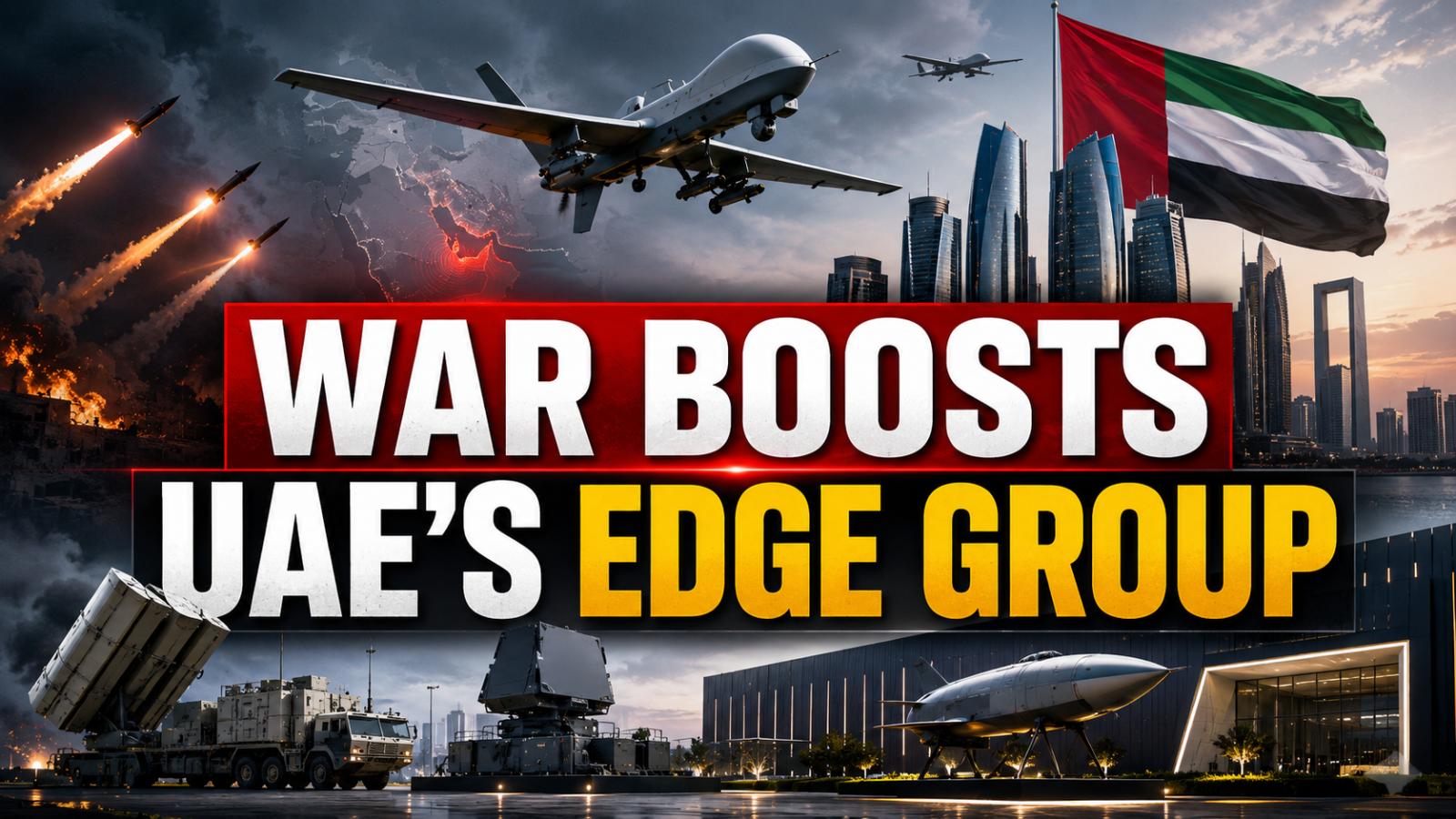
The six-month US-Iran conflict has unexpectedly strengthened the commercial position of the UAE’s EDGE Group, giving domestically developed defence systems real combat exposure. Company executives say the “battle-proven” status of drones, jammers and other equipment is now helping UAE EDGE defence growth and attracting greater international interest.
Battle-Proven EDGE Weapons
During the conflict, nearly 3,000 missiles and drones reportedly targeted the UAE, putting the country’s air-defence network under sustained pressure. EDGE executives cited in the source material said the fighting provided something the company previously lacked at scale: direct battlefield validation.
Khaled Al Zaabi, president of EDGE’s Platforms and Systems cluster, said only a limited number of products could be described as battle-proven before the war. He said that number has now increased significantly, giving the company a stronger selling point when competing for international defence contracts.
That matters in an industry where buyers often place a premium on systems that have already operated under real combat conditions rather than laboratory or demonstration environments.
UAE Drone Defence
The war also highlighted the economics of air defence. The UAE has invested billions of dollars in advanced American systems including Patriot and THAAD, but officials are increasingly focusing on cheaper ways to counter low-cost drones.
EDGE executives said locally produced electronic warfare and counter-drone technologies played an important role during the conflict. Company chairman Faisal Al Bannai said locally developed jammers achieved an interception rate of about 85% against incoming drones, according to the source material.
The broader challenge is cost. Using an expensive interceptor missile against every low-cost attack drone can become financially unsustainable during prolonged conflicts. EDGE is therefore positioning lower-cost drones, jammers and short-range systems as complementary layers of defence.
SkyKnight Air Defence
One of EDGE’s important locally developed systems is SkyKnight, a short-range air-defence platform designed to counter rockets, artillery, mortars, drones, cruise missiles and other aerial threats.
EDGE says the system can protect infrastructure, military bases, ports and urban areas, with missile interception ranges reaching up to 10 kilometres against several categories of aerial targets.
Developing more air-defence capability domestically would also reduce reliance on foreign suppliers while allowing the UAE to respond faster to evolving regional threats.
EDGE Global Expansion
EDGE, founded in 2019, has expanded rapidly across missiles, drones, armoured vehicles, naval systems and advanced technologies. The source material says international sales accounted for about 70% of the group’s roughly $5 billion in revenue last year.
Europe has become a major target for further growth. EDGE officially launched EDGE Europe in June 2026 and established its European headquarters in Paris, alongside plans for engineering and manufacturing operations in France.
The move places the Emirati group closer to NATO and European buyers at a time when defence budgets across the continent are rising.
Defence Export Ambitions
EDGE is also investing in production capacity at home, including facilities for components used in autonomous systems, while expanding partnerships and acquisitions abroad.
Its long-term ambition is to become one of the world’s top 10 defence contractors. The US-Iran conflict may have accelerated that strategy by giving its systems battlefield credibility that marketing campaigns cannot easily replicate.
The opportunity is significant, but so is the scrutiny. EDGE has faced allegations concerning the possible appearance of UAE-linked equipment in other conflicts, claims the company and UAE authorities have denied.
For now, the clearest commercial outcome is that prolonged regional warfare has turned operational experience into a valuable export advantage. If EDGE can convert that battlefield validation into sustained contracts, the conflict may prove to be a major turning point in the UAE’s push to become a globally competitive defence manufacturing hub.
The six-month US-Iran conflict has unexpectedly strengthened the commercial position of the UAE’s EDGE Group, giving domestically developed defence systems real combat exposure. Company executives say the “battle-proven” status of drones, jammers and other equipment is now helping UAE EDGE defence growth and attracting greater international interest.
Battle-Proven EDGE Weapons
During the conflict, nearly 3,000 missiles and drones reportedly targeted the UAE, putting the country’s air-defence network under sustained pressure. EDGE executives cited in the source material said the fighting provided something the company previously lacked at scale: direct battlefield validation.
Khaled Al Zaabi, president of EDGE’s Platforms and Systems cluster, said only a limited number of products could be described as battle-proven before the war. He said that number has now increased significantly, giving the company a stronger selling point when competing for international defence contracts.
That matters in an industry where buyers often place a premium on systems that have already operated under real combat conditions rather than laboratory or demonstration environments.
UAE Drone Defence
The war also highlighted the economics of air defence. The UAE has invested billions of dollars in advanced American systems including Patriot and THAAD, but officials are increasingly focusing on cheaper ways to counter low-cost drones.
EDGE executives said locally produced electronic warfare and counter-drone technologies played an important role during the conflict. Company chairman Faisal Al Bannai said locally developed jammers achieved an interception rate of about 85% against incoming drones, according to the source material.
The broader challenge is cost. Using an expensive interceptor missile against every low-cost attack drone can become financially unsustainable during prolonged conflicts. EDGE is therefore positioning lower-cost drones, jammers and short-range systems as complementary layers of defence.
SkyKnight Air Defence
One of EDGE’s important locally developed systems is SkyKnight, a short-range air-defence platform designed to counter rockets, artillery, mortars, drones, cruise missiles and other aerial threats.
EDGE says the system can protect infrastructure, military bases, ports and urban areas, with missile interception ranges reaching up to 10 kilometres against several categories of aerial targets.
Developing more air-defence capability domestically would also reduce reliance on foreign suppliers while allowing the UAE to respond faster to evolving regional threats.
EDGE Global Expansion
EDGE, founded in 2019, has expanded rapidly across missiles, drones, armoured vehicles, naval systems and advanced technologies. The source material says international sales accounted for about 70% of the group’s roughly $5 billion in revenue last year.
Europe has become a major target for further growth. EDGE officially launched EDGE Europe in June 2026 and established its European headquarters in Paris, alongside plans for engineering and manufacturing operations in France.
The move places the Emirati group closer to NATO and European buyers at a time when defence budgets across the continent are rising.
Defence Export Ambitions
EDGE is also investing in production capacity at home, including facilities for components used in autonomous systems, while expanding partnerships and acquisitions abroad.
Its long-term ambition is to become one of the world’s top 10 defence contractors. The US-Iran conflict may have accelerated that strategy by giving its systems battlefield credibility that marketing campaigns cannot easily replicate.
The opportunity is significant, but so is the scrutiny. EDGE has faced allegations concerning the possible appearance of UAE-linked equipment in other conflicts, claims the company and UAE authorities have denied.
For now, the clearest commercial outcome is that prolonged regional warfare has turned operational experience into a valuable export advantage. If EDGE can convert that battlefield validation into sustained contracts, the conflict may prove to be a major turning point in the UAE’s push to become a globally competitive defence manufacturing hub.