






















#healthcareaccess
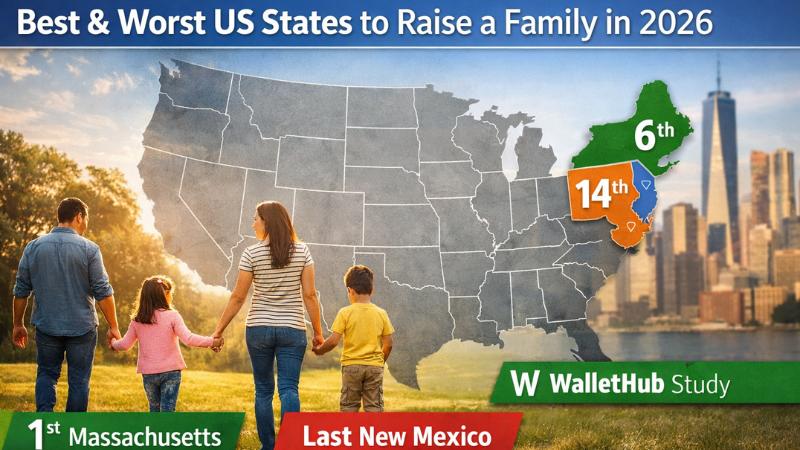
New Jersey ranks 14th among US states to raise a family in 2026 study
A new national study has identified the best and worst US states to raise a family in 2026, providing insight into how states compare on factors that matter most to households with children. The analysis, released by WalletHub, evaluated all 50 states using a broad set of indicators, including affordability, safety, job opportunities, education quality, health care access and recreational options. New Jersey ranked 14th overall in the study, placing it solidly in the upper half nationwide but trailing several nearby states. New York earned a sixth-place ranking, while Connecticut followed closely at seventh. Pennsylvania also ranked ahead of New Jersey at 12th, underscoring the strong performance of the Northeast region when it comes to family-related measures. Although its overall position was outside the top 10, New Jersey stood out in several individual categories. The Garden State ranked among the top five US states for median family income, reflecting strong earning potential for households. It also performed well on key family stability and health indicators, including infant mortality rates and divorce rates, both of which were among the nation’s best. At the top of the rankings, Massachusetts claimed first place, driven by consistently high scores in education, economic opportunity and health care. Minnesota and North Dakota followed closely, both benefiting from strong job markets, lower crime rates and accessible public services. In contrast, New Mexico ranked last among US states, facing challenges related to income levels, educational outcomes and health care access. The study offers a data-driven snapshot of how states stack up heading into 2026, serving as a reference point for families considering relocation, policymakers assessing quality-of-life issues and communities working to improve conditions for children and parents alike.
New Jersey ranks 14th among US states to raise a family in 2026 study
A new national study has identified the best and worst US states to raise a family in 2026, providing insight into how states compare on factors that matter most to households with children. The analysis, released by WalletHub, evaluated all 50 states using a broad set of indicators, including affordability, safety, job opportunities, education quality, health care access and recreational options. New Jersey ranked 14th overall in the study, placing it solidly in the upper half nationwide but trailing several nearby states. New York earned a sixth-place ranking, while Connecticut followed closely at seventh. Pennsylvania also ranked ahead of New Jersey at 12th, underscoring the strong performance of the Northeast region when it comes to family-related measures. Although its overall position was outside the top 10, New Jersey stood out in several individual categories. The Garden State ranked among the top five US states for median family income, reflecting strong earning potential for households. It also performed well on key family stability and health indicators, including infant mortality rates and divorce rates, both of which were among the nation’s best. At the top of the rankings, Massachusetts claimed first place, driven by consistently high scores in education, economic opportunity and health care. Minnesota and North Dakota followed closely, both benefiting from strong job markets, lower crime rates and accessible public services. In contrast, New Mexico ranked last among US states, facing challenges related to income levels, educational outcomes and health care access. The study offers a data-driven snapshot of how states stack up heading into 2026, serving as a reference point for families considering relocation, policymakers assessing quality-of-life issues and communities working to improve conditions for children and parents alike.
Dallas Parkland Hospital Celebrates A Decade At State Of The Art Medical Facility
Parkland Hospital in Dallas is marking a major milestone this week as it celebrates ten years since the opening of its modern medical facility in August 2015. The hospital, located directly across from the county’s older hospital that had served the community since 1954, represented a transformative leap forward in health care for Dallas County residents. For Dr. Fred Cerise, the hospital’s CEO, the move symbolized not only a new building but a fund
Dallas Parkland Hospital Celebrates A Decade At State Of The Art Medical Facility
Parkland Hospital in Dallas is marking a major milestone this week as it celebrates ten years since the opening of its modern medical facility in August 2015. The hospital, located directly across from the county’s older hospital that had served the community since 1954, represented a transformative leap forward in health care for Dallas County residents. For Dr. Fred Cerise, the hospital’s CEO, the move symbolized not only a new building but a fund
Planned Parenthood closes 5 NorCal clinics, including Bay Area locations
Planned Parenthood Mar Monte has permanently closed five of its Northern California health centers, including locations in South San Francisco, San Mateo, Gilroy, Westside/Santa Cruz, and Madera. The closures mark a significant loss of health services for thousands of patients in the region. The organization cited recent federal policy changes that restrict funding for clinics providing abortion services, except in limited cases, as the driving force behind the decision. These closures have cut
Planned Parenthood closes 5 NorCal clinics, including Bay Area locations
Planned Parenthood Mar Monte has permanently closed five of its Northern California health centers, including locations in South San Francisco, San Mateo, Gilroy, Westside/Santa Cruz, and Madera. The closures mark a significant loss of health services for thousands of patients in the region. The organization cited recent federal policy changes that restrict funding for clinics providing abortion services, except in limited cases, as the driving force behind the decision. These closures have cut
Elk Grove Village Hospital to End Labor and Delivery Services, Sparking Public Outrage
The community of Elk Grove Village, Illinois, is reeling after the announcement that Ascension Alexian Brothers Hospital will be eliminating its labor and delivery services. The decision, revealed earlier this week, has stirred deep concern and criticism, particularly from former staff members and advocates for equitable maternal health care. According to hospital officials, the services will be consolidated and transferred to a new, centralized labor and delivery center approximately 10 mile
Elk Grove Village Hospital to End Labor and Delivery Services, Sparking Public Outrage
The community of Elk Grove Village, Illinois, is reeling after the announcement that Ascension Alexian Brothers Hospital will be eliminating its labor and delivery services. The decision, revealed earlier this week, has stirred deep concern and criticism, particularly from former staff members and advocates for equitable maternal health care. According to hospital officials, the services will be consolidated and transferred to a new, centralized labor and delivery center approximately 10 mile
Youth under 19 no longer eligible for gender surgeries at Stanford starting June 2025
Stanford Medicine has ended all gender-affirming surgical procedures for patients under 19, effective June 2, 2025. The healthcare provider cited recent federal actions and directives as major factors influencing the decision. Leadership within Stanford’s clinical programs, including its LGBTQ+ care team, participated in reviewing these developments before finalizing the policy change. This move significantly alters access to medical transition services for minors in the region.
Youth under 19 no longer eligible for gender surgeries at Stanford starting June 2025
Stanford Medicine has ended all gender-affirming surgical procedures for patients under 19, effective June 2, 2025. The healthcare provider cited recent federal actions and directives as major factors influencing the decision. Leadership within Stanford’s clinical programs, including its LGBTQ+ care team, participated in reviewing these developments before finalizing the policy change. This move significantly alters access to medical transition services for minors in the region.


