






















#musiceducation
How did Western music begin in Athens? It started with mathematics and philosophy
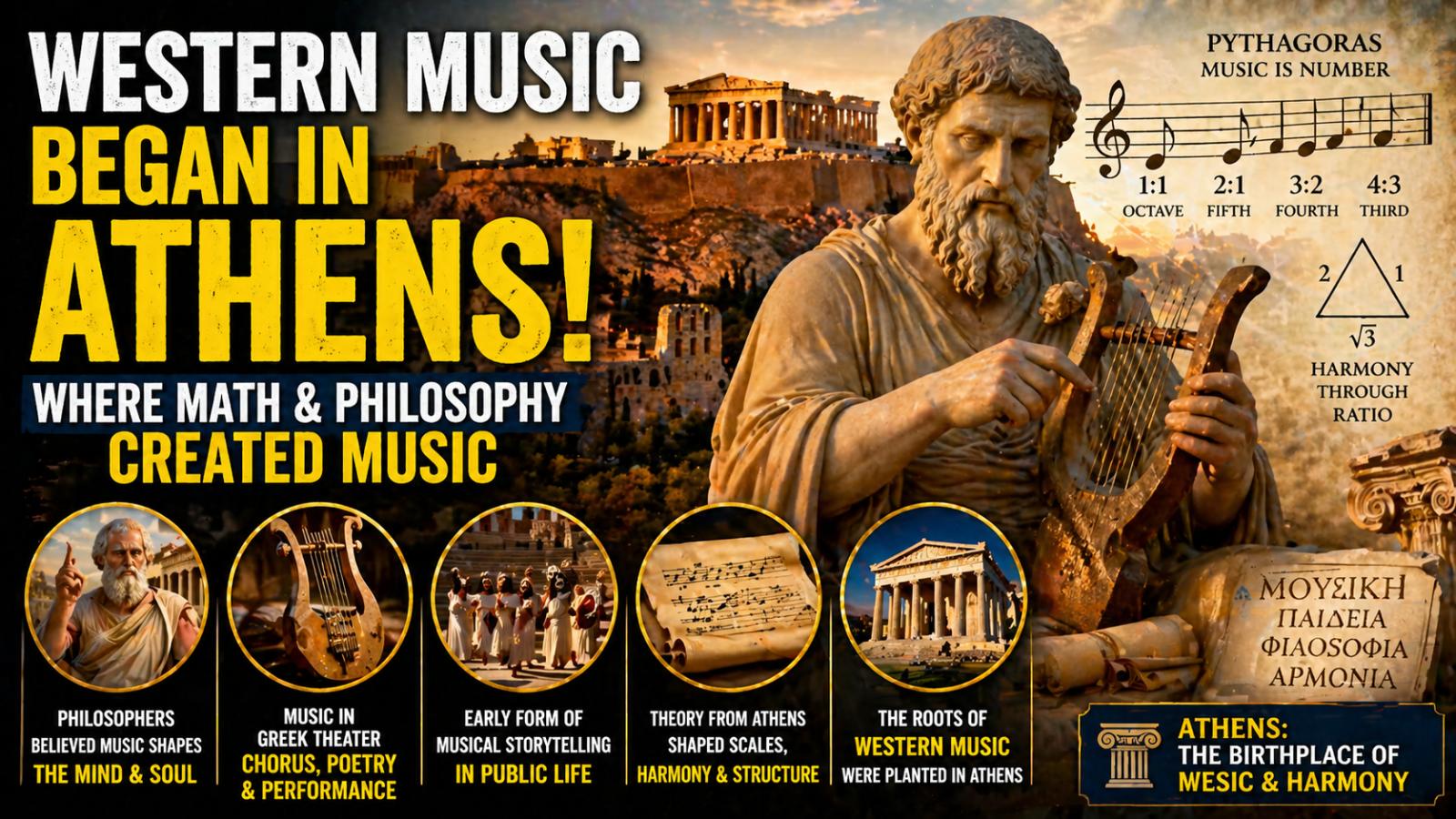
Western music traces back to ancient Athens, where philosophy and mathematics defined sound and structure. In this early period, music was not merely entertainment but an intellectual discipline deeply connected to science and education. The ideas developed in Athens would later influence the foundations of Western music, shaping how sound is understood and organized. Mathematical foundations of musical sound Ancient Greek thinkers explored the relationship between numbers and sound, establishing principles that continue to influence music theory. Pythagoras, a key figure in this development, discovered that harmonious tones could be produced through simple mathematical ratios. By observing vibrating strings, he demonstrated that pitch changes were directly related to numerical relationships, laying the groundwork for structured scales and harmony. Music as part of education and philosophy In Athens, music was considered essential to intellectual and moral development. Philosophers such as Plato argued that music could influence human behavior, emotions, and character. As a result, music education became an integral part of learning, reinforcing the idea that sound had both scientific and psychological significance. Performance traditions in Greek theater Music also played a central role in public life, particularly in theatrical performances. Greek dramas incorporated choruses that combined singing, poetry, and movement to convey stories. These performances represented one of the earliest forms of organized musical storytelling, demonstrating how music functioned as both an artistic and communal experience. Lasting influence on Western musical systems Although ancient Greek compositions have not survived in their original form, the theoretical framework developed in Athens continues to shape Western music. Concepts such as scales, harmony, and structured composition evolved from these early discoveries. The emphasis on mathematical order and philosophical meaning established a foundation that later cultures expanded upon. The legacy of Athens highlights how music evolved from a study of numbers and ideas into a complex artistic system. This transition marks the beginning of a tradition that continues to influence modern music across the world.
How did Western music begin in Athens? It started with mathematics and philosophy
Western music traces back to ancient Athens, where philosophy and mathematics defined sound and structure. In this early period, music was not merely entertainment but an intellectual discipline deeply connected to science and education. The ideas developed in Athens would later influence the foundations of Western music, shaping how sound is understood and organized. Mathematical foundations of musical sound Ancient Greek thinkers explored the relationship between numbers and sound, establishing principles that continue to influence music theory. Pythagoras, a key figure in this development, discovered that harmonious tones could be produced through simple mathematical ratios. By observing vibrating strings, he demonstrated that pitch changes were directly related to numerical relationships, laying the groundwork for structured scales and harmony. Music as part of education and philosophy In Athens, music was considered essential to intellectual and moral development. Philosophers such as Plato argued that music could influence human behavior, emotions, and character. As a result, music education became an integral part of learning, reinforcing the idea that sound had both scientific and psychological significance. Performance traditions in Greek theater Music also played a central role in public life, particularly in theatrical performances. Greek dramas incorporated choruses that combined singing, poetry, and movement to convey stories. These performances represented one of the earliest forms of organized musical storytelling, demonstrating how music functioned as both an artistic and communal experience. Lasting influence on Western musical systems Although ancient Greek compositions have not survived in their original form, the theoretical framework developed in Athens continues to shape Western music. Concepts such as scales, harmony, and structured composition evolved from these early discoveries. The emphasis on mathematical order and philosophical meaning established a foundation that later cultures expanded upon. The legacy of Athens highlights how music evolved from a study of numbers and ideas into a complex artistic system. This transition marks the beginning of a tradition that continues to influence modern music across the world.
Protests Erupt in Dhaka as Yunus Govt Bows to Islamists, Drops Music Teachers from Schools
Massive student and teacher protests erupted across Dhaka University and Jagannath University after the Yunus-led interim government scrapped the posts of music and physical education teachers in public schools. The move came after Islamist organisations like Hefazat-e-Islam and Islami Andolon Bangladesh denounced such subjects as “un-Islamic” and threatened street protests unless the government prioritized religious education. The Ministry of Primary and Mass Education had init
Protests Erupt in Dhaka as Yunus Govt Bows to Islamists, Drops Music Teachers from Schools
Massive student and teacher protests erupted across Dhaka University and Jagannath University after the Yunus-led interim government scrapped the posts of music and physical education teachers in public schools. The move came after Islamist organisations like Hefazat-e-Islam and Islami Andolon Bangladesh denounced such subjects as “un-Islamic” and threatened street protests unless the government prioritized religious education. The Ministry of Primary and Mass Education had init
World Music Day 2025: Celebrating the global language of music on June 21
Every year on June 21, music lovers around the world celebrate World Music Day, a vibrant event that brings people together through the universal language of music. Also known as Fête de la Musique, this global celebration is dedicated to honoring the spirit of music by encouraging participation from amateur and professional musicians alike. Originating in France in 1982, the concept was introduced by then French Minister of Culture, Maurice Fleuret. Th
World Music Day 2025: Celebrating the global language of music on June 21
Every year on June 21, music lovers around the world celebrate World Music Day, a vibrant event that brings people together through the universal language of music. Also known as Fête de la Musique, this global celebration is dedicated to honoring the spirit of music by encouraging participation from amateur and professional musicians alike. Originating in France in 1982, the concept was introduced by then French Minister of Culture, Maurice Fleuret. Th


