




















#northernlights
Northern Lights Dazzle Chicago Skies After Powerful Solar Flare
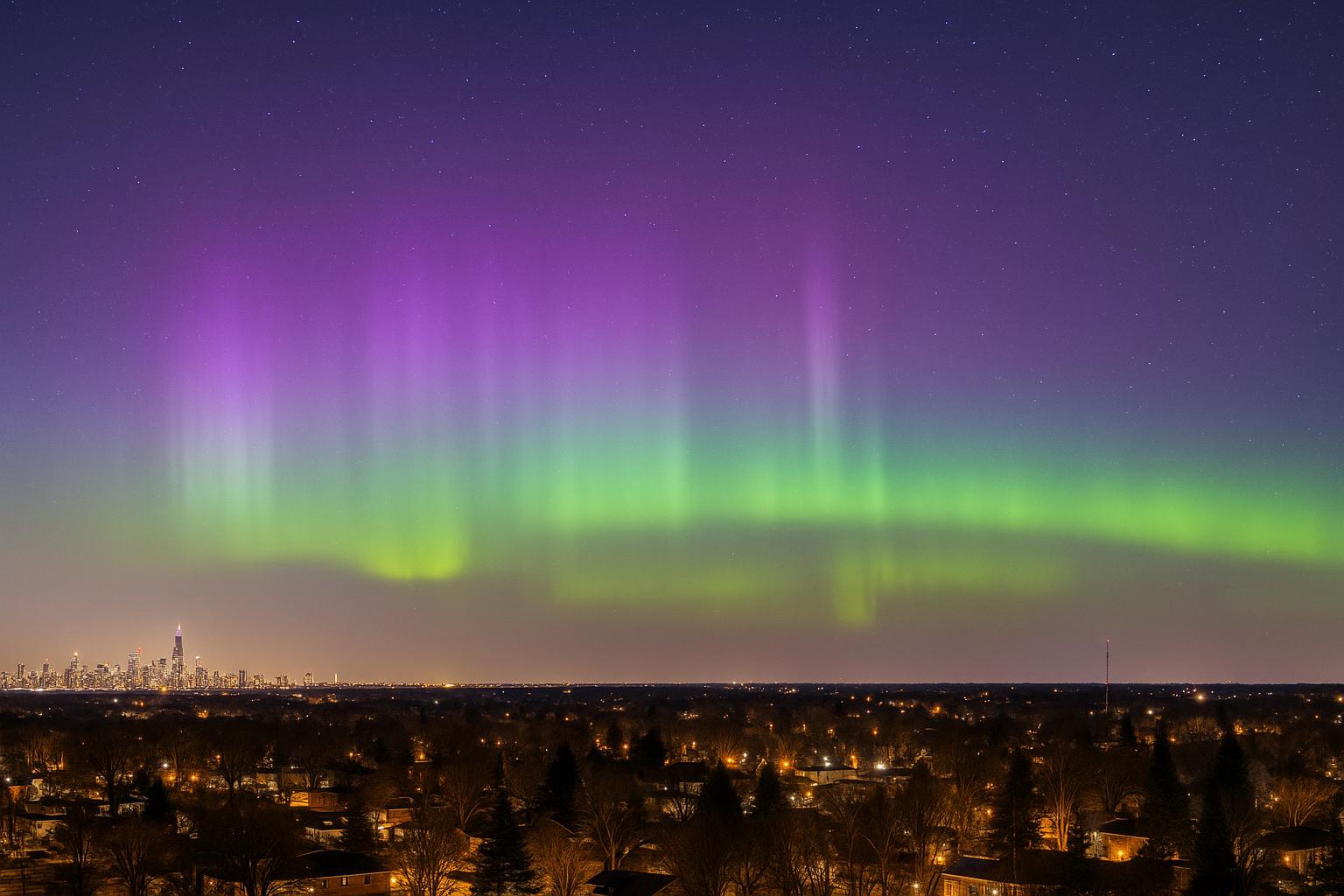
On Tuesday night, residents throughout the Chicago metropolitan area were treated to a rare celestial display as the multi-hued ribbons of the aurora borealis lit up the sky following a powerful solar flare. From the heart of the city to suburban neighbourhoods, witnesses described vivid shades of pink, purple, green and yellow drifting across the horizon, signalling the arrival of an energetic stream of solar particles. Meteorologists and space-weather experts attribute the spectac
Northern Lights Dazzle Chicago Skies After Powerful Solar Flare
On Tuesday night, residents throughout the Chicago metropolitan area were treated to a rare celestial display as the multi-hued ribbons of the aurora borealis lit up the sky following a powerful solar flare. From the heart of the city to suburban neighbourhoods, witnesses described vivid shades of pink, purple, green and yellow drifting across the horizon, signalling the arrival of an energetic stream of solar particles. Meteorologists and space-weather experts attribute the spectac
Geomagnetic storm brings northern lights chance over Chicago skies
A geomagnetic storm that began Monday evening across the Northern Hemisphere has raised the possibility of a rare sight in the skies over Chicago, with the northern lights potentially visible overnight. The storm was triggered by a Coronal Mass Ejection, or CME, that erupted from the sun over the weekend. This burst of solar particles reached Earth near 5 p.m. EDT on Monday, with the first signs detected at the L1 orbital point about one million miles away from Earth by monitoring satellites.
Geomagnetic storm brings northern lights chance over Chicago skies
A geomagnetic storm that began Monday evening across the Northern Hemisphere has raised the possibility of a rare sight in the skies over Chicago, with the northern lights potentially visible overnight. The storm was triggered by a Coronal Mass Ejection, or CME, that erupted from the sun over the weekend. This burst of solar particles reached Earth near 5 p.m. EDT on Monday, with the first signs detected at the L1 orbital point about one million miles away from Earth by monitoring satellites.
Geomagnetic storm from cannibal CME could light up skies across US and Europe
A rare and powerful space weather event is on its way, as a cannibal coronal mass ejection from the sun is forecast to strike Earth late on Monday, September 1, 2025. Scientists warn that this unusual solar explosion could create a strong geomagnetic storm, bringing both dazzling auroras and potential disruptions to satellites, power grids, and communications. The phenomenon began on August 30 when sunspot region AR 41
Geomagnetic storm from cannibal CME could light up skies across US and Europe
A rare and powerful space weather event is on its way, as a cannibal coronal mass ejection from the sun is forecast to strike Earth late on Monday, September 1, 2025. Scientists warn that this unusual solar explosion could create a strong geomagnetic storm, bringing both dazzling auroras and potential disruptions to satellites, power grids, and communications. The phenomenon began on August 30 when sunspot region AR 41
Northern lights may shine over 20 US states tonight due to intense geomagnetic storm
A breathtaking display of northern lights may be visible across parts of the United States tonight, May 31, as space weather experts forecast heightened geomagnetic storm activity that could push auroras much farther south than usual. According to the National Oceanic and Atmospheric Administration, Earth is currently being impacted by high-speed solar wind, which is increasing geomagnetic pressure and fueling storm conditions in Earth’s upper atmosphere—an ideal scenario for auro
Northern lights may shine over 20 US states tonight due to intense geomagnetic storm
A breathtaking display of northern lights may be visible across parts of the United States tonight, May 31, as space weather experts forecast heightened geomagnetic storm activity that could push auroras much farther south than usual. According to the National Oceanic and Atmospheric Administration, Earth is currently being impacted by high-speed solar wind, which is increasing geomagnetic pressure and fueling storm conditions in Earth’s upper atmosphere—an ideal scenario for auro


