





















#sanitation
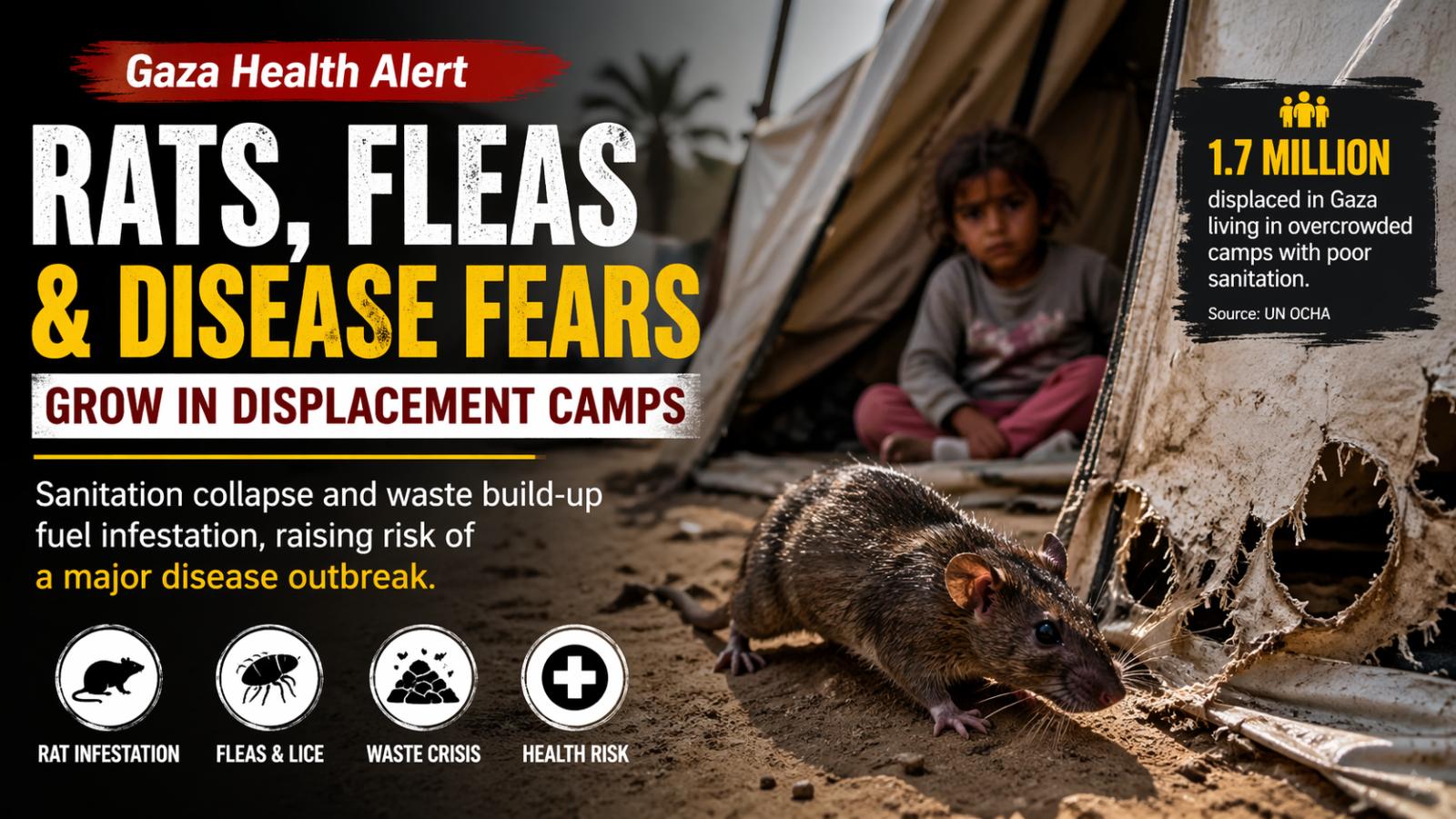
Gaza faces rising disease risk as rat infestation spreads in displacement camps
Rising temperatures are intensifying public health concerns in the Gaza Strip, where a widespread infestation of rodents and parasites is compounding already dire living conditions for displaced civilians. Health officials warn that the rapid spread of rats, fleas, and lice could trigger a major disease outbreak in overcrowded camps lacking basic sanitation. In areas such as Khan Yunis and the Al-Mawasi coastal strip, displaced families are living in makeshift shelters that offer little protection against pests. Residents report that large rodents, identified by some as Norway rats, are burrowing into tents at night. Muhammad al-Raqab, a displaced father, described repeated attacks on his family, saying rodents chewed through his shelter and bit his children while they slept. He now stays awake overnight to guard them. The infestation is closely linked to the collapse of Gaza’s sanitation infrastructure. With municipal services largely nonfunctional and access to landfill sites near the eastern border restricted, millions of tons of waste have accumulated near populated areas. The buildup has created ideal conditions for vermin to thrive. According to the United Nations Office for the Coordination of Humanitarian Affairs, approximately 1.7 million of Gaza’s 2.2 million residents remain displaced and unable to return to their homes despite a ceasefire that began in October 2025. Field assessments conducted in March described camp conditions as heavily affected by vermin and parasite infestations. Medical professionals are already seeing the consequences. Hani al-Flait, head of pediatrics at Al-Aqsa Hospital in central Gaza, reported a steady rise in skin infections such as scabies. Residents also describe worsening conditions as fleas spread allergies among both children and adults, further straining limited healthcare resources in the enclave.
Gaza faces rising disease risk as rat infestation spreads in displacement camps
Rising temperatures are intensifying public health concerns in the Gaza Strip, where a widespread infestation of rodents and parasites is compounding already dire living conditions for displaced civilians. Health officials warn that the rapid spread of rats, fleas, and lice could trigger a major disease outbreak in overcrowded camps lacking basic sanitation. In areas such as Khan Yunis and the Al-Mawasi coastal strip, displaced families are living in makeshift shelters that offer little protection against pests. Residents report that large rodents, identified by some as Norway rats, are burrowing into tents at night. Muhammad al-Raqab, a displaced father, described repeated attacks on his family, saying rodents chewed through his shelter and bit his children while they slept. He now stays awake overnight to guard them. The infestation is closely linked to the collapse of Gaza’s sanitation infrastructure. With municipal services largely nonfunctional and access to landfill sites near the eastern border restricted, millions of tons of waste have accumulated near populated areas. The buildup has created ideal conditions for vermin to thrive. According to the United Nations Office for the Coordination of Humanitarian Affairs, approximately 1.7 million of Gaza’s 2.2 million residents remain displaced and unable to return to their homes despite a ceasefire that began in October 2025. Field assessments conducted in March described camp conditions as heavily affected by vermin and parasite infestations. Medical professionals are already seeing the consequences. Hani al-Flait, head of pediatrics at Al-Aqsa Hospital in central Gaza, reported a steady rise in skin infections such as scabies. Residents also describe worsening conditions as fleas spread allergies among both children and adults, further straining limited healthcare resources in the enclave.
City of Houston promises reforms after weeks of missed recycling pickups
For more than a month, recycling bins across Houston have gone uncollected, with many residents waiting over 40 days for service. Piles of recyclable materials like bottles, cans, and cardboard have lined curbs throughout neighborhoods, frustrating homeowners. City officials have now come forward with explanations for the crisis and announced plans to restore regular service. Speaking before the Houston City Council, Interim Solid Waste Director Larius Hassen described a combin
City of Houston promises reforms after weeks of missed recycling pickups
For more than a month, recycling bins across Houston have gone uncollected, with many residents waiting over 40 days for service. Piles of recyclable materials like bottles, cans, and cardboard have lined curbs throughout neighborhoods, frustrating homeowners. City officials have now come forward with explanations for the crisis and announced plans to restore regular service. Speaking before the Houston City Council, Interim Solid Waste Director Larius Hassen described a combin
Open Shelter and Sanitation Teams Play Key Roles at Red White and Boom in Columbus
In Columbus, Ohio, the annual Red White and Boom celebration draws massive crowds eager to enjoy fireworks, food, and festive fun. While most attendees focus on the colorful spectacle in the sky, there’s an entire network of behind-the-scenes workers and volunteers who make the event possible. From sanitation crews to community outreach organizations, several teams come together each year to support the event in meaningful ways—often unnoticed by the thousands of spectators.
Open Shelter and Sanitation Teams Play Key Roles at Red White and Boom in Columbus
In Columbus, Ohio, the annual Red White and Boom celebration draws massive crowds eager to enjoy fireworks, food, and festive fun. While most attendees focus on the colorful spectacle in the sky, there’s an entire network of behind-the-scenes workers and volunteers who make the event possible. From sanitation crews to community outreach organizations, several teams come together each year to support the event in meaningful ways—often unnoticed by the thousands of spectators.


