










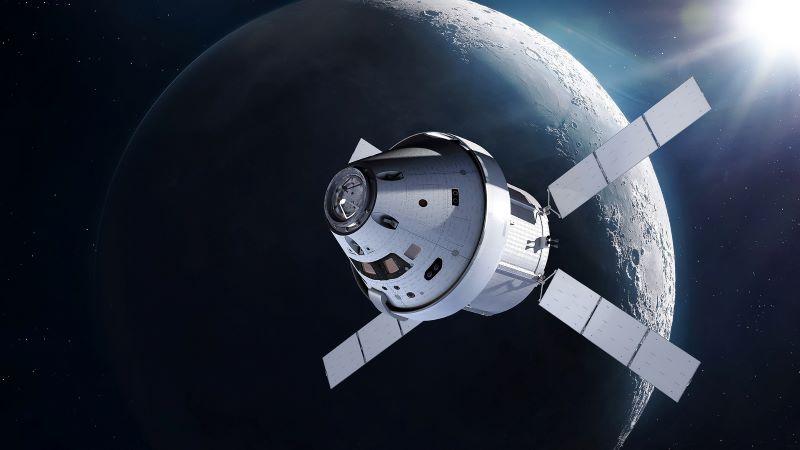
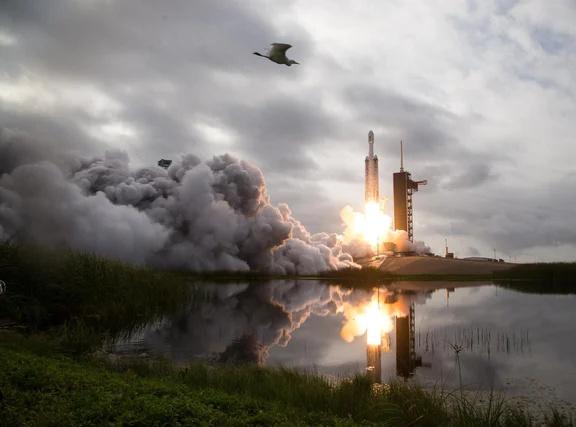











The Artemis II mission, a landmark achievement in human space exploration, has successfully concluded with a dramatic splashdown in the Pacific Ocean. The mission, which took four astronauts farther than any human before, traversed 4,06,778 kilometers from Earth, reaching the vicinity of the Moon. This daring journey marked humanity’s first crewed mission to the Moon since the Apollo program. The crew, consisting of Commander Reid Wiseman, Pilot Victor Glover, and Mission Speciali
NASA is preparing for the safe return of the Artemis II mission after successfully completing its 10-day journey around the Moon. The spacecraft is expected to splash down in the Pacific Ocean, off the coast of California, on Friday, April 10 at around 8 PM EDT (5:37 AM IST, April 11). NASA officials have confirmed that all mission operations are going smoothly and are on track.
The Artemis II crew has made history by capturing breathtaking views of the far side of the Moon during a record-setting flyby. This landmark achievement in space exploration comes as part of NASA's Artemis program, which aims to return humans to the Moon and ultimately send astronauts to Mars. The crew of Artemis II, aboard the Orion spacecraft, achieved a rare and remarkable perspective of the lunar surface, providing viewers with never-before-seen imagery of the Moon’s far side.
On April 7, 2026, the crew set a new record for the farthest human spaceflight, surpassing the distance achieved during the Apollo 13 mission in 1970. During the lunar flyby, astronauts Reid Wiseman,
NASA’s Artemis II mission marks a major step in the United States’ return to deep space exploration, serving as a critical test before astronauts attempt to land on the moon again. While the mission does not include a lunar landing, its primary purpose is to validate systems and operations required for future crewed missions. Artemis II will carry astronauts beyond Earth’s orbit for the first time in more than 50 years, testing the Orion spacecraft and Space Launch System unde
The NASA-led Artemis II mission is marking a historic milestone as four astronauts conduct a seven-hour flyby of the moon, traveling farther into space than any humans have before. The flyby operations are scheduled to begin at 2:45 PM ET and conclude at 9:20 PM ET on the same day (full date not specified in the official report), representing a key phase of the mission. The crew includes NASA astronauts Reid Wiseman, Victor Glover, and Christina Koch, along with Canadian Space Agenc
NASA’s Artemis 2 mission is advancing as the agency prepares to send astronauts on a historic journey around the moon, marking the first crewed lunar mission in decades. The mission represents a major milestone in the broader Artemis program, which aims to establish a sustained human presence on the lunar surface and eventually support deeper space exploration. The Artemis 2 crew is expected to travel aboard the Orion spacecraf
The world is once again looking at the Moon with excitement. After more than 50 years, humans are preparing to travel around the Moon again, and the NASA Artemis II mission is ready to make history. This mission will send four astronauts into space, taking them around the Moon and back to Earth. It is not just a space journey—it is the beginning of a new era of space exploration. What is Artemis II Mission?
The 2026 Solar Eclipse will occur on February 17, and it is set to be a remarkable celestial event. This eclipse will be an annular solar eclipse, often referred to as the Ring of Fire eclipse. Here's everything you need to know about this rare event: Eclipse Type: The eclipse will be an annular solar eclipse. In this type of eclipse, the Moon will cover about 96% of the Sun, but due to the Moon being farther from Earth, it will appear slightly smaller than the Sun. As a
A century ago, the notion of restoring lost senses or detecting ancient life beyond Earth belonged firmly to science fiction. In 2025, such ideas moved decisively into reality as a series of scientific breakthroughs reshaped long-standing assumptions across medicine, space science, climate research, and artificial intelligence. These advances did not arrive as distant promises or speculative theories, but as working solutions that delivered measurable results and altered how science interacts
As people across the globe prepare to welcome the New Year with countdowns, fireworks, and celebrations across different time zones, a small group of astronauts orbiting far above Earth will experience the arrival of the new year in a way unlike anyone on the planet. Aboard the International Space Station, astronauts currently in orbit will celebrate the New Year an astonishing 16 times, highlighting the extraordinary reality of life in space and the unique way time is experienced beyond Earth.
India’s space journey reached another landmark moment as Indian Space Research Organisation successfully launched the heaviest foreign satellite ever placed into orbit from Indian soil. The mission was carried out using the powerful LVM3 launch vehicle from the Satish Dhawan Space Centre in Sriharikota, reinforcing India’s growing reputation as a reliable and competitive space launch destination
In a remarkable achievement for Indian academia and space research, Assistant Professor Alok Sagar Gautam from the Department of Physics at Hemvati Nandan Bahuguna Garhwal University has been selected to join the Indian Space Research Organisation’s upcoming Venus Orbiter Mission, officially known as Shukrayaan-1. This marks a significant moment in India’s pursuit of interplanetary exploration, as the mission represents the nation’s first dedicated effort to study Venus, often referred
NASA’s discovery of interstellar comet 3I/ATLAS has sparked global interest after Harvard astrophysicist Avi Loeb suggested it could be a form of alien technology. Detected on July 1, 2025, the comet is only the third known interstellar object to pass through our solar system. While NASA confirmed that 3I/ATLAS poses no threat to Earth, Loeb and other researchers argue that its unique chemical and physical properties set it apart from natural space objects, warranting a deeper investigation
Nasa has announced that it is suspending most of its operations after the United States entered a government shutdown on October 1, 2025, following Congress’s failure to pass a budget or temporary funding measure. A notice on the agency’s website declared that it is “closed until further notice,” with only a limited workforce continuing essential tasks. The shutdown, the first in nearly six years, has led to thousands of federal employees being furloughed acr
1. Choosing a Career Based on Parental or Societal Pressure It’s easy to fall into the trap of choosing a career that makes others happy—whether it's your parents, peers, or society’s expectations. But if the job doesn’t align with your own interests, it can quickly feel like a chore. How to avoid this mistake? Instead of choosing a career just to please others, take time to explore what actually excites you. Consider your hobbies, stren
AI is everywhere right now — writing emails, powering chatbots, predicting your shopping habits… and maybe even taking your job. But here's the real question: What’s next? What comes after AI? What’s the next big thing that could be bigger, bolder, and more life-changing than artificial intelligence? You’re about to find out. Let’s dive into 5 f
James Lovell, the iconic Apollo 13 commander whose leadership and quick thinking turned a near-disaster into one of NASA’s greatest examples of problem-solving, has died at the age of 97. He passed away on Thursday in Lake Forest, Illinois, as confirmed by NASA in an official statement on Friday. Lovell’s remarkable career in space exploration spanned some of the most pivotal missions in the early years of the United States space program, and his a