


















The 2026 Solar Eclipse will occur on February 17, and it is set to be a remarkable celestial event. This eclipse will be an annular solar eclipse, often referred to as the Ring of Fire eclipse. Here's everything you need to know about this rare event: Eclipse Type: The eclipse will be an annular solar eclipse. In this type of eclipse, the Moon will cover about 96% of the Sun, but due to the Moon being farther from Earth, it will appear slightly smaller than the Sun. As a
The Indian Space Research Organisation experienced a tense morning on Tuesday after the Polar Satellite Launch Vehicle C62 lifted off from the Satish Dhawan Space Centre in Sriharikota at 10.18 am carrying a total of 16 satellites. The mission initially appeared to progress as planned, with scientists closely monitoring each phase of the flight. However, around 30 minutes after liftoff, ISRO confirmed that the mission had encountered an anomaly during the third stage of the launch sequence, r
India’s space journey reached another landmark moment as Indian Space Research Organisation successfully launched the heaviest foreign satellite ever placed into orbit from Indian soil. The mission was carried out using the powerful LVM3 launch vehicle from the Satish Dhawan Space Centre in Sriharikota, reinforcing India’s growing reputation as a reliable and competitive space launch destination
NASA’s discovery of interstellar comet 3I/ATLAS has sparked global interest after Harvard astrophysicist Avi Loeb suggested it could be a form of alien technology. Detected on July 1, 2025, the comet is only the third known interstellar object to pass through our solar system. While NASA confirmed that 3I/ATLAS poses no threat to Earth, Loeb and other researchers argue that its unique chemical and physical properties set it apart from natural space objects, warranting a deeper investigation
AI is everywhere right now — writing emails, powering chatbots, predicting your shopping habits… and maybe even taking your job. But here's the real question: What’s next? What comes after AI? What’s the next big thing that could be bigger, bolder, and more life-changing than artificial intelligence? You’re about to find out. Let’s dive into 5 f
Austin has just surpassed Houston in height, securing its spot as the home of the tallest building in Texas. The Waterline Tower, located at 98 Red River Street, stands at an impressive 74 stories and reaches a height of 1,025 feet. This new landmark in the Texas skyline is now 23 feet taller than the Chase Tower in Houston, which had held the title of Texas' tallest building since 1981. Waterline Tower:
India marked a major milestone in space collaboration today with the successful launch of the NISAR mission, a joint project between ISRO and NASA. Lifted into orbit aboard the GSLV-F16 from Sriharikota, NISAR is set to become the world’s most advanced Earth observation satellite. With a unique dual-frequency Synthetic Aperture Radar that combines NASA’s L-band and ISRO’s S-band systems, the satellite can penetrate clouds, forests, and even d
India is preparing for a historic milestone as Group Captain Shubhanshu Shukla, a highly accomplished pilot of the Indian Air Force, readies himself to become the second Indian ever to venture into space. Slated for launch on June 10 aboard the Axiom-4 mission, his journey to the International Space Station (ISS) comes nearly 41 years after Wing Commander Rakesh Sharma made his mark in 1984. As the designated mission pilot, Shukla will fly aboard SpaceX’s Falcon 9 Crew Drago
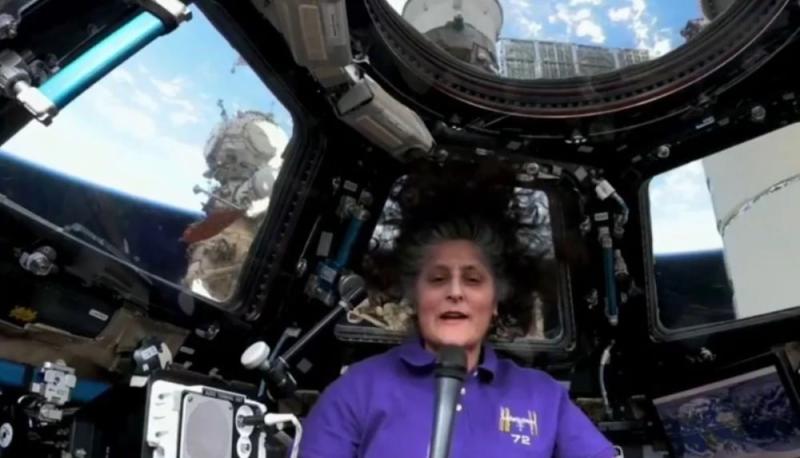
Sunita Williams and Butch Wilmore, the two American astronauts who spent an unexpected nine months aboard the International Space Station following issues with Boeing's Starliner capsule, are gradually transitioning back to life on Earth. After their return in March, the duo has been undergoing a rigorous rehabilitation phase to recover from the physical toll of extended microgravity exposure. Now, they’re emerging stronger, participating in post-mission responsibilities with both N
Detailed new images of the sun, taken in early December by the Inouye Solar Telescope, reveal complex sunspot activity during the current solar maximum, a phase in the sun's 11-year cycle when magnetic activity peaks. These dark sunspots mark regions where intense magnetic disturbances occur, often triggering solar flares and coronal mass ejections (CMEs)—massive eruptions of ionized gas, or plasma, from the sun's outer atmosphere. Such events can significantly impact Earth
In a momentous development for India's space program, Indian astronaut Shubhanshu Shukla is all set for his maiden journey to the International Space Station (ISS) as part of the Axiom Mission 4 (Ax-4). The mission, a private endeavor organized by Axiom Space in collaboration with NASA, SpaceX, and the Indian Space Research Organisation (ISRO), will see Shukla take flight aboard a SpaceX Falcon 9 rocket. The launch is scheduled for 10:33 pm IST on May 29, 2025, from NASA’s Kennedy S
In a spectacular display of cosmic alignment, NASA’s Solar Dynamics Observatory (SDO) captured rare and stunning images of a solar eclipse visible only from space. This event, known as a "lunar transit," took place on Sunday, April 27, 2025. Unlike solar eclipses witnessed from Earth, this particular event was not visible to ground-based observers. The moon passed between the SDO and the sun, covering approximately 23% of the sun’s surface, creating a dramatic yet serene
NASA astronauts Sunita Williams and Barry "Butch" Wilmore have returned safely to Earth after spending over nine months aboard the International Space Station (ISS). Their mission, originally scheduled for just eight days, extended unexpectedly due to technical issues, subjecting them to prolonged exposure to microgravity and other space-related conditions. The Crew-9 capsule successfully splashed down near the coast of Florida, USA, concluding their extended stay. The mission, whic
NASA has confirmed that astronauts Sunita Williams and Butch Wilmore, who have been stranded aboard the International Space Station (ISS) for over nine months, are finally set to return to Earth. The two astronauts initially embarked on a 10-day mission but remained in space far longer than planned due to propulsion malfunctions in their Boeing Starliner spacecraft. The much-anticipated return journey will now be carried out using the SpaceX Crew Dragon spacecraft, which successfully docked a
Washington, DC: After an unexpected 10-month extended mission aboard the International Space Station (ISS), NASA astronauts Sunita Williams and Butch Wilmore are finally set to return to Earth. NASA officials have confirmed that the duo will be brought back as early as March 16 aboard SpaceX’s Crew-9 spacecraft following the successful launch of Crew-10 this week. Delayed Return After Boeing Starliner Malfunction Williams and Wilmore
For centuries, humans have gazed at the night sky, pondering the mysteries of the universe. But what if those mysteries are not just distant wonders, but tangible objects already drifting through our own Solar System? Scientists now believe that material from Alpha Centauri, our closest stellar neighbor, may have made its way into our cosmic backyard—and possibly even to Earth.A new study suggests that tiny fragments from Alpha Centauri, a three-star system located just over four light-
Firefly Aerospace’s Blue Ghost lunar lander is on track to achieve a historic landing on the Moon, marking a significant milestone in NASA’s lunar exploration efforts. As part of NASA’s Commercial Lunar Payload Services (CLPS) program, Blue Ghost will play a key role in gathering scientific data to support future lunar missions under the Artemis program.The spacecraft has been steadily lowering its orbit around the Moon, performing a crucial engine burn to reduce its altitud
On the eve of Republic Day, Wing Commander Akshay Saxena of the Indian Air Force was conferred the Vayu Sena Medal (Gallantry) for his remarkable leadership and courage during a high-stakes mission off the Somali coast. The operation, which took place on March 16, 2024, involved rescuing 17 crew members from the MV Ruen, a merchant ship that had been seized by pirates. The pirates had previously attacked merchant vessels in the Arabian Sea and even fired at the Indian Navy’s INS Kolkata
ISRO's Liquid Propulsion Systems Centre (LPSC) has successfully completed the integration of the liquid propulsion system for the Crew Module of Gaganyaan, India's first human spaceflight mission. On January 21, 2025, ISRO dispatched the Crew Module to the Satish Dhawan Space Centre in Sriharikota for further processing and integration. This uncrewed mission, known as Gaganyaan (G1), is a crucial step in ISRO's efforts to acquire human spaceflight capabilities. The Crew
The James Webb Space Telescope (JWST), the most advanced telescope ever built, has provided a groundbreaking view of the universe by revealing detailed 3D maps of interstellar dust and gas. Recently, it captured the infrared glow of this cosmic material, showing delicate patterns that resemble wood grain. This discovery marks the first time scientists have been able to map the interstellar medium in such detail. The findings offer a fresh perspective on star formation and galaxy evo