













#trustvote
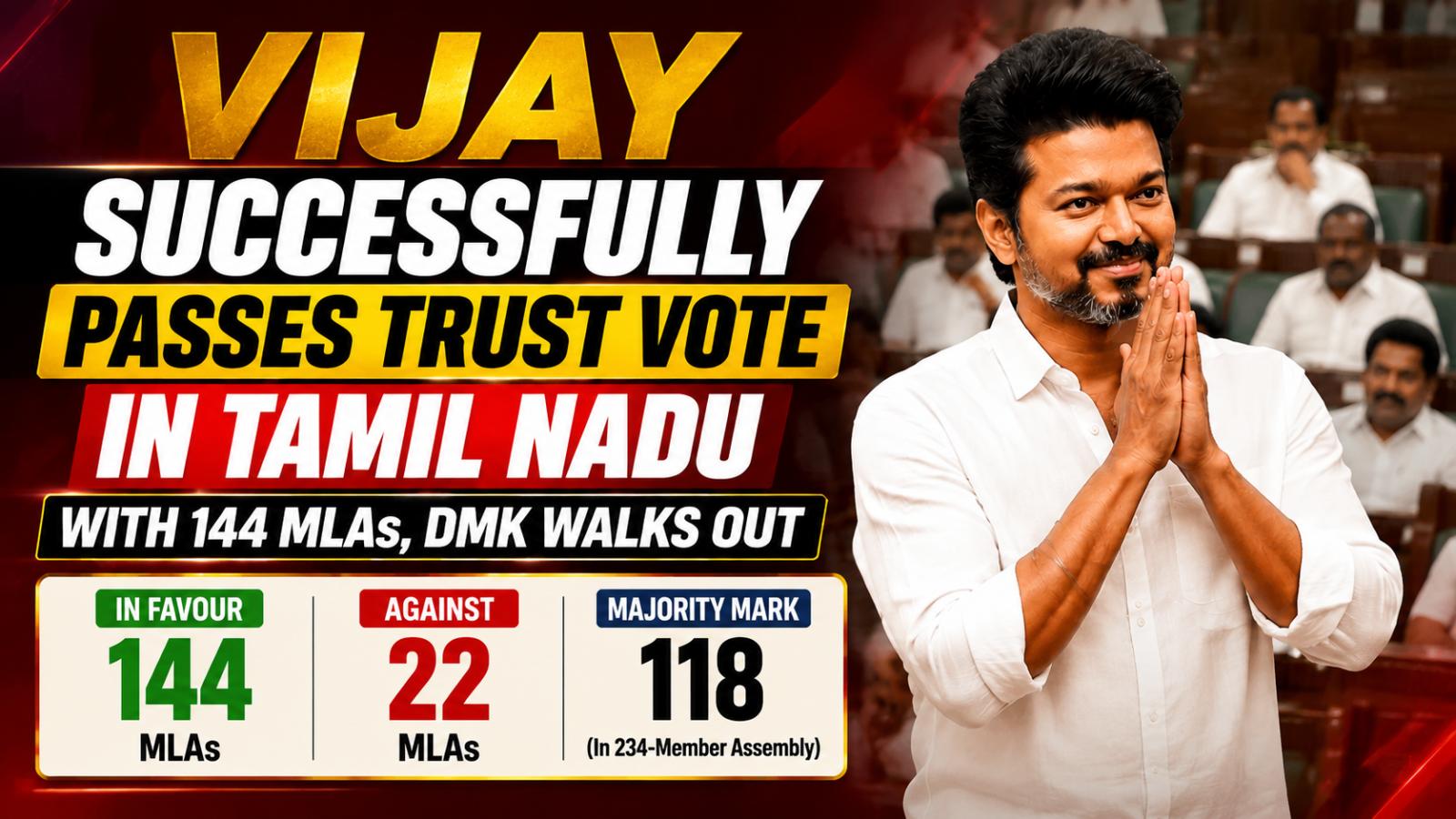
Vijay Successfully Passes Trust Vote in Tamil Nadu with 144 MLAs, DMK Walks Out
Vijay successfully passed the confidence motion in the Tamil Nadu Assembly on Wednesday with 144 MLAs backing his government. The required majority mark was 118, and despite some opposition from the DMK and PMK, Vijay comfortably crossed this threshold. The trust vote unfolded with empty benches in the opposition as the DMK and DMDK legislators staged a walkout, while several PMK and BJP MLAs abstained from voting. Among the supporting MLAs, the AIADMK faction led by rebel leaders S
Vijay Successfully Passes Trust Vote in Tamil Nadu with 144 MLAs, DMK Walks Out
Vijay successfully passed the confidence motion in the Tamil Nadu Assembly on Wednesday with 144 MLAs backing his government. The required majority mark was 118, and despite some opposition from the DMK and PMK, Vijay comfortably crossed this threshold. The trust vote unfolded with empty benches in the opposition as the DMK and DMDK legislators staged a walkout, while several PMK and BJP MLAs abstained from voting. Among the supporting MLAs, the AIADMK faction led by rebel leaders S
Rahul Gandhi Submits Dissent Note on CBI Chief Selection, Claims Biased Process
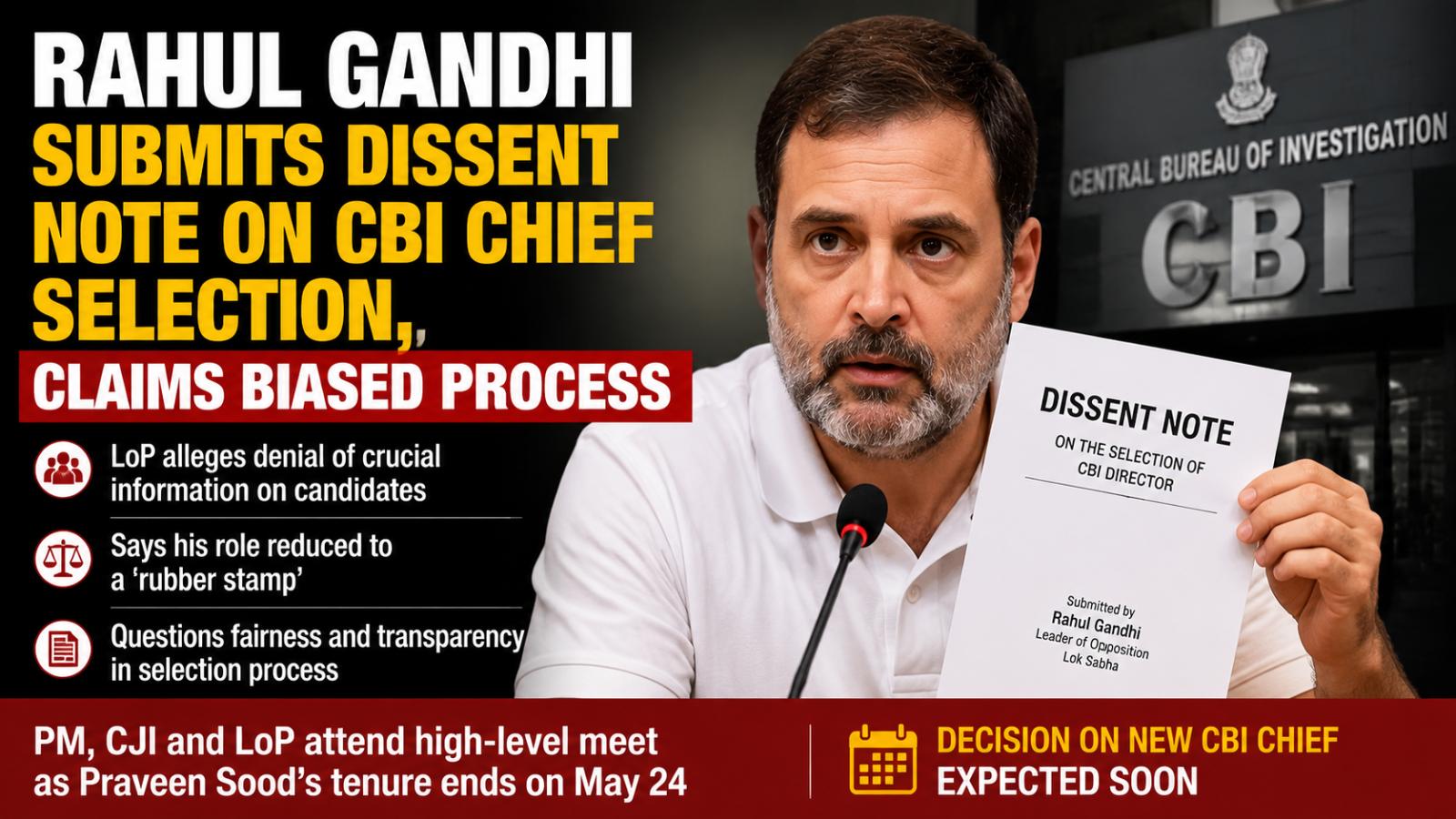
On May 13, 2026, Rahul Gandhi, the Leader of Opposition in the Lok Sabha, submitted a dissent note to Prime Minister Narendra Modi regarding the selection process for the new Central Bureau of Investigation (CBI) chief. The Congress MP accused the process of being biased, stating that his constitutional role in the appointment process had been reduced to that of a "rubber stamp." Gandhi expressed that the procedure was designed to ensure that the government's preferred candidate would be selected, and he refused to participate in what he deemed a "mockery" of the process. The high-level meeting, which included Prime Minister Modi, Chief Justice of India Surya Kant, and Gandhi, was held at the Prime Minister's residence to discuss the potential successors to Praveen Sood, the outgoing CBI Director, whose tenure ends on May 24, 2026. Gandhi claimed that despite repeated requests, he was denied access to crucial self-appraisal and assessment reports of the 69 shortlisted candidates. He pointed out that he was expected to review these records only during the meeting, preventing a meaningful evaluation of the candidates' histories and performances. The lack of transparency in the process, he said, made it difficult for him to fulfill his constitutional duty to ensure a fair and unbiased selection for the critical position. In his note, Gandhi also accused the Modi government of using the CBI to target political opponents, journalists, and critics. He noted that his suggestions for a more transparent and fair process had been ignored, including earlier written requests made on October 21 and May 5 of the previous year. Gandhi’s criticism of the process is seen as part of a broader political strategy to hold the government accountable on issues of institutional independence, especially as the CBI has often been at the center of political controversies. As the selection process for the new CBI chief continues, it is expected that the Modi government will announce the new director soon, with several senior IPS officers under consideration for the top position. This issue remains a politically sensitive one, with several high-profile cases involving the agency, making the outcome of the CBI chief selection process crucial for the current government and the opposition alike.
Rahul Gandhi Submits Dissent Note on CBI Chief Selection, Claims Biased Process
On May 13, 2026, Rahul Gandhi, the Leader of Opposition in the Lok Sabha, submitted a dissent note to Prime Minister Narendra Modi regarding the selection process for the new Central Bureau of Investigation (CBI) chief. The Congress MP accused the process of being biased, stating that his constitutional role in the appointment process had been reduced to that of a "rubber stamp." Gandhi expressed that the procedure was designed to ensure that the government's preferred candidate would be selected, and he refused to participate in what he deemed a "mockery" of the process. The high-level meeting, which included Prime Minister Modi, Chief Justice of India Surya Kant, and Gandhi, was held at the Prime Minister's residence to discuss the potential successors to Praveen Sood, the outgoing CBI Director, whose tenure ends on May 24, 2026. Gandhi claimed that despite repeated requests, he was denied access to crucial self-appraisal and assessment reports of the 69 shortlisted candidates. He pointed out that he was expected to review these records only during the meeting, preventing a meaningful evaluation of the candidates' histories and performances. The lack of transparency in the process, he said, made it difficult for him to fulfill his constitutional duty to ensure a fair and unbiased selection for the critical position. In his note, Gandhi also accused the Modi government of using the CBI to target political opponents, journalists, and critics. He noted that his suggestions for a more transparent and fair process had been ignored, including earlier written requests made on October 21 and May 5 of the previous year. Gandhi’s criticism of the process is seen as part of a broader political strategy to hold the government accountable on issues of institutional independence, especially as the CBI has often been at the center of political controversies. As the selection process for the new CBI chief continues, it is expected that the Modi government will announce the new director soon, with several senior IPS officers under consideration for the top position. This issue remains a politically sensitive one, with several high-profile cases involving the agency, making the outcome of the CBI chief selection process crucial for the current government and the opposition alike.
Tamil Nadu CM Vijay Faces Live Crucial Floor Test, Banks on Allies to Secure Trust Vote
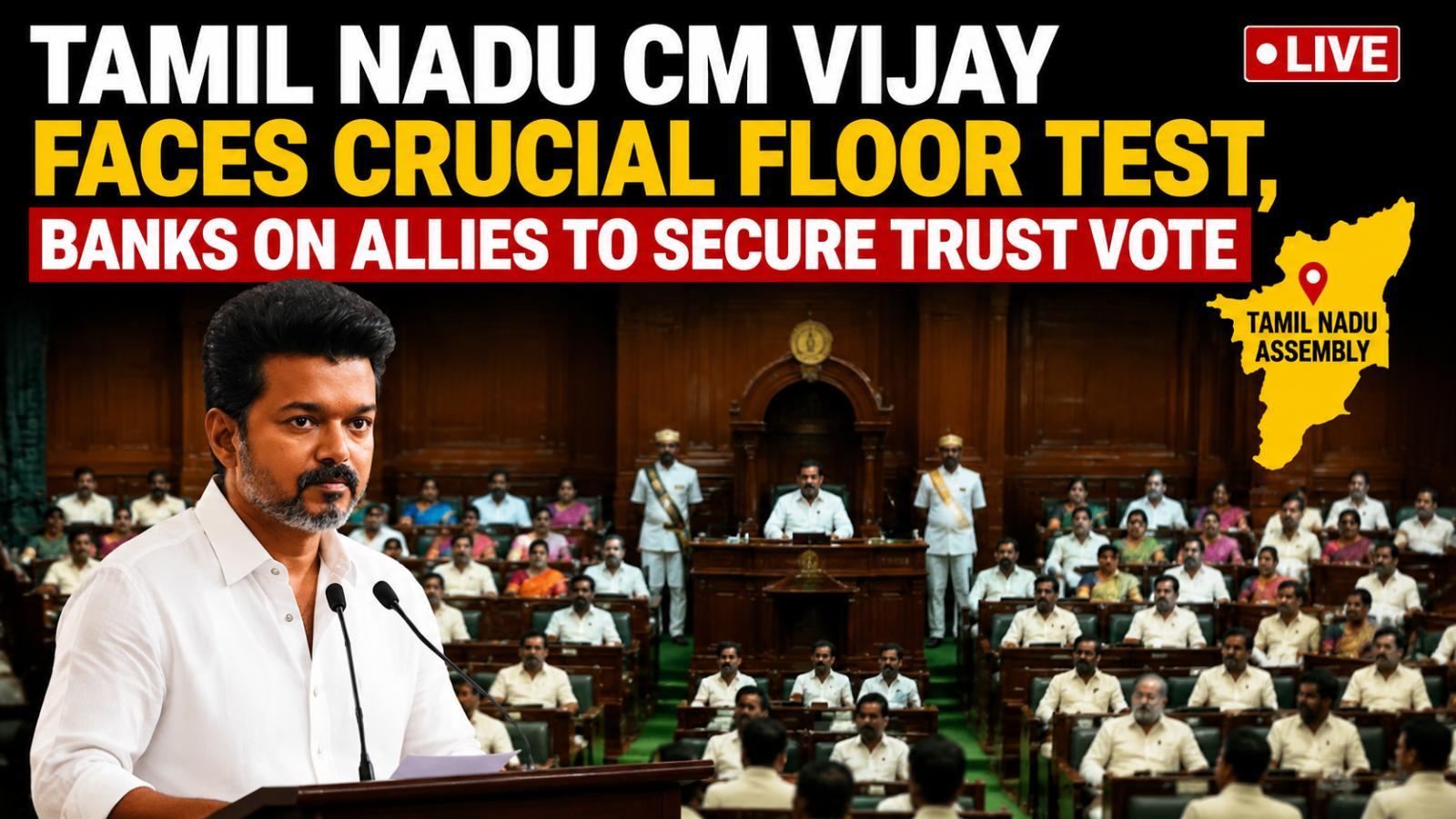
Tamil Nadu Chief Minister C Joseph Vijay is set to face his first trust vote today in the Tamil Nadu Legislative Assembly. While the numbers appear to favor him, the lead-up to the floor test has been filled with swift political alliances, intense negotiations, and even a court intervention. Vijay, who took oath as Chief Minister recently, currently enjoys the support of 120 MLAs, just above the required majority mark of 118 in the 234-member Assembly. Despite emerging as the largest party in the 2026 elections with 108 seats, Vijay’s Tamilaga Vettri Kazhagam (TVK) remained short of a majority. After securing support from the Congress, Indian Union Muslim League (IUML), Communist Party of India (CPI), and the Communist Party of India (Marxist) (CPIM), Vijay consolidated a coalition of 120 MLAs. Even with one MLA temporarily barred from participating, the coalition remains above the majority line, ensuring a manageable trust vote. A major boost came from VCK leader Thol Thirumavalavan, who confirmed that his two-party MLAs would vote in favor of Vijay. Thirumavalavan’s support was instrumental in ensuring stability within the coalition. Additionally, Vijay’s efforts to consolidate support included meetings with Congress leaders, IUML, and even AIADMK dissidents. The opposition also faced internal turmoil, with a group of around 30 AIADMK MLAs led by CV Shanmugam and SP Velumani announcing their support for Vijay’s government. This added to the political chaos as these rebels accused the AIADMK leadership of secretly seeking DMK’s support to form an alternative government. However, the situation took another twist when TVK MLA R Seenivasa Sethupathy was temporarily barred from voting in the trust motion due to a pending case regarding vote-counting irregularities. Despite this, Vijay's coalition remains slightly above the required majority, and unless last-minute abstentions or legal interventions alter the scenario, he seems likely to survive the floor test. In the backdrop, the AMMK controversy added more drama when AMMK’s MLA Kamaraj was removed after his alleged forged support letter was used to claim his backing for the TVK. Vijay’s future in office hinges on today’s floor test, but with declared support from 120 MLAs, and despite a legal complication reducing his effective tally to 119, he is expected to clear the vote barring any unexpected developments.
Tamil Nadu CM Vijay Faces Live Crucial Floor Test, Banks on Allies to Secure Trust Vote
Tamil Nadu Chief Minister C Joseph Vijay is set to face his first trust vote today in the Tamil Nadu Legislative Assembly. While the numbers appear to favor him, the lead-up to the floor test has been filled with swift political alliances, intense negotiations, and even a court intervention. Vijay, who took oath as Chief Minister recently, currently enjoys the support of 120 MLAs, just above the required majority mark of 118 in the 234-member Assembly. Despite emerging as the largest party in the 2026 elections with 108 seats, Vijay’s Tamilaga Vettri Kazhagam (TVK) remained short of a majority. After securing support from the Congress, Indian Union Muslim League (IUML), Communist Party of India (CPI), and the Communist Party of India (Marxist) (CPIM), Vijay consolidated a coalition of 120 MLAs. Even with one MLA temporarily barred from participating, the coalition remains above the majority line, ensuring a manageable trust vote. A major boost came from VCK leader Thol Thirumavalavan, who confirmed that his two-party MLAs would vote in favor of Vijay. Thirumavalavan’s support was instrumental in ensuring stability within the coalition. Additionally, Vijay’s efforts to consolidate support included meetings with Congress leaders, IUML, and even AIADMK dissidents. The opposition also faced internal turmoil, with a group of around 30 AIADMK MLAs led by CV Shanmugam and SP Velumani announcing their support for Vijay’s government. This added to the political chaos as these rebels accused the AIADMK leadership of secretly seeking DMK’s support to form an alternative government. However, the situation took another twist when TVK MLA R Seenivasa Sethupathy was temporarily barred from voting in the trust motion due to a pending case regarding vote-counting irregularities. Despite this, Vijay's coalition remains slightly above the required majority, and unless last-minute abstentions or legal interventions alter the scenario, he seems likely to survive the floor test. In the backdrop, the AMMK controversy added more drama when AMMK’s MLA Kamaraj was removed after his alleged forged support letter was used to claim his backing for the TVK. Vijay’s future in office hinges on today’s floor test, but with declared support from 120 MLAs, and despite a legal complication reducing his effective tally to 119, he is expected to clear the vote barring any unexpected developments.


