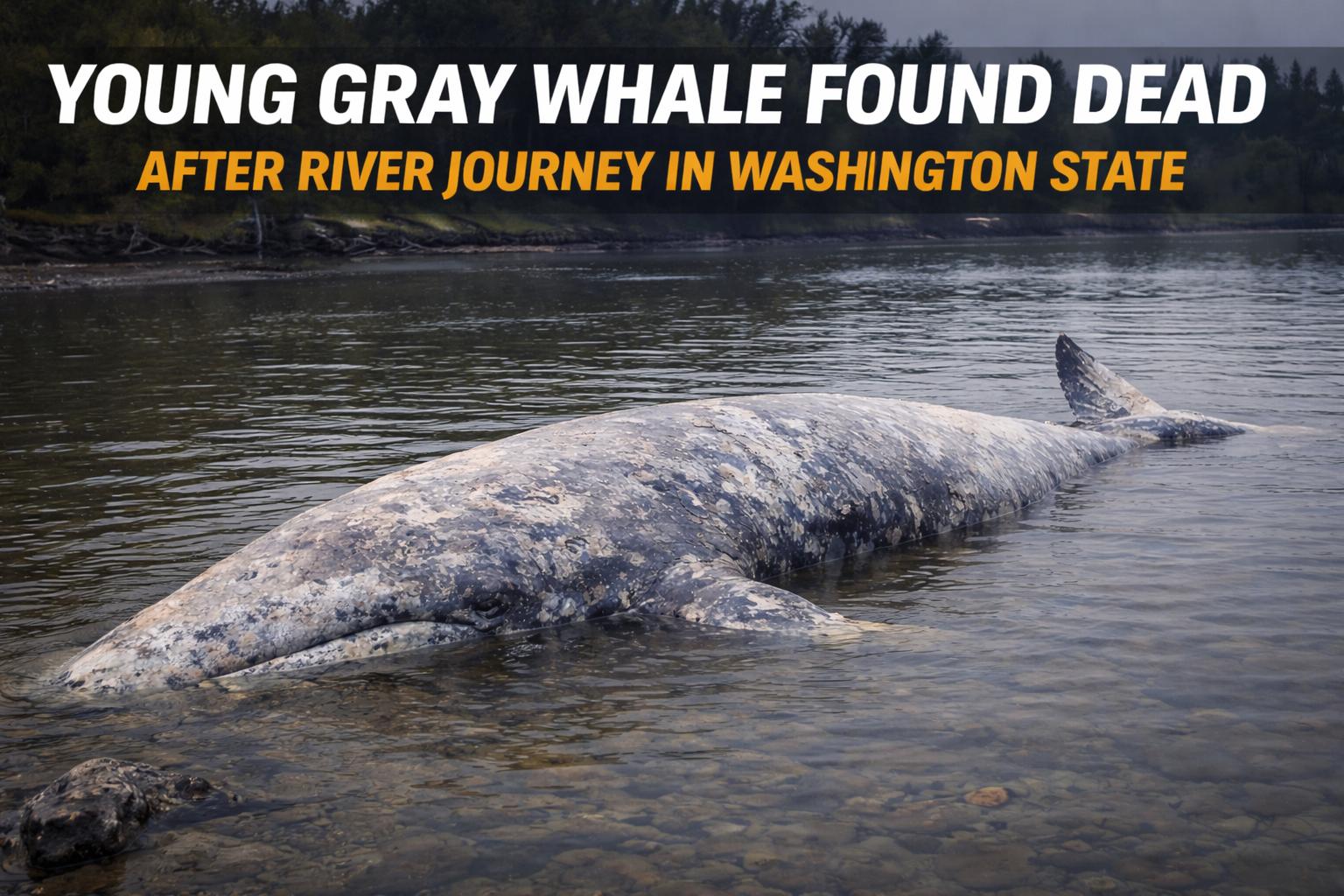
A young gray whale has been found dead after traveling approximately 20 miles inland along the Willapa River in Washington state, according to an update shared by the Cascadia Research Collective on Saturday (full date not specified in the official report). The juvenile whale, which had drawn local attention and was nicknamed “Willapa Willy,” had been observed in the river for several days before its death.
The whale was first spotted on Wednesday in the north fork of the Willapa River, located about 145 miles southwest of Seattle. At the time, researchers noted that although the animal appeared thin, it showed no visible injuries and was behaving normally. Teams had initially hoped the whale would navigate back toward the ocean on its own, but it ultimately did not leave the river.
Researchers now believe hunger may have been a contributing factor. Gray whales undertake long seasonal migrations along the Pacific Coast, traveling north in the spring to feeding grounds in Arctic waters. During this journey, they rely heavily on stored energy reserves. Scientists say that when food sources become scarce, whales may deviate from their typical routes in search of alternative feeding areas.
Recent environmental conditions have added pressure on gray whale populations. Reduced food availability in the northern Bering and Chukchi seas has been linked to declining health among the species. According to NOAA Fisheries, the eastern North Pacific gray whale population was estimated at approximately 13,000 during the winter of 2025, marking one of the lowest levels recorded since the 1970s.
Additional incidents in the region have raised concerns among researchers. Earlier in April, two adult gray whales were found dead near Ocean Shores, both showing signs of malnourishment, with one also exhibiting injuries consistent with a vessel strike. These events highlight ongoing risks facing the species, including limited food resources, ship collisions, and entanglement in fishing gear.
The Cascadia Research Collective is assessing conditions to determine whether a detailed examination of the juvenile whale can be safely conducted, which may provide further insight into the circumstances surrounding its death.
A young gray whale has been found dead after traveling approximately 20 miles inland along the Willapa River in Washington state, according to an update shared by the Cascadia Research Collective on Saturday (full date not specified in the official report). The juvenile whale, which had drawn local attention and was nicknamed “Willapa Willy,” had been observed in the river for several days before its death.
The whale was first spotted on Wednesday in the north fork of the Willapa River, located about 145 miles southwest of Seattle. At the time, researchers noted that although the animal appeared thin, it showed no visible injuries and was behaving normally. Teams had initially hoped the whale would navigate back toward the ocean on its own, but it ultimately did not leave the river.
Researchers now believe hunger may have been a contributing factor. Gray whales undertake long seasonal migrations along the Pacific Coast, traveling north in the spring to feeding grounds in Arctic waters. During this journey, they rely heavily on stored energy reserves. Scientists say that when food sources become scarce, whales may deviate from their typical routes in search of alternative feeding areas.
Recent environmental conditions have added pressure on gray whale populations. Reduced food availability in the northern Bering and Chukchi seas has been linked to declining health among the species. According to NOAA Fisheries, the eastern North Pacific gray whale population was estimated at approximately 13,000 during the winter of 2025, marking one of the lowest levels recorded since the 1970s.
Additional incidents in the region have raised concerns among researchers. Earlier in April, two adult gray whales were found dead near Ocean Shores, both showing signs of malnourishment, with one also exhibiting injuries consistent with a vessel strike. These events highlight ongoing risks facing the species, including limited food resources, ship collisions, and entanglement in fishing gear.
The Cascadia Research Collective is assessing conditions to determine whether a detailed examination of the juvenile whale can be safely conducted, which may provide further insight into the circumstances surrounding its death.
Health authorities in the United States have confirmed the country’s first human case of the H5N5 bird flu virus after a Washington state resident tested positive for the strain earlier this month. The infection marks the first documented instance of H5N5 in a person anywhere in the world, underscoring what experts describe as the unpredictable evolution of avian influenza viruses. Officials emphasized that the overall public risk remains low, but the case is being closely monitored due to the unusual nature of the strain.
According to Washington state health officials, the patient became severely ill in early November, presenting with a high fever, significant breathing difficulty, and episodes of confusion. The individual was initially treated at a medical facility in Grays Harbor County, approximately 100 miles from Seattle, before being transferred to a hospital in King County for advanced care. Authorities revealed that the patient is older and has underlying health conditions, though no further identifying information was provided.
Laboratory testing confirmed that the patient had contracted H5N5, a subtype of bird flu previously detected only in birds. Until now, human infections in the United States have involved the more widely recognized H5N1 strain. Researchers say the emergence of H5N5 in a human highlights the ongoing adaptability of influenza viruses circulating in domestic and wild bird populations.
Investigators believe the patient’s exposure likely came from their own property, where they kept a mixed backyard flock of domestic poultry. The area is also frequented by wild birds such as ducks and geese, which are known carriers of various avian influenza strains. Officials stated that either domestic birds or wild species could have transmitted the virus, and both scenarios are under review.
Despite the unusual circumstances, health authorities maintain that the case does not indicate increased transmission risk to the broader public. The Centers for Disease Control and Prevention and Washington state officials reiterated that there is no evidence of human-to-human spread associated with H5N5. Individuals who had close contact with the patient were evaluated and tested, and no additional infections have been identified.
Experts also clarified that H5N5 is not a newly discovered virus; it has been circulating among birds for some time. This instance simply marks the first confirmation of the strain infecting a human. Because influenza viruses regularly mutate as they pass between species, scientists continue to track their behavior, particularly when new patterns of infection appear.
This case is the first recorded human bird flu infection in the United States in at least eight months. The country has been dealing with a widespread bird flu outbreak since early 2022, during which 71 human infections have been documented. One fatality was reported in Louisiana. Only a handful of cases have occurred so far this year, reflecting the sporadic and largely low-risk nature of avian influenza transmission to people.
Health agencies continue to monitor bird populations, agricultural settings, and human cases to better understand how avian influenza evolves and to ensure timely guidance for the public. While the H5N5 infection represents a rare event, officials stressed that prevention measures, including avoiding contact with sick or dead birds and practicing proper hygiene around poultry, remain important tools in reducing exposure risks.
Health authorities in the United States have confirmed the country’s first human case of the H5N5 bird flu virus after a Washington state resident tested positive for the strain earlier this month. The infection marks the first documented instance of H5N5 in a person anywhere in the world, underscoring what experts describe as the unpredictable evolution of avian influenza viruses. Officials emphasized that the overall public risk remains low, but the case is being closely monitored due to the unusual nature of the strain.
According to Washington state health officials, the patient became severely ill in early November, presenting with a high fever, significant breathing difficulty, and episodes of confusion. The individual was initially treated at a medical facility in Grays Harbor County, approximately 100 miles from Seattle, before being transferred to a hospital in King County for advanced care. Authorities revealed that the patient is older and has underlying health conditions, though no further identifying information was provided.
Laboratory testing confirmed that the patient had contracted H5N5, a subtype of bird flu previously detected only in birds. Until now, human infections in the United States have involved the more widely recognized H5N1 strain. Researchers say the emergence of H5N5 in a human highlights the ongoing adaptability of influenza viruses circulating in domestic and wild bird populations.
Investigators believe the patient’s exposure likely came from their own property, where they kept a mixed backyard flock of domestic poultry. The area is also frequented by wild birds such as ducks and geese, which are known carriers of various avian influenza strains. Officials stated that either domestic birds or wild species could have transmitted the virus, and both scenarios are under review.
Despite the unusual circumstances, health authorities maintain that the case does not indicate increased transmission risk to the broader public. The Centers for Disease Control and Prevention and Washington state officials reiterated that there is no evidence of human-to-human spread associated with H5N5. Individuals who had close contact with the patient were evaluated and tested, and no additional infections have been identified.
Experts also clarified that H5N5 is not a newly discovered virus; it has been circulating among birds for some time. This instance simply marks the first confirmation of the strain infecting a human. Because influenza viruses regularly mutate as they pass between species, scientists continue to track their behavior, particularly when new patterns of infection appear.
This case is the first recorded human bird flu infection in the United States in at least eight months. The country has been dealing with a widespread bird flu outbreak since early 2022, during which 71 human infections have been documented. One fatality was reported in Louisiana. Only a handful of cases have occurred so far this year, reflecting the sporadic and largely low-risk nature of avian influenza transmission to people.
Health agencies continue to monitor bird populations, agricultural settings, and human cases to better understand how avian influenza evolves and to ensure timely guidance for the public. While the H5N5 infection represents a rare event, officials stressed that prevention measures, including avoiding contact with sick or dead birds and practicing proper hygiene around poultry, remain important tools in reducing exposure risks.
A powerful 8.8-magnitude earthquake struck off the far eastern coast of Russia, triggering a widespread tsunami alert across the Pacific region. The tremor generated strong ocean waves that have already impacted parts of Japan and are now moving towards the United States with several coastal areas bracing for impact. In Japan, tsunami waves reaching heights of around 60 centimeters struck Hamanaka town in northern Hokkaido as well as Kuji port in Iwate on the main island. The tremors and subs
A powerful 8.8-magnitude earthquake struck off the far eastern coast of Russia, triggering a widespread tsunami alert across the Pacific region. The tremor generated strong ocean waves that have already impacted parts of Japan and are now moving towards the United States with several coastal areas bracing for impact. In Japan, tsunami waves reaching heights of around 60 centimeters struck Hamanaka town in northern Hokkaido as well as Kuji port in Iwate on the main island. The tremors and subs