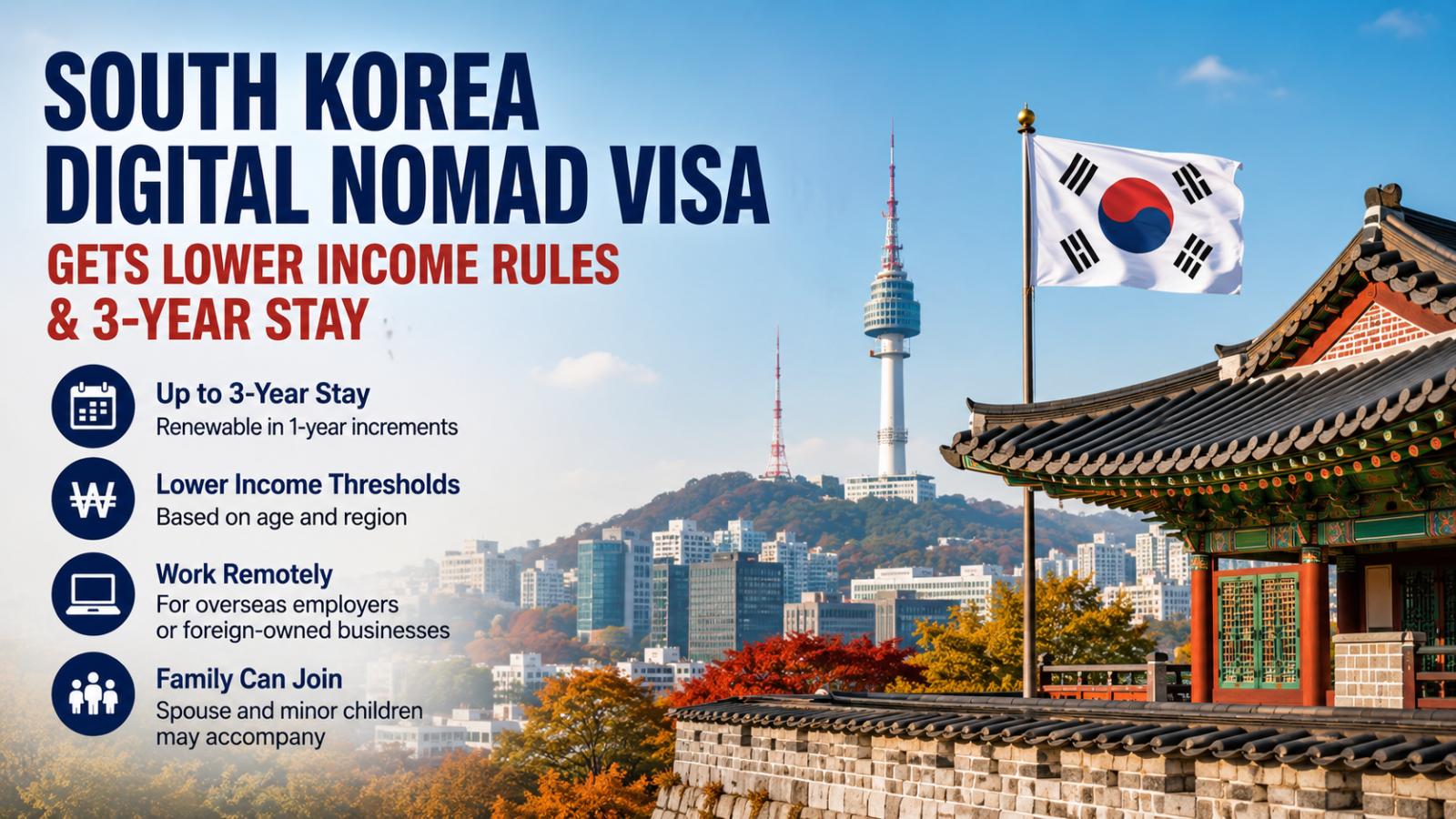
The South Korea digital nomad visa became permanent on Tuesday, June 30, 2026, after a two-and-a-half-year pilot. The F-1-D program lowers income thresholds for younger applicants and regional residents, extends stays to three years and bars local employment.
South Korea Makes F-1-D Visa Permanent
South Korea made its F-1-D workation visa permanent on Tuesday, June 30, 2026, after a pilot from January 2024 through May 2026. The trial issued 743 visas. As of May 2026, about 85% of registered holders lived in Seoul, Incheon or Gyeonggi Province, helping explain the new regional incentives.
Income Rules Vary by Age and Location
Thresholds are tied to South Korea’s 2025 gross national income per capita of 52.41 million won. Applicants aged 18 to 34 need 78.62 million won for most Greater Seoul locations or 52.41 million won in non-capital and designated population-decline areas. Those aged 35 or older need 104.83 million won in the capital region or 78.62 million won in qualifying regional areas.
Applicants bringing a spouse or minor children need twice the GNI in the capital region and 1.5 times the GNI in qualifying regional areas, regardless of age.
Eligibility and Documents
Applicants must be at least 18, work remotely for an overseas company and have worked in the same field for at least one year. Existing Korean consular guidance also includes owners of foreign companies. Spouses and minor children may accompany the primary applicant.
Documents include the visa form, passport, photograph, fee, employment and income evidence, bank records, a criminal record certificate and private medical insurance with at least 100 million won in coverage for treatment and repatriation. Applicants claiming a regional threshold must also prove qualifying accommodation for at least one month.
Stay Period and Work Limits
Applications are filed through a Korean embassy or consulate. Eligible B-1, B-2 and C-3 visitors may request a status change inside South Korea. The status begins with a one-year stay and can be renewed in one-year increments for up to three years.
The visa permits overseas remote work but restricts employment and profit-making activity in South Korea. Fees and processing procedures can vary by diplomatic mission, so applicants should confirm local requirements. The revised program is intended to attract global remote workers while directing more long-stay spending beyond Greater Seoul.
The South Korea digital nomad visa became permanent on Tuesday, June 30, 2026, after a two-and-a-half-year pilot. The F-1-D program lowers income thresholds for younger applicants and regional residents, extends stays to three years and bars local employment.
South Korea Makes F-1-D Visa Permanent
South Korea made its F-1-D workation visa permanent on Tuesday, June 30, 2026, after a pilot from January 2024 through May 2026. The trial issued 743 visas. As of May 2026, about 85% of registered holders lived in Seoul, Incheon or Gyeonggi Province, helping explain the new regional incentives.
Income Rules Vary by Age and Location
Thresholds are tied to South Korea’s 2025 gross national income per capita of 52.41 million won. Applicants aged 18 to 34 need 78.62 million won for most Greater Seoul locations or 52.41 million won in non-capital and designated population-decline areas. Those aged 35 or older need 104.83 million won in the capital region or 78.62 million won in qualifying regional areas.
Applicants bringing a spouse or minor children need twice the GNI in the capital region and 1.5 times the GNI in qualifying regional areas, regardless of age.
Eligibility and Documents
Applicants must be at least 18, work remotely for an overseas company and have worked in the same field for at least one year. Existing Korean consular guidance also includes owners of foreign companies. Spouses and minor children may accompany the primary applicant.
Documents include the visa form, passport, photograph, fee, employment and income evidence, bank records, a criminal record certificate and private medical insurance with at least 100 million won in coverage for treatment and repatriation. Applicants claiming a regional threshold must also prove qualifying accommodation for at least one month.
Stay Period and Work Limits
Applications are filed through a Korean embassy or consulate. Eligible B-1, B-2 and C-3 visitors may request a status change inside South Korea. The status begins with a one-year stay and can be renewed in one-year increments for up to three years.
The visa permits overseas remote work but restricts employment and profit-making activity in South Korea. Fees and processing procedures can vary by diplomatic mission, so applicants should confirm local requirements. The revised program is intended to attract global remote workers while directing more long-stay spending beyond Greater Seoul.