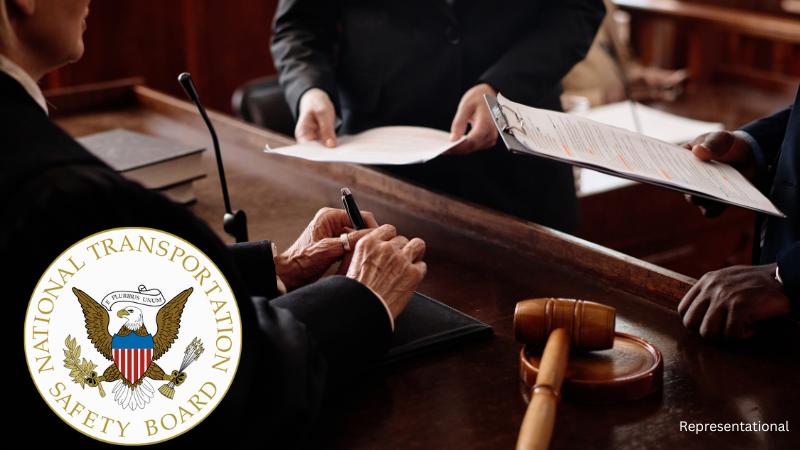
Federal investigators continued their inquiry into the deadly January midair collision over the Potomac River, where an Army Black Hawk helicopter collided with a commercial airliner, killing 67 people. During the second day of National Transportation Safety Board hearings, witnesses revealed longstanding concerns about the dense military helicopter traffic near Washington D.C. airspace, particularly around Ronald Reagan National Airport. These concerns had been raised years before the tragedy but went largely unaddressed by aviation authorities.
Testimonies presented on Thursday emphasized how pilots frequently relied on visual separation to navigate the crowded airspace. Visual separation, which depends on pilots’ ability to see other aircraft, was a routine practice approved by air traffic controllers. FAA officials confirmed that this method was used daily to manage the complexity of helicopter and commercial traffic near Reagan Airport. However, aviation experts highlighted the inherent risks, especially at night, when spotting other aircraft becomes significantly harder. Rick Dressler, representing a medevac operator, stated that identifying helicopters in the dark sky is particularly challenging when onboard locator systems are switched off, as was common for Army aircraft. Dressler, himself a former Army aviator, expressed that civilian pilots felt deeply uncomfortable operating near military units under such conditions.
The midair collision, which became the deadliest plane crash in the nation since 2001, raised questions about the adequacy of existing safety measures. Investigators pointed out that pilots were allowed to fly under landing planes, a practice widely acknowledged during testimony. NTSB Chairwoman Jennifer Homendy strongly criticized the Federal Aviation Administration, urging them to “fix it and do better.” She highlighted how the FAA ignored repeated warnings about helicopter congestion around the airport. Despite clear risks identified by local controllers, the FAA failed to implement additional safety measures, such as adding cautionary notes to helicopter charts or adjusting routes to ensure safer separation from commercial flights.
Homendy’s remarks underscored the severity of bureaucratic delays that prevented critical safety improvements. She condemned the agency’s decision to transfer managers instead of addressing the root cause of the problem after the crash. The hearings revealed that a 2022 FAA working group had raised concerns about helicopter traffic near the airport, yet no additional warnings were issued. The lack of decisive action, combined with reliance on visual separation and minimal altitude margins, became a key focus of the investigation.
Investigators also examined technical factors, including discrepancies in the Black Hawk helicopter’s altimeters. Data indicated that the aircraft was flying 80 to 100 feet higher than what the barometric altimeter showed, a variance considered acceptable within current Army standards but potentially dangerous in tightly controlled airspace. Tests on other helicopters from the same unit revealed similar inconsistencies. Army officials explained that the Black Hawk’s design dates back to the 1970s, using older altimeter technology less precise than modern air data computers found in newer aircraft. Pilots testified that they rely on multiple instruments at lower altitudes to cross-check readings, but investigators remain concerned about how these discrepancies may have affected situational awareness that night.
The hearings further explored how the FAA-approved routes around Reagan Airport allowed minimal separation distances—sometimes less than 500 feet—between helicopters and planes on approach. Experts argued that such close margins leave little room for error. This concern was echoed by both Army and civilian aviation representatives. Additionally, testimony revealed that a single air traffic controller was managing communications with several aircraft, including the Black Hawk, a departing plane, two other helicopters, and an inbound flight, just minutes before the collision. The controller’s workload highlighted systemic risks in handling multiple aircraft in congested airspace.
Family members of the victims attended the hearing, seeking answers about the failures that led to the tragedy. Among the victims were young figure skaters, their coaches, and union workers, all of whom lost their lives in the crash. Their presence served as a sobering reminder of the stakes involved in aviation safety decisions.
While the investigation continues, NTSB officials stated that it is too early to determine the final cause of the crash. The final report is expected next year, but preliminary findings already point to a combination of operational practices, regulatory gaps, and technical issues that created an environment ripe for disaster. Calls for reform have intensified, with demands for stricter altitude separation, clearer safety protocols, and updated technology to prevent another tragedy.
As the hearings progress, pressure is mounting on the FAA and the Army to implement reforms that will ensure safer operations around one of the nation’s most complex airspaces. The outcome of this investigation is expected to influence future aviation policies and improve air traffic safety, aiming to prevent similar accidents in the years to come.