Ashish Jha Says COVID Lab Leak More Likely
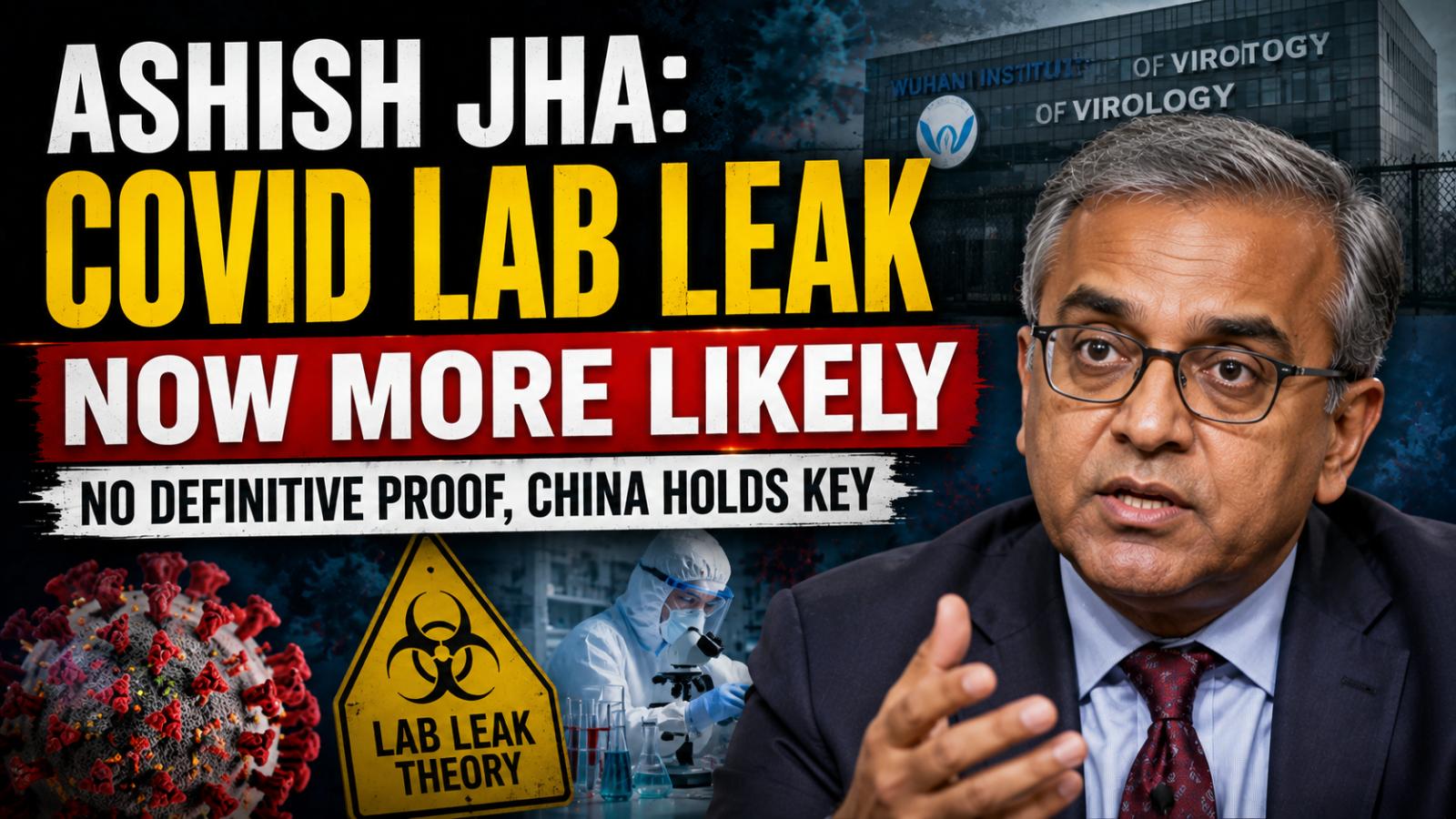
Former White House adviser Ashish Jha says a COVID lab leak now appears more likely to him than natural spillover. However, he stressed that the origin remains unproven, the virus was not deliberately released and missing information from China prevents a conclusive finding.
Ashish Jha Revises His Assessment
Former White House COVID-19 Response Coordinator Dr Ashish Jha has said he now considers an accidental laboratory-related incident the more likely explanation for the start of the pandemic.
Speaking during a televised interview on Sunday, August 2, Jha said he entered the Biden administration believing that transmission from an infected animal was almost certainly responsible. He said information he reviewed during and after his White House service led him to reassess that position.
Jha carefully described the conclusion as his personal assessment rather than an established fact. He said no American official or researcher could claim certainty and argued that Chinese authorities hold information necessary to determine what happened during the earliest days of the outbreak. His remarks were also shared through his social media account after the interview.
Ashish Jha Lab Leak Assessment
Dr Ashish Jha, who served as White House COVID-19 Response Coordinator under President Joe Biden, has said he now considers an accidental laboratory leak the more likely explanation for the emergence of SARS-CoV-2.
During an August 2 television interview, Jha said he initially entered the White House believing that a natural animal-to-human outbreak was the strongest explanation. He said information he reviewed during and after his government service changed his assessment.
Jha did not claim that the virus was deliberately released or genetically engineered. Instead, he described an accidental research-related incident as more likely based on what he called strong circumstantial evidence. He also acknowledged that experts can review the same information and reach different conclusions.
No Definitive COVID Origin Proof
Jha repeatedly stressed that no US official or scientist can presently prove how the pandemic began. He argued that Chinese authorities hold information needed to reach a more certain conclusion and renewed calls for transparency and accountability.
That distinction is crucial. A personal assessment from a former government official does not establish that a laboratory incident occurred. It adds another influential voice to the debate, but the publicly available evidence still does not provide a definitive answer.
The US intelligence community has remained divided. Earlier declassified assessments found that different agencies favoured natural exposure, a laboratory incident or neither explanation with varying confidence levels. The intelligence community broadly assessed that SARS-CoV-2 was not developed as a biological weapon.
WHO Origins Report Favors Spillover
The World Health Organization’s independent scientific advisory group released its latest assessment in June 2025. It concluded that the weight of available scientific evidence points toward zoonotic spillover, meaning transmission from animals to humans either directly from bats or through an intermediate host.
However, the WHO did not rule out a laboratory-related incident. Its experts said missing records and limited access to information from China prevented them from evaluating every hypothesis fully. The group therefore maintained that the pandemic’s precise origin remains unresolved.
China rejected suggestions that it had withheld decisive evidence and said the WHO assessment produced no new findings that overturned the earlier joint investigation.
COVID Origins Debate Remains Open
The debate has changed significantly since the pandemic’s early stages. Natural transmission was initially treated as the leading scientific explanation, while many public discussions of a lab leak were dismissed as misinformation or conspiracy.
Later intelligence assessments and continued gaps in the evidence made a possible accidental laboratory incident a more widely discussed hypothesis. Even so, neither public intelligence reports nor scientific reviews have supplied direct proof that the Wuhan Institute of Virology caused the outbreak.
Jha’s statement is therefore newsworthy because of his former White House role, not because it settles the issue. The responsible conclusion remains that an accidental lab leak is possible, zoonotic spillover currently has stronger published scientific support, and the absence of crucial data prevents certainty.
Understanding the origin matters for future pandemic prevention. A natural spillover would strengthen the case for wildlife surveillance and market controls, while a laboratory incident would highlight biosafety, research oversight and reporting failures.