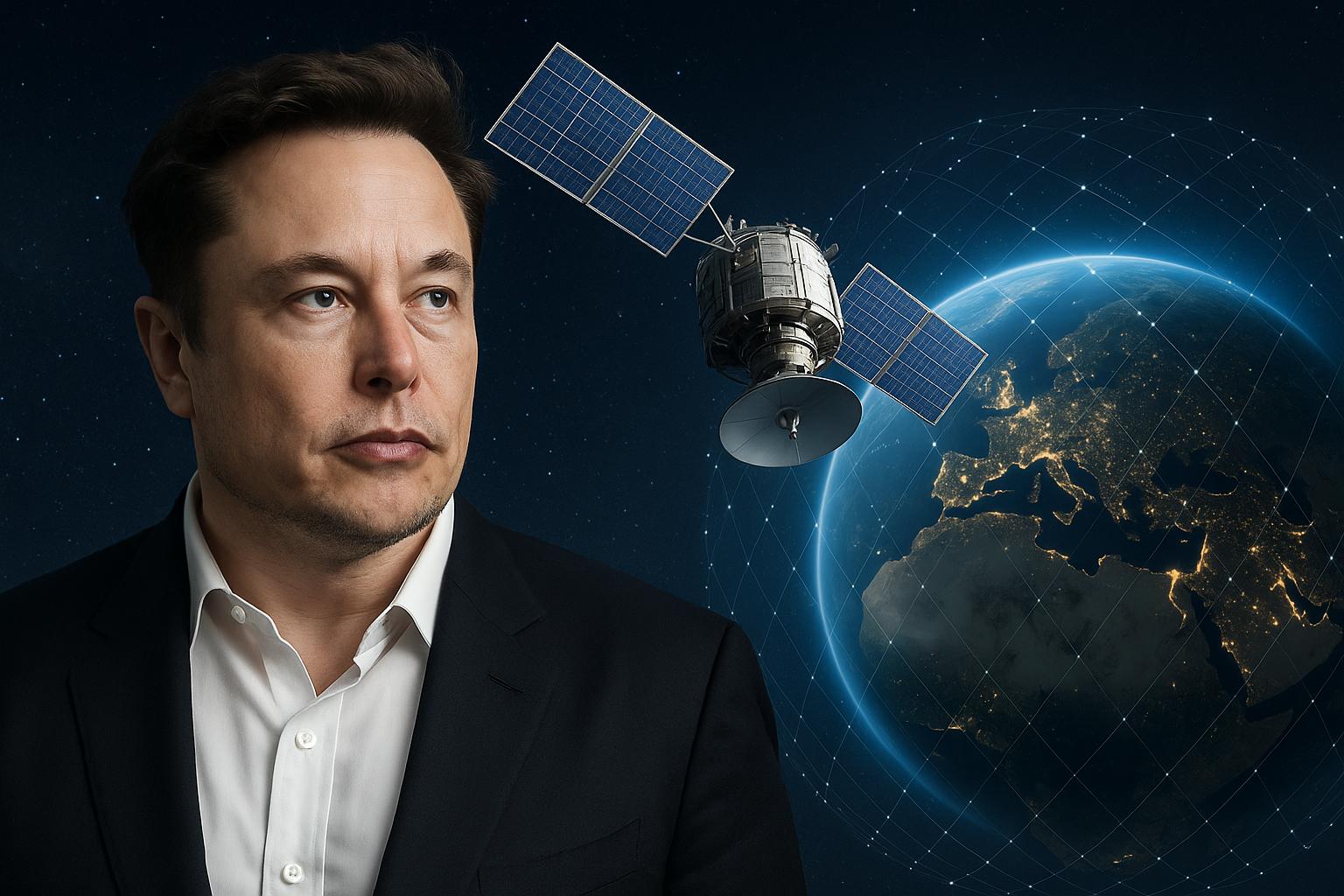
Global competition in the satellite internet market is intensifying as Europe and China prepare to launch large-scale projects aimed at rivaling Elon Musk’s Starlink network. The developments mark a significant shift in the global communications landscape, with governments and private aerospace firms seeking to establish independent systems to reduce reliance on the American provider.
Europe’s leading aerospace manufacturers have reached an agreement to combine their satellite production and services, marking a milestone in the continent’s space collaboration. Airbus, Thales of France, and Italy’s Leonardo have come together under a new initiative known as “Project Bromo.” The venture, based in Toulouse, France, is expected to begin operations in 2027 and aims to provide Europe’s answer to Starlink’s low Earth orbit satellite constellation.
The creation of Project Bromo represents the most significant unification of European space assets since the founding of missile maker MBDA in 2001. The companies involved have traditionally competed to build geostationary satellites, but the emergence of low-cost, small satellites operating in low Earth orbit has changed the market dynamics. SpaceX’s Starlink, which recently celebrated its 10,000th satellite launch, has established a dominant global presence and is used in several countries, including conflict zones such as Ukraine, where around 50,000 terminals support communication infrastructure.
In a joint statement, the chief executives of Airbus, Thales, and Leonardo described the merger as a “pivotal milestone” for Europe’s space ambitions. They emphasized that the collaboration aims to strengthen Europe’s strategic autonomy in satellite communications and foster a more competitive position in the global market. The proposed venture, which is expected to employ around 25,000 people across Europe, still requires regulatory approval but is projected to launch within the next two years.
In parallel, other European initiatives are also underway. Eutelsat, another major player in the satellite communications sector, recently secured a €1.35 billion investment from the French government to enhance its infrastructure. Meanwhile, the European Space Agency (ESA) is collaborating with Thales on the High-throughput Digital and Optical Network (HydRON) project. This system will use laser-based communication between satellites and ground stations, capable of delivering internet speeds reaching up to a terabit per second, setting new benchmarks for data transmission technology.
China, too, has entered the race with ambitious projects of its own. Two large-scale initiatives, Guowang and Qianfan, have been developed to compete with Starlink. The Guowang constellation, also known as Xingwang or SatNet, primarily focuses on domestic telecommunications and national security, while Qianfan, also known as Spacesail or SSST, aims to provide services to international telecom operators. As of mid-2024, Qianfan had already signed agreements with countries such as Brazil, Malaysia, and Thailand, and expressed interest in expanding into several Asian, African, and Latin American markets.
However, both Chinese projects face challenges in scaling up operations. Industry reports indicate a higher number of faulty satellites compared with SpaceX’s track record, coupled with bureaucratic and logistical hurdles. China’s limited launch capacity and slower regulatory approvals could delay the deployment of the full constellations. According to international guidelines, if sufficient satellites are not launched within a specified timeframe, the International Telecommunication Union (ITU), the United Nations body overseeing orbital coordination, could require China to reduce the scope of its planned satellite networks.
Starlink, which gained regulatory approval from the United States Federal Communications Commission in 2021 to deploy up to 12,000 satellites by 2026, continues to maintain a significant lead. The company’s global presence, rapid deployment capability, and integration with both civilian and military operations have set a high benchmark for competitors.
As the satellite internet sector grows increasingly vital for defense, commerce, and global connectivity, Europe and China’s efforts underscore a broader geopolitical goal: achieving technological independence in space-based communication. While both regions are investing heavily in innovation and infrastructure, matching Starlink’s scale and operational reliability will remain a formidable challenge.
The coming decade is expected to witness an unprecedented expansion of low Earth orbit constellations, transforming how the world accesses the internet. With Europe’s Project Bromo and China’s Guowang and Qianfan entering the race, the global space industry is set for intense competition, driving advancements that could reshape the future of communication across the planet.