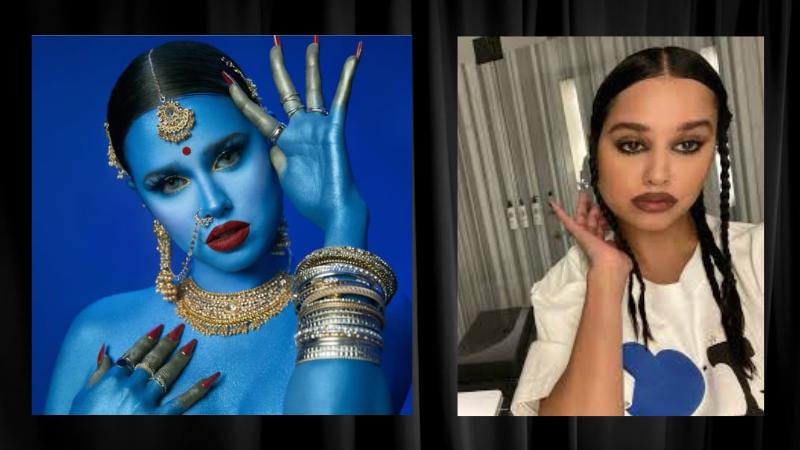
Canadian rapper and model Tommy Genesis, of Indian origin, has found herself at the center of controversy following the release of her latest music video titled True Blue. The video, which features her dressed as the Hindu goddess Kali, has sparked outrage among viewers who believe it disrespects religious sentiments and misuses sacred symbols for artistic expression. Genesis, whose full name is Genesis Yasmine Mohanraj, has connections to Malayali, Tamil, and Swedish ancestry and is known for her provocative themes often centered around sexuality and gender.
In True Blue, the artist appears wearing a gold bikini and stilettos, styled with jewelry to resemble the goddess Kali. The video also includes scenes of her licking a crucifix and performing a traditional namaste gesture. These visuals were quickly shared and circulated online, drawing criticism for mixing sexual imagery with religious iconography in a way many consider offensive. Viewers, particularly from Hindu and Catholic backgrounds, have condemned the video for its perceived insensitivity toward both faiths.
Genesis has responded to the backlash by downplaying the criticism, explaining that her work is not intended for audiences who interpret it through a religious lens. She has maintained that her artistic message is personal and open to interpretation, and that the video was created with a specific vision, regardless of differing reactions. According to her, people will either relate to it or they won’t, and that’s something she fully accepts.
Born in Vancouver, Genesis studied film and sculpture at a design university before entering the music scene in the early 2010s. She initially began recording music under the name G3NESIS and later released her first mixtape, which brought her attention in underground music circles. She continued building her career with a series of singles and collaborations, eventually earning a reputation for bold lyrics and unconventional sound. One of her most recognized tracks, 100 Bad, was released in 2018 and helped solidify her place as a distinctive voice in alternative rap.
In addition to her music career, Genesis has made a name for herself in the fashion world. She has appeared in campaigns and walked in runway shows, using both music and modeling as platforms to express her identity and challenge societal norms. Her artistic approach has often blended themes of femininity, power, and rebellion, which is reflected in her performances and visual storytelling.
However, True Blue has crossed a line for many viewers who argue that creative freedom should not come at the expense of religious reverence. The depiction of deities in ways that contrast with traditional beliefs, especially when paired with sexualized imagery, has fueled a debate about the role of responsibility in artistic expression. For those who hold these religious symbols sacred, the portrayal has been seen not as art but as a mockery.
The response from audiences in India and among the Indian diaspora has been particularly strong. Many have expressed disappointment that an artist with Indian heritage would engage in what they consider a disrespectful representation of their culture. Social media platforms have been flooded with calls for accountability, with some demanding the video be taken down or amended to remove the offensive scenes.
Genesis has previously spoken about her identity and music style, emphasizing that she often draws from her personal experiences and outlook on sexuality. She has described her work as a blend of sex, art, and introspection. In her own words, she does not aim to fit into conventional categories and prefers to express herself freely, even when that leads to controversy. She has stated that her art is not always meant to be comfortable and that she embraces the discomfort it may provoke.
Despite the growing criticism, Genesis has not issued a formal apology or retraction. Instead, she continues to promote the video, standing by her work as an expression of her unique perspective. Whether this stance will affect her long-term reputation remains to be seen, but the incident has certainly reignited discussions about cultural sensitivity, religious representation, and the boundaries of creativity.
As the debate continues, some believe the controversy could serve as a moment for reflection in the broader artistic community. The question remains whether there is a way to balance freedom of expression with a respect for cultural and religious sentiments, especially in an increasingly global and interconnected world. For Tommy Genesis, the backlash surrounding True Blue may become a defining moment in her career — one that highlights both the power and consequences of bold artistic choices.
In True Blue, the artist appears wearing a gold bikini and stilettos, styled with jewelry to resemble the goddess Kali. The video also includes scenes of her licking a crucifix and performing a traditional namaste gesture. These visuals were quickly shared and circulated online, drawing criticism for mixing sexual imagery with religious iconography in a way many consider offensive. Viewers, particularly from Hindu and Catholic backgrounds, have condemned the video for its perceived insensitivity toward both faiths.
Genesis has responded to the backlash by downplaying the criticism, explaining that her work is not intended for audiences who interpret it through a religious lens. She has maintained that her artistic message is personal and open to interpretation, and that the video was created with a specific vision, regardless of differing reactions. According to her, people will either relate to it or they won’t, and that’s something she fully accepts.
Born in Vancouver, Genesis studied film and sculpture at a design university before entering the music scene in the early 2010s. She initially began recording music under the name G3NESIS and later released her first mixtape, which brought her attention in underground music circles. She continued building her career with a series of singles and collaborations, eventually earning a reputation for bold lyrics and unconventional sound. One of her most recognized tracks, 100 Bad, was released in 2018 and helped solidify her place as a distinctive voice in alternative rap.
In addition to her music career, Genesis has made a name for herself in the fashion world. She has appeared in campaigns and walked in runway shows, using both music and modeling as platforms to express her identity and challenge societal norms. Her artistic approach has often blended themes of femininity, power, and rebellion, which is reflected in her performances and visual storytelling.
However, True Blue has crossed a line for many viewers who argue that creative freedom should not come at the expense of religious reverence. The depiction of deities in ways that contrast with traditional beliefs, especially when paired with sexualized imagery, has fueled a debate about the role of responsibility in artistic expression. For those who hold these religious symbols sacred, the portrayal has been seen not as art but as a mockery.
The response from audiences in India and among the Indian diaspora has been particularly strong. Many have expressed disappointment that an artist with Indian heritage would engage in what they consider a disrespectful representation of their culture. Social media platforms have been flooded with calls for accountability, with some demanding the video be taken down or amended to remove the offensive scenes.
Genesis has previously spoken about her identity and music style, emphasizing that she often draws from her personal experiences and outlook on sexuality. She has described her work as a blend of sex, art, and introspection. In her own words, she does not aim to fit into conventional categories and prefers to express herself freely, even when that leads to controversy. She has stated that her art is not always meant to be comfortable and that she embraces the discomfort it may provoke.
Despite the growing criticism, Genesis has not issued a formal apology or retraction. Instead, she continues to promote the video, standing by her work as an expression of her unique perspective. Whether this stance will affect her long-term reputation remains to be seen, but the incident has certainly reignited discussions about cultural sensitivity, religious representation, and the boundaries of creativity.
As the debate continues, some believe the controversy could serve as a moment for reflection in the broader artistic community. The question remains whether there is a way to balance freedom of expression with a respect for cultural and religious sentiments, especially in an increasingly global and interconnected world. For Tommy Genesis, the backlash surrounding True Blue may become a defining moment in her career — one that highlights both the power and consequences of bold artistic choices.