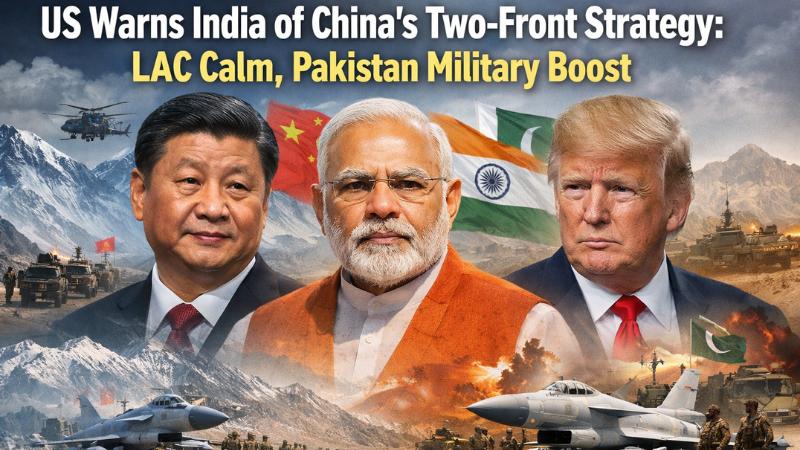
The United States has cautioned India about China’s evolving two-front strategic approach that combines diplomatic calm along the Line of Actual Control with an aggressive expansion of military support to Pakistan. The warning comes from the US Department of Defense’s 2025 Annual Report to Congress on Military and Security Developments involving the People’s Republic of China, a comprehensive assessment of Beijing’s military modernisation and regional ambitions.
The report highlights how China has simultaneously pursued disengagement talks with India while reinforcing its strategic partnership with Pakistan. According to the assessment, Beijing’s easing of tensions along the LAC should not be seen as a sign of long-term reconciliation, but rather as a tactical move aimed at stabilising relations with New Delhi and preventing deeper strategic alignment between India and Washington. This dual-track policy, the Pentagon suggests, allows China to reduce immediate border friction while sustaining pressure on India through its closest regional ally.
China’s leadership under Xi Jinping is described as prioritising strategic flexibility, balancing dialogue with coercion. The report notes that despite disengagement agreements reached in October 2024, deep mistrust continues to define India-China relations. Past border standoffs and China’s wider regional conduct have limited prospects for a genuine reset, keeping the relationship fragile and unpredictable.
The Pentagon assessment points out that Arunachal Pradesh remains a critical flashpoint, with China continuing to classify the Indian state as a core interest. By placing Arunachal Pradesh in the same non-negotiable category as Taiwan and the South China Sea, Beijing directly challenges India’s territorial sovereignty. This stance, the report notes, underscores that de-escalation at the LAC does not equate to a shift in China’s long-term territorial claims or strategic posture toward India under the leadership of Narendra Modi.
China’s military posture further reinforces these concerns. The report states that the People’s Liberation Army’s Western Theatre Command conducted extensive high-altitude, low-oxygen training exercises throughout 2024. These drills indicate sustained preparation for mountain warfare scenarios, suggesting that operational readiness against India remains a priority despite ongoing diplomatic engagement.
While maintaining tactical calm with India, China has significantly expanded its military cooperation with Pakistan, a development the Pentagon flags as a serious concern for regional security. The report confirms that China has delivered 36 J-10C fighter jets to Pakistan since 2020, enhancing the Pakistan Air Force’s frontline combat strength. In addition, China and Pakistan continue to co-produce JF-17 fighter aircraft, while Islamabad remains a major recipient of Chinese armed drones and naval platforms.
Joint military activities between China and Pakistan have also intensified. The report highlights joint counterterrorism exercises conducted in December 2024, reflecting deepening defence coordination. More significantly, the Pentagon identifies Pakistan as a potential future location for Chinese military facilities, a move that would extend the PLA’s operational reach closer to India’s borders.
Overall, the 100-page assessment concludes that China’s strategy of selective de-escalation combined with strategic pressure presents a complex challenge for India. As the United States underlines through this report, New Delhi must remain vigilant as Beijing balances calm diplomacy with long-term military and geopolitical manoeuvring, even as global dynamics involving leaders such as Donald Trump continue to influence the broader Indo-Pacific security landscape.