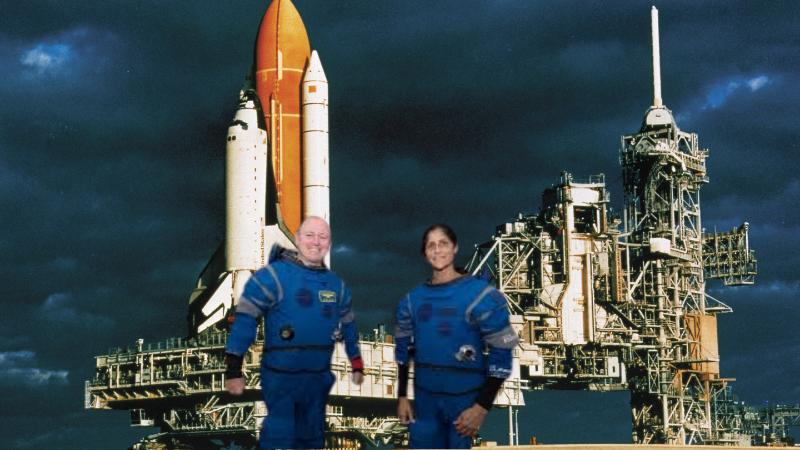
Sunita Williams and Butch Wilmore, the two American astronauts who spent an unexpected nine months aboard the International Space Station following issues with Boeing's Starliner capsule, are gradually transitioning back to life on Earth. After their return in March, the duo has been undergoing a rigorous rehabilitation phase to recover from the physical toll of extended microgravity exposure. Now, they’re emerging stronger, participating in post-mission responsibilities with both NASA and Boeing, while also sharing their perspectives on the future of the Starliner program.
Wilmore, aged 62, explained that returning to Earth's gravity brings a host of neurovestibular and muscular challenges. "Gravity stinks for a period, and that period varies for different people, but eventually you get over those neurovestibular balance type of issues," he said. Both astronauts had to adjust to Earth's gravity after months in orbit by retraining their muscles, reestablishing balance, and regaining basic motor skills. For astronauts who spend a long duration in space, NASA enforces a standard 45-day recovery regime to help their bodies re-adapt. During this time, Wilmore and Williams spent two hours daily with NASA’s astronaut strength and reconditioning experts while simultaneously taking on increasing responsibilities related to Boeing’s Starliner development and NASA research projects.
Williams, 59, described the rehabilitation process as a physically demanding journey. She experienced persistent fatigue as her muscles began reengaging after months of inactivity in zero gravity. She noted that it took weeks before her internal body clock and strength fully returned. "Then I'm up at four in the morning, and I'm like, Aha! I'm back," she remarked. Wilmore, meanwhile, shared that certain pre-flight discomforts returned almost immediately upon landing. A neck stiffness he had prior to the mission had disappeared in space but reappeared before he was even extracted from the capsule after splashdown, highlighting just how swiftly gravity reasserts itself once back on Earth.
The human body, not designed for life outside of Earth’s gravitational pull, undergoes significant changes during extended space travel. These include muscle and bone density loss, cardiovascular shifts, and other physiological adaptations. Upon return, astronauts often require intensive therapy to regain normal function. The confinement in space, limited mobility, and exposure to cosmic radiation further complicate their recovery.
Williams and Wilmore were initially set to participate in a short eight-day test mission on the Starliner. However, technical issues with the capsule's propulsion system left NASA with no choice but to bring the capsule back to Earth uncrewed, extending their stay on the ISS by several months. This unexpected delay led NASA to incorporate the duo into its regular long-term astronaut rotation schedule on the space station. Boeing has already incurred over $2 billion in charges developing Starliner, including $410 million spent on a 2022 uncrewed test following an earlier failure in 2019.
With another critical phase of Starliner testing set for the summer, the future of the spacecraft remains in question. Williams and Wilmore believe that flying the Starliner uncrewed again is the most logical and safe path forward before allowing humans onboard. "Reflying Starliner uncrewed seems like the logical thing to do," Williams said, comparing the practice to standard procedures followed by SpaceX and Russia’s space programs, which regularly perform uncrewed flights before human-crewed missions. She added, "I think that's the correct path. I'm hoping Boeing and NASA will decide on that same course of action soon."
NASA officials have also indicated that the results of this upcoming round of tests will determine if Starliner can be certified for its next human flight. The astronauts' support for an uncrewed trial reflects a shared priority on crew safety and thorough testing protocols before putting more lives at stake. As both astronauts continue to support NASA and Boeing’s ongoing space efforts, their recent experiences serve as a reminder of the risks and resilience involved in space exploration, and the continuous need for stringent testing, evaluation, and care in human spaceflight programs.