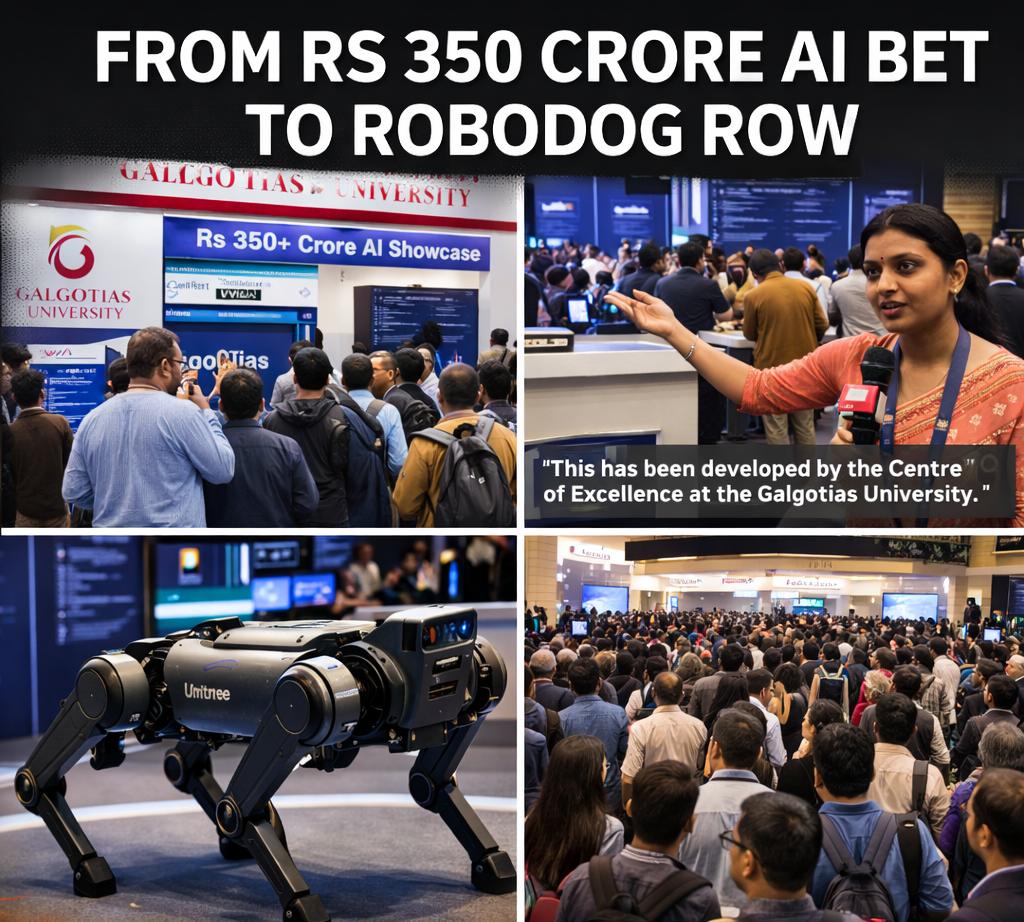
On February 6, Galgotias University made headlines with a bold announcement: it had invested more than Rs 350 crore in artificial intelligence infrastructure, calling it the largest AI investment by any private university in India. The statement positioned the institution as a future global AI powerhouse, citing partnerships, supercomputing infrastructure, and ambitions aligned with global leaders such as the United States and China. CEO Dr Dhruv Galgotia projected confidence, suggesting that such investments would make India’s AI leadership inevitable.
Just ten days later, the spotlight shifted dramatically at the AI Impact Summit 2026 held at Bharat Mandapam in New Delhi. The university’s pavilion showcased a robotic dog named Orion, presented as a campus-developed innovation under its Centre of Excellence. During a televised segment, a faculty member described the robot as developed at the university and highlighted the Rs 350 crore AI initiative. The demonstration drew attention for its interactive features, including surveillance capabilities and real-time movement.
By the second day of the summit, social media users identified Orion as the Unitree Go2, a commercially available robodog manufactured by Chinese firm Unitree Robotics. Priced at roughly Rs 2–2.5 lakh depending on configuration, the revelation triggered sharp criticism online. Viral posts questioned whether a purchased robot had been presented as a homegrown breakthrough under the banner of a Rs 350 crore AI push.
Facing backlash, the university issued a late-evening clarification stating it had not claimed to have built the robodog and that the device was acquired for academic purposes. However, earlier video clips featuring the “developed at the centre” remark continued circulating widely, intensifying the credibility crisis. In subsequent comments, faculty acknowledged that communication may not have been clear and accepted responsibility for the confusion.
Reports later surfaced suggesting the university had been asked to vacate the expo space, though officials indicated they had not received formal communication at that time. The robot was eventually removed from display. What began as a high-profile AI showcase turned into a broader debate about transparency, authenticity, and the optics of India’s AI ambitions.
The controversy unfolded against the backdrop of India’s accelerating push into artificial intelligence. With policymakers emphasizing sovereign AI models and domestic innovation, public claims tied to large financial investments carry heightened scrutiny. The episode has also reignited discussions about how institutions communicate technological achievements and whether marketing narratives can blur the line between acquisition and innovation.
In less than two weeks, the narrative moved from ambitious AI expansion and supercomputing platforms to a reputational challenge centered around a single robot. The larger question now extends beyond one device: how institutions balance ambition with accountability in a rapidly evolving AI ecosystem. In an era where digital claims are instantly archived and amplified, credibility has become as critical as capital investment.