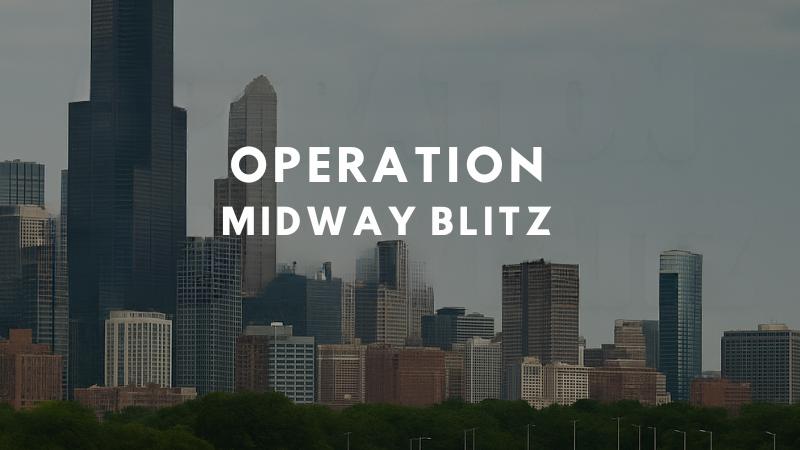
The Department of Homeland Security has announced a new initiative called Operation Midway Blitz, aimed at stepping up immigration enforcement in the Chicago area with a specific focus on individuals it described as criminal illegal aliens. The announcement came only days after reports indicated that several federal agencies were preparing to surge manpower into the city. The operation was highlighted in a DHS social media post that cited the tragic case of Katie Abraham, a 20-year-old woman from Glenview who, along with a friend, was killed in Urbana, Illinois earlier this year in a crash involving a suspected drunk driver who authorities believe was in the country illegally. A Guatemalan national was later arrested and charged in connection with the crash.
The DHS post offered no details about the precise timing of the operation or the neighborhoods that may be targeted. What drew immediate attention, however, was former President Donald Trump’s online post over the weekend that used a parody meme based on the film Apocalypse Now to underscore his message. The meme, shared on his personal platform, showed Trump against the Chicago skyline with helicopters, smoke, and flames, accompanied by the caption: “I love the smell of deportations in the morning... Chicago about to find out why it’s called the Department of WAR.” His words quickly stirred strong reactions across the political spectrum.
When pressed about the post and the operation, Trump rejected the suggestion that the government was declaring war on the city. “We’re not going to war,” he said Sunday. “We’re going to clean up our cities. We’re going to clean them up so they don’t kill five people every weekend. That’s not war. That’s common sense.” Still, the scale and tone of the federal presence in Chicago have raised alarms among local leaders. Immigration and Customs Enforcement began conducting visible operations across the city Monday, and images surfaced of arrests including one man from Mexico wanted for aggravated sexual assault of a child.
The growing tension prompted a sharp response from Illinois Senator Dick Durbin, who criticized the president’s approach. He argued that labeling enforcement in such militaristic terms amounted to a dangerous precedent. “The president of the USA essentially declared war on an American city, one I love and am honored to represent,” Durbin said. “This is no joke. It is an unprecedented threat against the American people.”
Trump’s immigration adviser Tom Homan, who has been acting as the administration’s border czar, defended the operation and stated that ICE does not engage in targeting people based on race. Chicago’s Mayor Brandon Johnson also weighed in, pointing out that the city has recently recorded record-low homicide numbers, marking the safest summer since the 1960s. “We are making progress,” he said, though not all local officials agreed. Alderman Anthony Napolitano from the 41st Ward took a different view, saying, “Our city needs as much help as we can possibly get.”
Governor J.B. Pritzker added his voice to the criticism, noting that the state had received no communication from the White House about the operation. He accused the administration of using fear tactics instead of working with local leaders. “Once again, this isn’t about fighting crime. That requires support and coordination — yet we’ve experienced nothing like that over the past several weeks,” Pritzker said. “Instead of taking steps to work with us on public safety, the Trump administration is focused on scaring Illinoisians.” Trump responded Monday by saying that working with leaders like Pritzker and Johnson was pointless, describing it as like “talking to a wall” and suggesting their opposition stemmed from political ideology rather than reason.
The logistics of Operation Midway Blitz are being coordinated from Naval Station Great Lakes in suburban North Chicago, where about 300 agents are expected to be based. According to Durbin, the base will be used to provide office space, parking, and storage for non-lethal ammunition through October 5. Importantly, service members will not be directly involved in the enforcement actions.
Adding to the administration’s momentum, the Supreme Court on Monday issued a ruling that loosened restrictions on ICE operations in Los Angeles, giving the administration a significant legal victory and potentially setting a broader precedent for immigration enforcement nationwide. The decision adds weight to the already controversial Chicago operation, signaling that enforcement efforts could continue to expand under legal backing.
As Operation Midway Blitz unfolds, Chicago finds itself once again at the center of a national debate on immigration, crime, and federal power. While supporters argue the measures are necessary to protect public safety and uphold the law, critics see it as a politically motivated show of force that risks undermining trust between communities and law enforcement. With tensions running high and both sides entrenched, the coming weeks will determine whether the operation fulfills its stated goals or deepens the divisions that already define the immigration debate in America.