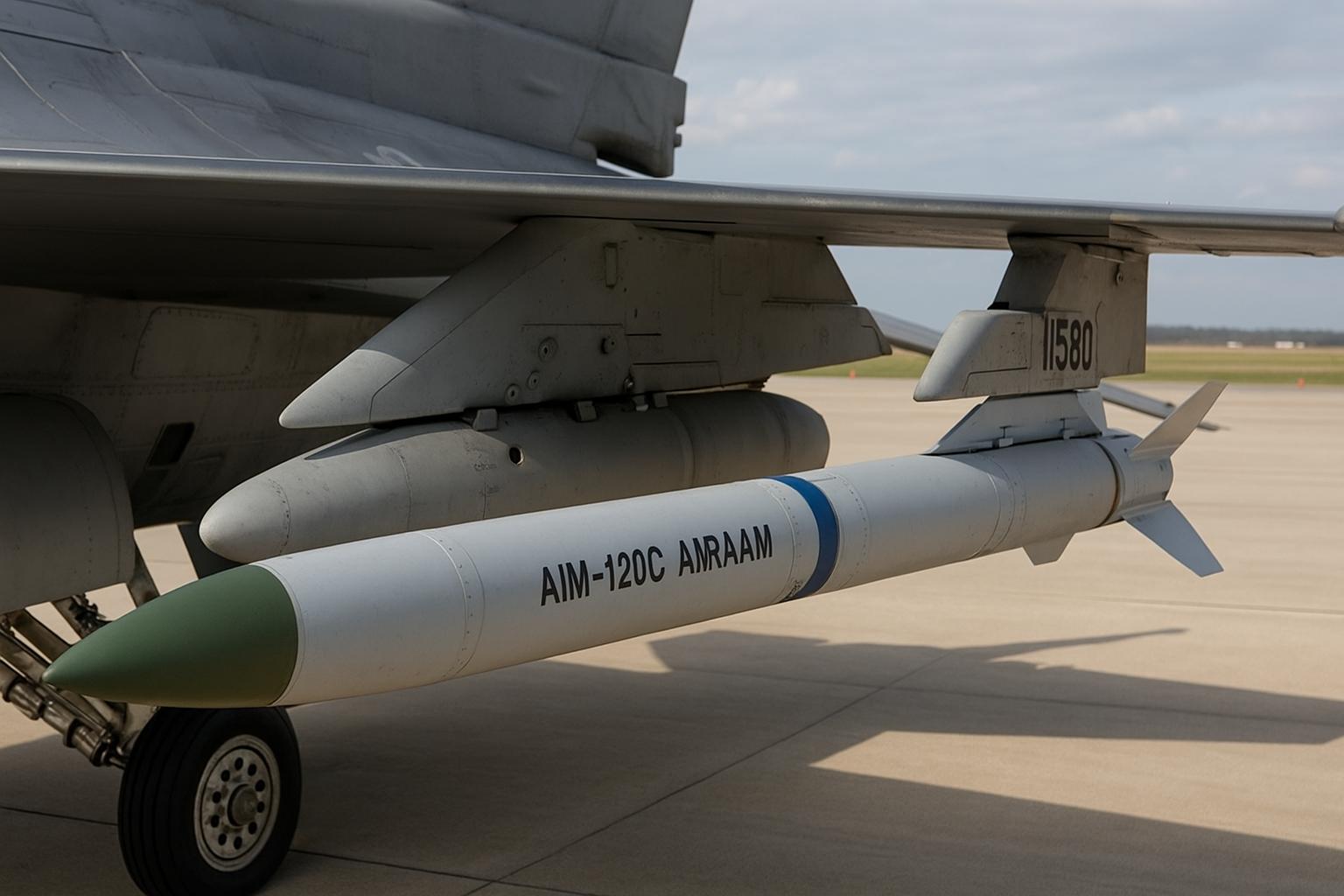
The United States has approved the supply of AIM-120 Advanced Medium-Range Air-to-Air Missiles (AMRAAM) to Pakistan, marking a new phase in defence cooperation between the two countries. The US Department of War announced the inclusion of Pakistan as one of several international buyers under a recently modified arms contract with Raytheon, the American defence manufacturer responsible for producing the missile systems.
According to the department’s notification, Raytheon received an additional USD 41.6 million under its existing contract (FA8675-23-C-0037) for the continued production of the AMRAAM C8 and D3 variants. This brings the total value of the contract to more than USD 2.51 billion. The work is expected to be completed by May 2030. However, the statement did not disclose the exact number of missiles Pakistan will receive as part of the deal.
The updated contract also covers deliveries to several allied countries, including the United Kingdom, Germany, Australia, Japan, and Saudi Arabia. For Pakistan, this inclusion is viewed as a significant signal of warming relations between Islamabad and Washington after years of fluctuating defence cooperation. The AMRAAM missile system is compatible only with the F-16 fighter jets operated by the Pakistan Air Force (PAF), raising speculation that the move is tied to ongoing upgrades to the country’s F-16 fleet.
The AIM-120 AMRAAM is a radar-guided air-to-air missile designed for beyond-visual-range combat and has been a cornerstone of modern air defence systems. It is used by multiple NATO members and allied nations. Pakistan previously operated the older AIM-120C5 variant, around 500 of which were acquired along with its F-16 Block 52 aircraft in 2010. Defence analysts believe the addition of the newer C8 and D3 variants will enhance the PAF’s interception and engagement capabilities significantly.
The latest development comes amid renewed diplomatic engagement between Pakistan and the United States. In recent months, bilateral relations have improved following a series of high-level meetings. Pakistani Prime Minister Shehbaz Sharif and Army Chief Field Marshal Asim Munir met former US President Donald Trump in Washington, followed by a separate meeting between the military chief and the US President at the White House. Pakistan’s Air Chief Marshal Zaheer Ahmed Babar also visited the US State Department in July, underscoring the growing defence dialogue between the two countries.
The AMRAAM deal is being interpreted by analysts as part of Washington’s strategic effort to re-engage with Pakistan in defence cooperation. The country has historically been a key partner in regional security, though relations have fluctuated depending on political and military dynamics in South Asia. Pakistan’s inclusion in this major contract signals a recalibration in US policy, balancing its defence partnerships in the region.
The sale also reignites discussion of the 2019 incident when Pakistan reportedly used an AMRAAM missile to down an Indian Air Force MiG-21 during an aerial skirmish. At the time, India had criticized the use of US-origin weapons, arguing it violated export agreements. Washington later confirmed that Pakistan’s use of the missile was within operational limits, though the episode added strain to Indo-US defence dialogue.
According to defence analysts, Pakistan’s induction of the C8 variant — the export version of the AIM-120D — will bring its air-to-air capabilities closer to those of advanced Western air forces. The AIM-120D remains one of the most sophisticated missile systems in active US service, with improved range, guidance, and resistance to countermeasures.
The timing of the deal coincides with shifting geopolitical currents in South Asia. Pakistan’s recent outreach to the United States follows its efforts to diversify defence partnerships beyond China. The US, meanwhile, has shown interest in re-establishing ties with Islamabad as part of broader regional stability initiatives.
While the inclusion of Pakistan in this arms programme may raise questions in neighbouring India, Washington’s decision appears to reflect a pragmatic approach to defence diplomacy. Both the US and Pakistan have reiterated their commitment to counter-terrorism cooperation, military modernization, and regional stability.
The AMRAAM contract, expected to run through 2030, represents not only a commercial transaction but also a symbolic revival of trust between the two long-standing defence partners. For Pakistan, the acquisition of modern AMRAAM variants will significantly boost its air defence capability, while for the United States, it reaffirms its role as a key player in maintaining balance and security in South Asia.