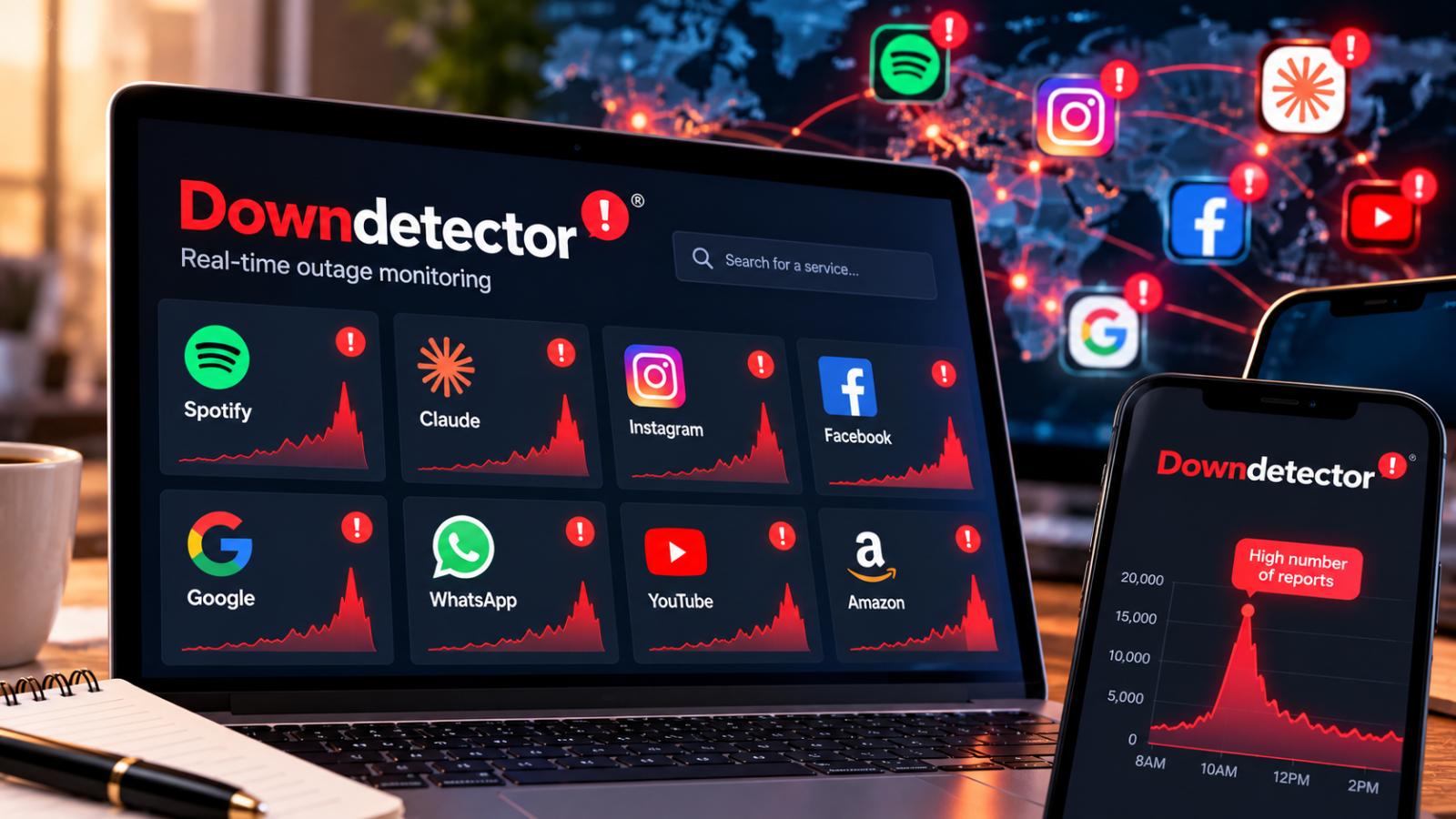
Downdetector is a real-time outage monitoring service that tracks user reports and other signals for websites, apps and online services. Its charts can reveal unusual disruption patterns, but the totals should not be treated as confirmed counts of affected customers.
When a major app, website or online service stops working, Downdetector is often one of the first places users check.
The platform monitors reports of service problems across internet providers, social networks, streaming platforms, banks, gaming services and other digital products. A sudden rise in reports can indicate that a broader outage may be developing.
What is Downdetector?
Downdetector is an outage-monitoring service that tracks reports from users who say they are experiencing problems with a website, app or online service.
Its service pages typically show whether reports are at normal levels or have increased beyond the usual baseline. This can help users determine whether a problem may be affecting many people rather than only their own device or connection.
Downdetector is operated by Ookla, the company also known for Speedtest.
How Downdetector detects an outage
Downdetector looks for unusual increases in problem reports compared with the normal level expected for a particular service.
When reports rise significantly above that baseline, the platform may show a visible outage spike.
Users can also indicate the type of problem they are experiencing, such as login failures, server connection issues, app problems or website access failures.
This makes Downdetector useful for identifying broad patterns while an incident is still unfolding.
Downdetector numbers are not exact user counts
One of the most important points is that a Downdetector total does not equal the exact number of customers affected.
The figures are based primarily on reports submitted by users, together with other monitoring signals. Not every person experiencing a problem will file a report, while some users may submit reports for issues that are local to their own device, network or account.
For that reason, Downdetector totals are best understood as indicators of disruption rather than confirmed impact figures.
Why outage reports can change quickly
Report totals can rise or fall sharply during a major service disruption.
A popular platform with millions of users may accumulate thousands of reports within minutes if a problem affects login, streaming, messaging or another core function.
Once the service begins recovering, new reports usually decline, causing the outage chart to move back toward its normal baseline.
This is why report totals quoted in news coverage often differ depending on the exact time they were recorded.
Downdetector vs. official status pages
Downdetector can reveal that users are experiencing problems before a company posts a formal update.
However, official status pages remain important because they can confirm which systems are affected, whether engineers are investigating, and when service has been restored.
For the most accurate picture, users should compare Downdetector data with the affected company’s official status page or support account.
Downdetector is most useful as an early-warning and monitoring tool, while official company updates provide the strongest confirmation of a service incident.