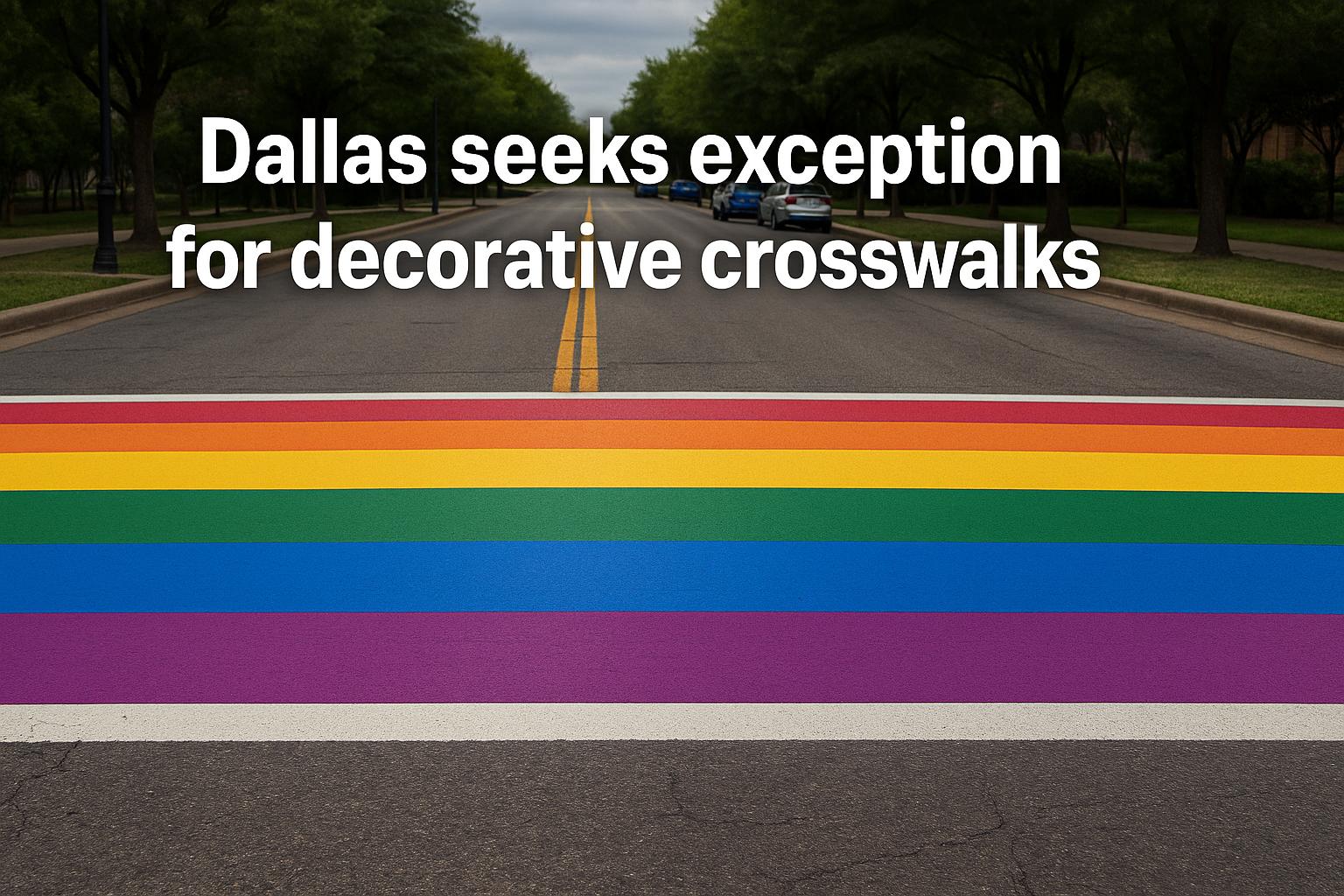
Nearly a month after Texas Governor Greg Abbott ordered cities to remove rainbow crosswalks and other “non-standard” symbols from public roads, the City of Dallas is formally pushing back. City officials have submitted a request for an exemption to the Texas Department of Transportation (TxDOT), arguing that the crosswalks not only meet safety standards but also represent inclusion, free expression, and community identity.
Abbott issued the directive on October 8, asserting that decorative or multicolored crosswalks violate state road safety regulations and misuse taxpayer funds. The governor’s office warned that municipalities refusing to comply within 30 days could face the withholding of state or federal transportation funding and suspension of agreements with TxDOT. The order immediately drew criticism from advocates and local leaders, particularly in cities known for vibrant neighborhood murals and pride installations.
In its response, the City of Dallas stated that it fully adheres to state safety standards, maintaining standard crosswalks as defined by the Texas Manual on Uniform Traffic Control Devices (TMUTCD). However, city officials clarified that decorative pavement markings are funded privately, not through public tax dollars. “There is no evidence these decorative crosswalks are any less safe than standard crosswalks, and some national research has shown these crosswalks are in fact safer,” the city said in an official statement.
City Manager Kimberly Bizor Tolbert submitted the exemption request, which identifies 12 intersections across Dallas. These include five multicolored crosswalks along Cedar Springs Road, a known hub for LGBTQ+ culture; three individualized designs in Uptown; and four message-based crosswalks in Oak Cliff. Among them, one at the intersection of Martin Luther King Jr. and Malcolm X Boulevards displays the phrase “Black Lives Matter.”
Tolbert emphasized that these installations go beyond aesthetics, serving as cultural and economic assets. “The city is also exploring options, including other opportunities for neighborhood identity and beautification efforts,” she said, underscoring that Dallas views such projects as community-driven expressions rather than political statements.
Local business owners and residents have voiced strong opposition to the potential removal of the crosswalks. Dorothy Jones, who owns Blackjack Pizza on MLK Jr. Boulevard, said the Black Lives Matter crosswalk represents both history and pride for the neighborhood. “If you take it away, that’s destroying it—and that’s our history,” she said.
Council member Paul Ridley, who chairs the city’s transportation committee, has been a vocal supporter of keeping the crosswalks. Representing District 14, Ridley described the installations as symbols of inclusivity and civic pride. “I fully support the City of Dallas in seeking an exception to the Governor’s directive regarding decorative and ‘ideological’ crosswalks,” he said. “In Oak Lawn specifically, our rainbow crosswalks are a symbol of pride and inclusion, not politics.”
TxDOT has indicated that exceptions may be considered if cities can demonstrate a “public safety benefit or compelling justification.” Dallas officials argue that the decorative crosswalks meet both standards, citing studies suggesting that brightly colored designs improve pedestrian visibility and reduce vehicle speeds in high-traffic areas.
If TxDOT denies the request, Tolbert’s letter includes a backup plan: a request for a 90-day extension to develop and implement an action plan for any required removals. For now, the city is awaiting a formal response and timeline for a decision.
The issue has become a flashpoint in Texas’ broader cultural and political debate over public expression and government control of civic spaces. Supporters of the governor’s directive argue that road markings should remain uniform for safety and compliance reasons. Opponents contend that crosswalks celebrating diversity and inclusion pose no measurable risk and instead reflect the values of the communities they serve.
As the standoff continues, the outcome of Dallas’ exemption request could set a precedent for other Texas cities grappling with the same directive. For now, the city’s rainbow stripes and message-painted intersections remain intact—serving as both a symbol of community identity and a test of local authority in the face of statewide policy.