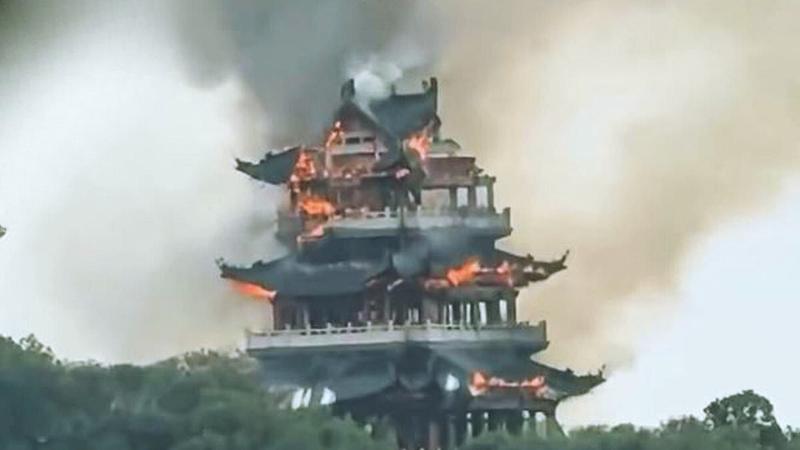
A routine trip to a scenic mountain destination in China turned into a widely discussed incident after a fire, reportedly caused by a tourist mishandling ceremonial candles and incense, engulfed the Wenchang Pavilion in Jiangsu Province. The fire broke out on November 12 and quickly spread through the three-storey structure, with videos online showing towering flames and dense black smoke rising above Fenghuang Mountain. The dramatic visuals sparked public concern and renewed debate about tourist behaviour at culturally significant locations, even when the structures are not ancient relics. The pavilion, although built in 2009, remained a popular destination for travellers exploring the mountain and surrounding temple complex.
Residents, travellers and online users shared shock as images of the roof collapsing and the wooden sections burning circulated across social platforms. Although the pavilion was a modern reconstruction, its traditional Chinese architectural design made it visually iconic in the region. Officials from the neighbouring Yongqing Temple, which manages the site and has centuries-old origins, expressed regret over the structural loss but confirmed that no injuries were reported. The fire was contained before spreading to the surrounding forested area, preventing what could have been a larger disaster.
Early investigation reports point to improper use of candles and incense by a visiting tourist, which authorities labelled as irresponsible behaviour that endangered both the heritage location and the natural environment. Local officials have emphasized the need for stricter monitoring of tourist activities, particularly in religious and cultural spaces where fire hazards are common. The incident has revived discussions that began after previous temple fires in China, including the notable 2023 blaze at the Shandan Great Buddha Temple in Gansu, where much of the complex was destroyed.
Authorities have announced that enhanced safety measures will be introduced soon, including supervised incense areas, restricted use of open flames, and improved fire detection systems. Once the investigation is completed, restoration efforts will begin to rebuild the pavilion using traditional architectural techniques that match its original design. Updates on the reconstruction timeline are expected in the coming weeks, as cultural preservation teams assess the full extent of the damage and plan for the rebuilding work.